A unique mystique . . .

4802076860_ce7d2a1221_bLegionnaires of the 3rd Foreign Infantry Regiment based in French Guiana were transported on September 11 to the Caribbean island of Saint Martin to help with rescue and clean up operations following Hurricane Irma. I would bet that others were on high alert as Maria turned toward Guadeloupe and Martinique just days ago.

I heard the news reports of France’s quick response, and I was once again entranced with thoughts of this band of men with a long history, a somewhat dubious reputation and a unique mystique.

Somehow, the desert and the sea always figured in my childhood dreams, along with a thirst for adventure, the appeal of colorful uniforms, and the sound of military marches.

The French Foreign Legion

This elite fighting force has always held inexplicable fascination. I once had a romantic notion that I could run away to North Africa and be a Legionnaire. 4566626508_a28b277564_bI pored over pictures of the bearded Sappers with their white kepis and leather aprons, and I listened endlessly to traditional marches, and to Edith Piaf singing “Mon Legionnaire” and “La Marseillaise.”

Strange, I know. But, truth be told, the same things thrill me today,

I wanted to know someone who joined up. I fancied myself fitting in to the hard life, seeing the world, and participating in endless adventure.

There is at least one major problem, however. First and most important, it seems, is that I was born female and, to this day, the Foreign Legion is a men’s club. Only a men’s club!

Actually, one British woman joined during World War II and served with distinction in North Africa. There have been no others.

And, yes, as outdated as it may seem, The French Foreign Legion still exists.

In fact, it thrives. The Legion has changed, but it is still an elite force. Only about 1000 men are admitted to the ranks each year.

Here’s how it works:

First, if you are male, between the ages of 17 1/2 and 39 1/2, you must get yourself to the door of a Foreign Legion facility within France. Literally, you must knock on the door of the Centre de Preselection in Paris or at the gate of Legion Headquarters in the hills above Marseilles; or at one of nine “recruiting offices” scattered in cities throughout the country. They are officially open 24 hours a day, 365 days a year. 6550986765_d4ae3024d0_b In truth, however, showing up during normal daytime business hours would be wise.
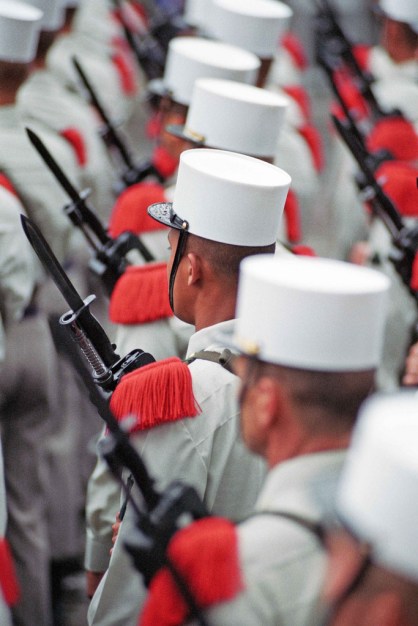
Potential recruits must have valid documentation from their country of origin, either a passport or government-issued ID, and a verified copy of their birth certificate obtained within the last six months. Aliases and anonymity are no longer an option.

And they must not be on Interpol’s wanted list!

Although it is expected that recruits will arrive with three sets of underwear and socks, sneakers, personal toiletries, and between 10-50 Euros, those who make it in the door are immediately provided food, lodging and uniforms.

That’s it; nothing else matters

Well, almost nothing else: Language doesn’t matter; there is no requirement to speak French. Marital status is unimportant: All recruits are treated as single men. There is no discrimination on the basis of citizenship, background, race, religion, education, training, previous military service, profession or expertise.

There are some “must nots” and some “should nots.” Among prohibited items are knives, weapons of any kind, and keys — no vehicle or personal house keys are allowed! Large amounts of cash, credit cards, jewelry and other valuables are highly discouraged. Cameras, personal computers and electronic devices must be left at home or abandoned.

Recruits must take IQ and personality tests, must pass sports and fitness tests, and must meet specific medical and physical standards. Only about one in eight candidates is accepted.4566623898_3897607b2f_b

Within a few days, those who “survive” an initial interview at a satellite center will be enlisted and transferred to one of the Legion’s two pre-selection centers, either in Paris or in the south of France. Finally, those who make it through the three to 14-day pre-selection testing are transferred to Legion Headquarters in Aubagne to complete the rigorous training process. And it is rigorous.

The initial commitment is for a five-year enlistment, and the entire pre-selection and selection process spans up to five weeks. After that there is training, and more training, then perhaps specialized training. And then duty assignments; often within France today,  sometimes in French territories, but truly all over the globe. The Legion has fought not only in French wars and in two World Wars, but in most of the world’s hot spots, including Vietnam, Cambodia, Bosnia, Kuwait, Iraq, Somalia and Afghanistan.

This year, on July 14, I watched with fascination as the new French president and the new American president beamed with pride as the Bastille Day parade along the Champs Elysees in Paris reached its conclusion.  As always, a detachment of Legionnaires participated and, as always, this unique fighting force constituted the final unit in the parade. The marching cadence of the Foreign Legion is measured and impressive (88 steps per minute rather than the normal 120) and a fitting finale to a day full of military pomp and tradition. 7467186668_61d2457d6b_z

The mystery and the magic of this special force still exist. The Pioneers with their leather aprons and axes seem throwbacks to another era as they march with pride and precision; and the band sounds the familiar somber beat.

But, across the globe, other Legionnaires stand ready, as necessary, to don their fatigues and get to work to put a devastated island nation back together. Or to fight, if called. It’s good to know they still exist.

If you’re interested in learning more about the French Foreign Legion, visit Uniforms, History, or 2016 News.

All Photos via Flickr (1) Brian Farrell, 2010; (2 & 4) Marcovdz, 2010; (3) Maglegion, 1993; (5) Archangel 12, 2012

 

9-11-2001: Years removed in time, but etched indelibly into our psyche . . .

Fifteen years: It’s the span from birth to teenager; young adult to middle age; active working adult to “old.”

It’s difficult to look 15 years into the future with any degree of accuracy, but looking back takes little effort. And, in some cases, 15 years — or 50, or only two  — disappear in an instant and we, in our minds, are returned to a time so hard to comprehend, so impossible to understand, so devastatingly brutal in memory that it brings us up short. The best we can do is retreat into our own silence, finding what solace exists with the passage of time.

Today is one of those days.

Fifteen years ago on a clear morning full of promise, the world was forever changed. For those of us old enough at the time to be aware of what happened in our world, it is a moment, a day, an era still frozen in time. There are other such days for many of us; actually, there are too many of those moments for some of us.

On days like this one, at a specific hour, whether the flag is lowered to half staff or we observe a moment of silence, whether there is a public ceremony or not, we cannot help but take a deep breath, suffer feelings of deep regret, and remember. Sadly, the list of those remembrances grows longer.

It is said that adversity make us strong. I wonder.

It is said that we must learn from the past. I am not certain we ever do.

It is said that we must not allow such things to happen again. Is that possible?

9-11-2001

Fifteen years ago.

Yes. I remember.

But I also remember other things about that day.

I recall standing silently with a group of coworkers, tears streaming down our cheeks, eyes trained on the television. I remember the need to talk with distant family members, to hear the voices of loved ones even though there were no words to soften the blow of that day. I remember the anguished — and accented — question of a recent immigrant: “How could they do this to our country?”

I have to think that Americans were one on that day, united in shock, and determined to face an uncertain future together.

Today, 15 years later, that oneness is no longer evident.

I wonder why we as a people are always at our best in crisis?

Actually, maybe that is the hope we should cling to.

No matter what our differences, no matter how much we disagree on most days — in thought and action and the ongoing exercise of our freedoms — maybe we can once again stand together when the next crisis occurs.

Not that I look forward to that day.

Also read my thoughts about a chance encounter on 9-11-2014.


The dream dies hard, but the memories live on

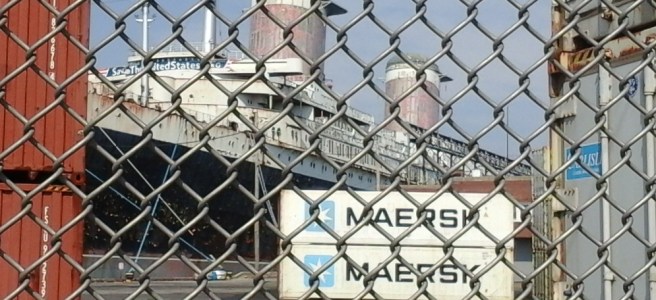
It looms large on the horizon, the hulk of the S.S. United States, as she lies in port in Philadelphia. Her stacks rise above the neighboring dock buildings, and it’s possible to use them as landmarks rather than following GPS directions as you chart a course to see the once grand ship in her current forlorn and decrepit state.

This ship — and the search for a traditional Philly cheesesteak — took us to the city of brotherly love this summer.

We found our ship with ease, and we lingered there. Remembering our first encounter with this vessel, my husband and I didn’t speak. We just gazed through the chain links at this once gleaming passenger liner with a history that is irrevocably intertwined with ours.

We met the S.S. United States, and one another, on the same day in August 50 years ago at the port in Le Havre, France. The ship was just a teenager at the time. We were young as  well, and impressionable.

She was a looker, massive and shiny and silent, but aswarm with crew going about their duties. We were impressed by her presence and by her glamor; she took our breath away. We had some other experiences with her, but her days at sea came to an end barely three years later.

Our story continues.

This summer, as we mapped our road trip north, it became a priority for us to see the grand old ship. Philadelphia was miles out of the way, but we took the detour. Our hearts were in our throats as we first spied those distinctive smokestacks. We were buoyed by the hope that this old lady might actually sail the seas once again.

Unfortunately, early this month, we learned that the plan to refurbish her as a cruise ship is not feasible. The S.S. United States has been out of service for 47 years; she has languished at the dock in Philadelphia for more than 20 years now, longer than she sailed! And, though she is deemed still structurally sound, the dream that she might again carry passengers has died.

There is still some hope that the S.S. United States will be saved from the scrap heap and turned into a floating “history book.” She is, after all, an engineering marvel; this last American flagship set a world speed record on her maiden voyage. It has never been broken. Is it so hard to believe that others could be inspired by looking up at her towering stacks, standing at her railing, or exploring her labyrinthian interior? Not for us.

The experience certainly stayed with me and my husband throughout our years!

As we again gazed at her with awe, she sat behind locked gates, no longer shiny and glamorous, but impressive nonetheless!

We left the docks finally, and found a Philly cheesesteak at a tiny Tony Luke’s on Oregon Ave., almost in the shadow of Interstate 95 South. There were only seven or eight tables inside, but the line snaked through the building and extended into the parking lot beyond. It took some time to reach the order window, but not long at all for our traditional beef and melted cheese sandwiches to be ready. Miraculously, there were two seats at a table. The wait was worth it; Philadelphia’s signature food treat was the second delight of the day!

We had come to Philly for the memories. And we left well satisfied.

It was an epic road trip and coming home is hard . . .

I am home now — after nearly two months away and never a dull moment. The summer included a path through 22 states and two Canadian provinces, a total of 4,780 highway miles, and almost six weeks in the historic small town of Wiscasset, Maine.

While in Maine, we explored new territory, basked in the sun, breathed the salt air, ate seafood and fresh corn as much as possible, and enjoyed every minute of the time we spent there. It was with regret that we packed up the car when it came time to leave. But the road trip was adventure of a different kind!

Although I’ve been home now for two weeks, I find myself still smiling about the trip just completed and considering the ones yet to come. Several are currently in the planning stages of my mind, waiting to emerge as full-fledged itineraries with dates and reservations.

Is it good to be home? Yes, it’s good to be home. I think so. But, it’s good to be gone. If I stutter and stammer a bit when asked if I’m happy to be home, it’s because the fun of being “on the road,” seeing new sights, eating new foods and meeting new people never seems to grow old. Some would term that a personality disorder.

Coming home seems like an ending somehow; and I haven’t yet gotten used to endings. New beginnings: Yes, those are what I thrive on. Readjusting to the routine of normal life — that’s a chore! But then, I can’t seem to define normal.

While watching the 2016 Summer Olympics in Rio, I find myself daydreaming about South America and fantasizing about what I hope will be an upcoming trip.

South America is on the horizon. But it will have to wait until after the Panama Canal, already scheduled for fall. And then, maybe,  a winter trip to Florida along with a jaunt to to Cuba? Or, as an alternate, perhaps a quick cruise along the Pacific Coast, or a few days in Cabo. Maybe the urge to travel is, after all, an obsession. It’s only a shame that I don’t have unlimited funds to fuel my desire to see the world.

Don’t be fooled into thinking that the world is shrinking. It is still as large as the mind can imagine. And so many destinations await.

So, my fascination with gauchos and Cape Horn, the southern fjords and Chilean wine (enjoyed at a Chilean vineyard, of course), the rainforest and the Amazon, the icebergs and the Andes, penguins and llamas — has only been heightened as I watch the world’s athletes compete in the games and celebrate their victories!

I guess I’ll have to get serious about getting back to work after the closing ceremony.

Note: Look for additional posts about this summer’s epic journey in coming weeks.

Bucket lists and traveling plans

Do you have a bucket list?

I have to confess that, until now, I never did. But I have been making one of late.

I have also been thinking about the next trip. A lot. And part of the thinking involves talking to friends and family about sharing it, a sort of old-friends-and-distant-relatives-reunion that would have our gang of crones and curmudgeons laughing it up and proving to younger people how the old folks can still “party on.”

The idea has been brewing for a while now. I’ve been poring over itineraries, and researching cruise lines, thinking about possible dates and ports, and wondering whether a summer or winter getaway would be better for most of the people I could hope to have join us.

And then it dawned on me. It’s not necessarily a one-time opportunity.

So, in case you’re wondering exactly where this is leading —

For me,  it’s leading to the Panama Canal — a journey from the Atlantic to the Pacific. I hope that a core group of compatible travelers joins in. It takes more time and energy than I seem to have to add “trip organizer” to my resume at this point, but I have put out the word.

The Map on the Wall

There was a time, several decades ago, when a group of young friends thought it fun to throw a dart at a wall map, and take off for a long weekend of sightseeing. Our group tasted several European capitals in that manner, motored through beautiful countryside along back roads, spent as little as possible because we had little, and savored every minute of every experience.

Later my husband and I traveled with other couples and other groups, on planned vacations, for spur-of-the-moment getaways, and sometimes just because we had free time and the urge to be gone.

I recently looked at another wall map and realized that, even though I have visited a fair number of cities, states and countries during my time on the home planet, there are still a huge number of places to explore.

Travel has become more complicated and much more expensive. As the world shrinks, its differences become less obvious — or more exaggerated, depending on your point of view. Personal devices allow popular music and movies to be delivered anywhere at any time, and travelers do not find it necessary to interact with one another or with strangers.

It’s a shame. So, I’m embarking on a modern crusade of sorts.

I don’t remember a time when I wasn’t eager to go somewhere new, taste new foods, meet new people and view life from a different perspective. Time, responsibility, finances and “respectability” may have gotten in the way along the way. I think it’s now time to rectify all that. The Panama Canal trip is not the result of throwing a dart and finding a way to get there.

It is more of a response to a fascination with the still-unfolding history of the canal. I’m really looking forward to seeing it with my own eyes. I’m sure I’ll be writing more about “the big ditch.”

But I’m not giving up dart-throwing either.

Flickr photos of Panama Canal by LyunGateley (2004) and Meghan Jones (2010 – evening shot) 

Let’s all remember our veterans

Poppy by Jenny Downing via Flickr

Today we are a long way in both space and time from the beaches at Normandy, the air fields of England and the islands of the Pacific, from the Gallipolli Campaign and the battlefields of Verdun, and from Gettysburg and Appomattox. We are also, too often, emotionally distant from the world’s current hot spots.

We have come a long way from those “great wars” that so gripped the spirit and the determination of a people. In the intervening century and a half, Americans have become war-weary, uncertain about the “just” causes we embark upon, and tired of it all. Today, fewer than one half of one percent (that’s 0.4%) of the population get up in the morning to dress in a uniform of the armed services. We still have troops around the world, however, and some of them are still dying for their country.

Veterans Day is November 11 and, because it falls on a Wednesday this year, I can’t help but wonder how many Americans will even think of its significance, or consider the millions of veterans who have served in our nation’s military services. At 11 a.m. on the 11th day of the 11th month, how many of us will stop what we are doing to give a moment’s thought or a silent prayer for those who serve in the military. It’s not a long weekend, after all, not really a holiday, and it’s easy to forget. But those who daily don a uniform, whether they serve at home or in a war zone, cannot forget.

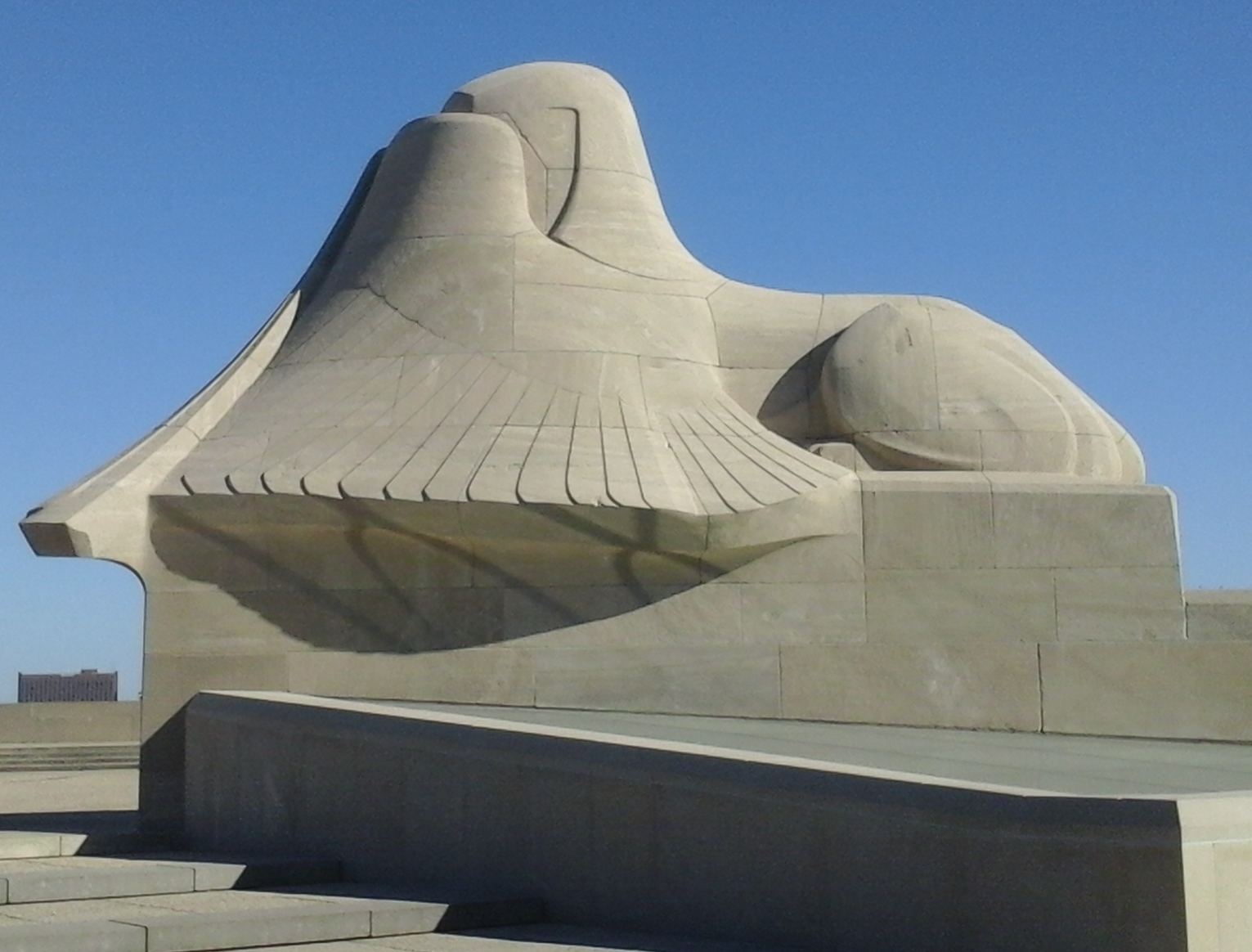
At the World War I Memorial in Kansas City, an Assyrian Sphinx shields its eyes from the war horrors.
At the World War I Memorial in Kansas City, an Assyrian Sphinx shields its eyes from the horrors of war.

The date and time commemorate the World War I armistice that was signed in a rail car in the forest of Compiegne, east of Paris, at 5 a.m. on a cold morning in 1918. It became effective six hours later — at 11 a.m. local time — and was for a period of 30 days, subsequently renewed many times. It represented a “ragged” peace, made even more so because the final peace treaty was not actually negotiated and agreed upon by all parties to the Great War until June of the following year.

The day was originally known as Armistice Day, and it is celebrated in France and other European nations as well as in Canada and the United Kingdom, where it is also known as Remembrance Day or Poppy Day.

The world was ready for peace. Unfortunately, the peace that seemed so hard won did not last all that long. And there have been, since then, far too few moments of worldwide peace. Perhaps all the more reason to remember those who serve daily in our armed services.

Veterans Day Flag Ceremony - Photo by Loren Javler via Flickr
Veterans Day Flag Ceremony – Photo (2009) by Loren Javler via Flickr

Veterans Day is more than a day to honor the dead — that occurs, in somber tribute, on Memorial Day in the spring. Veterans Day is, rather, the time to think of those who wear the uniform in both peace and war, those currently alive and those who served in the past. Because it falls just after election day, it is a good time to talk to children about the duties and responsibilities of citizenship, and to speak about patriotism and pride.

If you live in a city or town that has any sort of military museum, monument or memorial, November is a good month to visit, to think about the rights and privileges we all enjoy due to the continuing service of our service men and women. It gives us all a chance to think about history, and to forge the future that will become our legacy.