Pleasures and Pitfalls of Olive Oil

Recently, at a local farmers market, I stopped at an olive oil display and was transported – in memory – to my first encounter with the mystique of locally-produced olive oils. I learned that today, in Texas, there is not a “lone olive ranch” in the Lone Star state, but several. It seems this state is better suited for black oil than olive oil, but with time, luck and persistence, some olive ranchers are making a go of it. Texas A&M explains that climate is a limiting factor.

The oil pressed from trees has a long, rich history, and was commonly known as the “gift of the gods” by ancient civilizations. There is a bit of doubt about which gods first introduced olive oil to humans, and where exactly, but no doubt at all about its continuing popularity among Mediterranean peoples. That’s how I first was introduced to its wonders.

It was decades before the Mediterranean Diet became codified; EVOO, at the time, was not in the vocabulary of most chefs. But, even then, olive oil was something special among the “initiated.”

Photo by Adrienne Cohen

I have written about olive oil in terms of its natural properties, and as a regional, historical and cultural component of diet and tradition. The following piece first was published on Yahoo Contributor Network March 3, 2013. It was prompted by a news story confirming the health benefits of olive oil.

I’d like to share it again (with minor changes and updates):

Eating Well, Staying Healthy Are Not Mutually Exclusive

Many years ago, while vacationing at a Caribbean Island resort, my husband and I met a vivacious Italian couple at dinner. They were older, by decades, than we were at the time, but just as active, full of curiosity and fun to be with. They were swimmers, reef explorers and divers, and had come to enjoy the beautiful waters of the Caribbean. We met and talked, and because we had lived in France and traveled in Europe, we shared our experiences with them; they asked us about our life in the United States. We found we had much in common, despite the differences in age and geography.

One night at dinner, we tasted what that Italian gentleman called his “secret of long life.”

Olive Oil

Pressed from olives grown on his trees on his land, and carried from his home in travel flasks, he passed it around the resort’s community table for all to sample, and to savor, with our bread. I still recall the color, the scent and the flavor of that olive oil. The couple was justifiably proud of the golden elixir.

As “20-somethings,” we were enthralled. We were captivated by the setting; by the sun and the sea, by the activities and the bountiful food. We were charmed by the company. This pair

Olive Grove, Tuscany' Photo by Davide Rizzo via Flickr
Olive Grove, Tuscany’
Photo by Davide Rizzo via Flickr

of free-spirited, fit, fun grandparents enjoyed life every bit as much as we did. They were only too happy to meet new friends and share good times, good conversation, good food and abundant wine.

This incident occurred before the current popularity of all things Mediterranean, including the diet. On vacation, we two laid aside moderation: We overdid the activity as well as the food, the sun and the drink; and we paid the price upon our return home.

Not so our Italian friends. They maintained their routine. A simple breakfast of bread, with the requisite olive oil, and cheese; perhaps a soft-boiled egg, and black coffee. For lunch, a simple salad, with fish or fresh vegetables, fruit and bread, with olive oil. Whole olives, too, if they were available.

They walked, they swam, they dove; they relaxed.
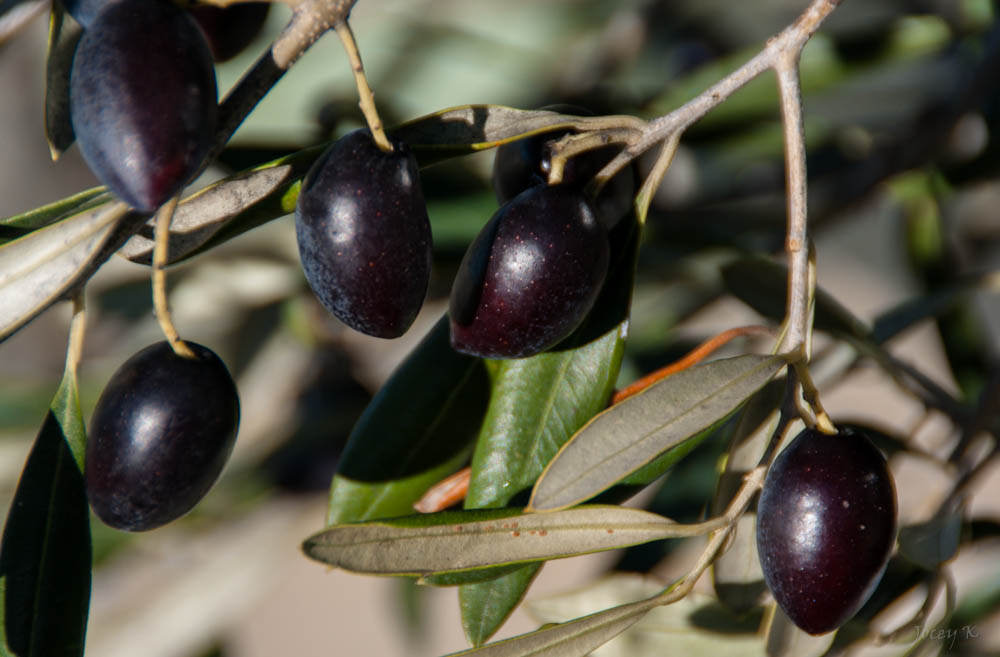
Olives ready to pick Photo by Jocelyn Kinghorn, Flickr
Olives ready to pick
Photo by Jocelyn Kinghorn, Flickr

And then dinner — long, multi-course dinners. Soup, appetizer, entrée, roasted vegetables, salad — and bread. Always with the olive oil. Good conversation, much laughter. Much wine. And then dessert.

No, we never saw them again. But we never forgot that olive oil.

When I heard on ABC News that new findings confirm that the benefits offered by the “Mediterranean Diet,” in particular its emphasis on daily consumption of olive oil, include an astounding 30 percent reduction in heart attack risk, I thought of those Italian friends from long ago. I doubt that they are traveling this earth still, some 30-plus years later. But I would wager that they did so for many years following our meeting, always with enthusiasm, with smiles and laughter, and with olive oil.

Note: Now that I have discovered, and confirmed, that olive trees grow in Texas, I am planning an upcoming visit to the groves. I’m really looking forward to exploring the modern process of producing that “divine” oil.

SOS — Saving a Grand Old Ship

By Frederic Logghe [GFDL], via Wikimedia Commons

A long-ago time, and in faraway places, the S.S. United States was a bright and shining example of American ingenuity, achievement and spirit. She is still grand and imposing, but her shine has given way to age; her paint is peeling, her interiors are empty; she has suffered greatly from years of sitting still.

There are those of us who would dearly love to see her live on, to enjoy another incarnation so that present and future generations could be awed by the sight of her — her size, her beauty and her story.

But, I fear that is not to be.

Three news networks this week have told her story. Those who are desperately trying to save her say that the deadline is near – maybe less than two weeks away – when they will be forced to give up the fight. Rent alone at her dock costs $60,000 a month, and before Christmas this year, the money will have run out.

Susan Gibbs, executive director of the conservancy that is seeking a benefactor, says the end of October marks the deadline. After that, she notes, negotiations with a “responsible recycler” will begin. This is not a new development, but it is no less disturbing. The ship has faced the wrecking ball before. But she has, in the past, been granted a “stay.”

For Ms. Gibbs, it’s personal. She is the granddaughter of the ship’s designer, naval architect William Francis Gibbs.

It’s personal for me too.

In a very real sense, the U.S. United States was a matchmaker; she was the reason I met my future husband almost 50 years ago.

At that time, she had been called into service to help move American servicemen and their families out of Europe, and specifically to move them home from France. She was still carrying paying passengers as well, but in some cases, American military families made a five-day passage to New York aboard this swift liner. They ate in the elegant dining rooms, were served by impeccably uniformed staff, and experienced a lifestyle that only a few tourists of the time shared. Luxury ocean liner travel then was the domain, for the most part, of the rich and famous.

But when General DeGaulle of France decreed on March 10, 1966, that foreign military in his country must withdraw or submit to French control, a massive logistical effort began almost immediately to relocate military families. The one-year deadline loomed large; time was of the essence. Even though air travel could accommodate the humans, shipment of household goods and automobiles had to be by sea. At the time, utilizing available staterooms and the cavernous below-deck holds of this great ship made a lot of sense.

So it was that the paths of one young U.S. Army lieutenant and one young working journalist converged one day on a dock in Le Havre, France. He was newly-assigned to help meet the deadline, charged with the responsibility of scheduling military travel and moving belongings. I had a story to write about the huge effort.

No, it wasn’t romantic; we were not her passengers. But she loomed large on the docks in Le Havre as we looked along her more than three-football-fields length and up at her 12-stories above-the-water countenance.

Just a little more than one year later, when there were no military personnel left in France, it was largely due to the S.S. United States and the numbers of people and tons of belongings that she transported back to American shores.

Yes, she was impressive then.

She is still impressive now. Her peeling paint and her empty decks do not detract from her presence and her lines. She still looms larger than life, even though she has sat silent far longer than she ever plied the seas. She was in service only from 1952 through 1969, silenced when she was only 17.

My personal story continues with her. In another tale of endings, my parents considered themselves fortunate to be among her passengers on a scheduled North Atlantic crossing in November 1969. They enjoyed the experience immensely, and they disembarked in New York. The ship was bound for Newport News and a refurbishing “furlough,” but she never returned to service. My father thought it ironic, in his later years, that he had sailed on one of the last troop-carrying voyages of Cunard’s Queen Mary, as it ferried American servicemen home after World War II, as well as on the final crossing of the S.S. United States.

S.S. United States, Philadelphia, 2005

The rebirth of cruising vacations came too late.

Today, the irony is that more people than ever before take to the sea for vacations. Cruising ships have grown larger, accommodations more deluxe, and onboard amenities overwhelming. The S.S. United States was the last American-flagged passenger vessel afloat. She was also the largest ship ever to be built in the United States. She is substantial even by today’s standards, although her passenger load was not quite 2,000 in 692 staterooms, with a crew of just over 1,000. But, she had a distinctive look about her, with two stacks towering almost 65 feet above her decks. And she was fast. She remains the Blue Riband-Hales Trophy winner. She set the speed record for crossing the North Atlantic on her maiden voyage in 1952, snatching it away from the Queen Mary. It has not since been broken!

Both Cunard’s Queen Mary and the S.S. United States were known for elegance and speed. Both were designed for passenger comfort, but built to carry troops in case of need. Both served well. Both today are listed on the National Register of Historic Places.

View a slideshow of the S.S. United States.

There the similarities, unfortunately, end. The Queen Mary is now a popular hotel and tourist attraction in Long Beach, Calif. The S.S. United States rots at the dock in Philadelphia.

Surely, she too has value as a destination resort, a museum, an office building, a shopping center, or a funky condominium development. Or, am I just out of touch with reality?

As Susan Gibbs and others have stated in recent news interviews, “We have never been so close to saving her; and we have never been so close to losing her.” Save Our Ship (SOS) efforts are ongoing. But, hopes are beginning to fade.

I will continue to hope. Yes, it’s very personal.

Along the road: The giggles are gone

The road goes on foreverIt’s hard to know just what will trigger a long-forgotten memory; it’s harder still to know just where that memory will lead. A small piece in last Sunday’s paper mentioned that the Highway Beautification Act was signed into law by President Lyndon Johnson on October 22 — 50 years ago. Of course, here in Texas we all credit Lady Bird Johnson with the impressive expanses of bluebonnets and wildflowers along our highways. That’s all good.

But highway beautification as a national mandate — Wow, I missed that one, I guess, in my youth. Actually, now that I think about it, I was living in Europe at the time — billboard proliferation along American highways was not something I concerned myself with then. But, on Sunday, that little news story suddenly brought back the memory of red and white Burma-Shave signs — and the realization that the act signed into law that long ago October day most likely spelled the end of a long tradition. Those clever advertising messages sometimes contained important messages; they certainly prompted adult smiles and kept young minds occupied for almost 40 years.

The 1965 Outdoor Advertising Control Program did not actually mandate the removal of signs, and it really didn’t force states to control those massive billboards. It was designed to discourage excessive signage along the Interstates, and stipulated that development funds could be withheld for non-compliance by the states. In that way, it was effective. And the Interstate highway system soon supplanted most of the older highways.

You had to be there: Missing one of the signs could sometimes be the cause of tears; more often, an attempt to fill in the missing word or phrase spawned uncontrollable giggles. It was, for generations of kids, one of the few fun things about road trips — often long, hot, dusty treks along not-so-good highways. Towns in most of this United States at that time were far apart, usually small, and boasted no readily available “fast food.” Gas station and rest room stops were the result of advance planning, for the most part.

Summer or winter, travel could be iffy — heat, cold, mechanical problems, flat tires, boredom, seemingly endless stretches of blacktop. Radio station signals made news and music unreliable across vast distances. But the signs — oh, those signs! We all looked forward to them. The “game” became who spotted the first sign first. Then, everyone “won” as the message was revealed across the miles. At the height of their campaign, Burma-Shave had 7,000 signs in all but four of the Lower 48 states.

20151001_160745

Yes, the occasional giant billboard may have ruined the view, distracted drivers and “polluted” the landscape. But, Burma-Shave signs? Although I haven’t thought about them for decades, I miss them. I’m also sorry  I  couldn’t play the game with my own child; I have trouble even explaining the concept to my grandchildren. But, then, today we travel on smoother Interstate highways — and the kids are plugged in to their own virtual world of movies, music or audio books.

The times have changed — but, the “road goes on forever.” I’ll just spend the rest of the day humming that tune and laughing about those verses! There’s currently a new interest in Route 66 and its associated memorabilia. Sadly, though, Burma-Shave signs seem to have disappeared forever.

Some of them were totally about the shaving cream. In 1932:

You’ll love your wife

You’ll love her paw

You’ll even love

Your mother-in-law

If you use

Burma-Shave

Others were just plain clever! From 1945:

‘Twould be

More fun

To go by air

If we could put

These signs up there

Burma-Shave

Sometimes they had important messages. Here’s a good one from 1949:

When frisky

with whiskey

Don’t drive

‘Cause it’s

Risky

Burma-Shave

Another:

Ashes to Ashes

Forests to Dust

Keep Minnesota Green

Or we’ll ‘

All go Bust

Burma-Shave

They could also be a little risque. This one’s from 1959:

Baby your skin

Keep it fitter

Or “baby”

Will get

Another sitter

Burma-Shave

You can read more of the iconic road-sign jingles, indexed by year at Burma-Shave.org.