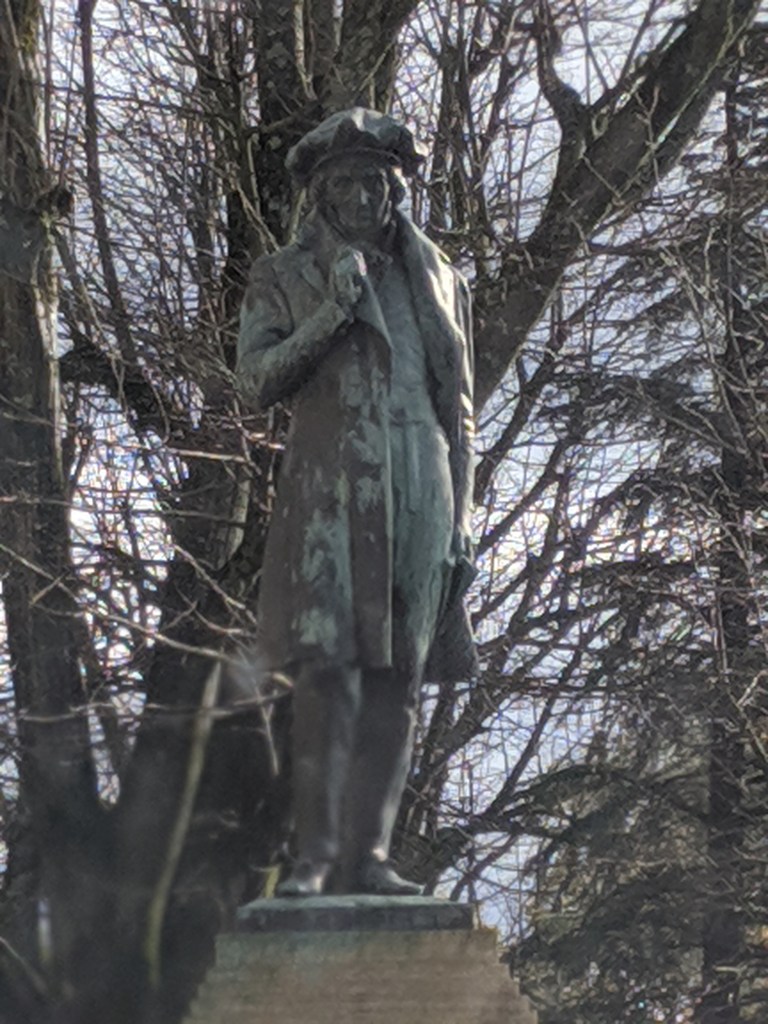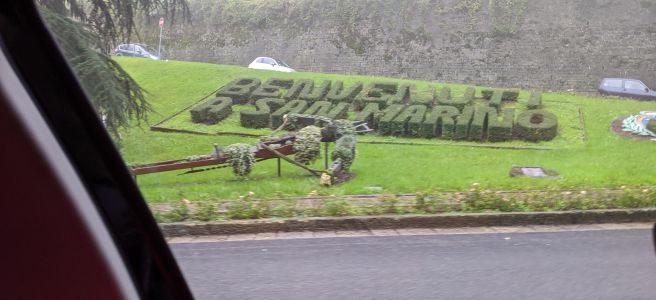
A lesson in democracy

San Marino, capital of the European “microstate” of the same name, is not on most lists of “not-to-be-missed” European destinations. However, this tiny nation, founded in the year 301 and reputed to be the world’s oldest constitutional republic, ranks among our best adventures.

We had read, in passing, about this tiny, ancient city-state, and could not resist the temptation to visit a modern-day anomaly. The lure of the fifth-smallest nation on earth was strong.

My husband and I planned this quick excursion in conjunction with last winter’s Mediterranean/Adriatic cruise. Tiny San Marino is an easy drive — not more than about an hour — from the Italian port of Ravenna.

The world’s longest-surviving republic has known its share of difficult times and has been occupied three times, it is said, by foreign powers. But it has survived, and today it enjoys one of the world’s most stable economies, much of it derived from tourism, and is considered one of the wealthiest countries in Europe in terms of GDP.

Its claim to be the oldest existing sovereign state as well as the oldest constitutional republic is not disputed. San Marino’s 60-member legislature is elected every five years, and dual heads of state, “Captains Regents,” are elected by the council every April and October to serve six-month terms. From all outward appearances, the system of government, with an unlimited number of political parties, seems to work very well.

I think of San Marino now, as the calendar ticks down to our own election and wish I had been able to spend more time getting to know the people and learning more about their system of government.

The few hours we spent there are unforgettable. The mountaintop site of the old city is spectacular and the people we met were lively, welcoming and “real.” There is something compelling about a “parliamentary representative democratic republic” that has survived this long!

With a land area of only 23.6 miles, and a total population of just over 36,000, San Marino is completely surrounded by Italy. Its official language is Italian, and the currency is the Euro, although San Marino is not a member of the EU. There is no official border crossing.

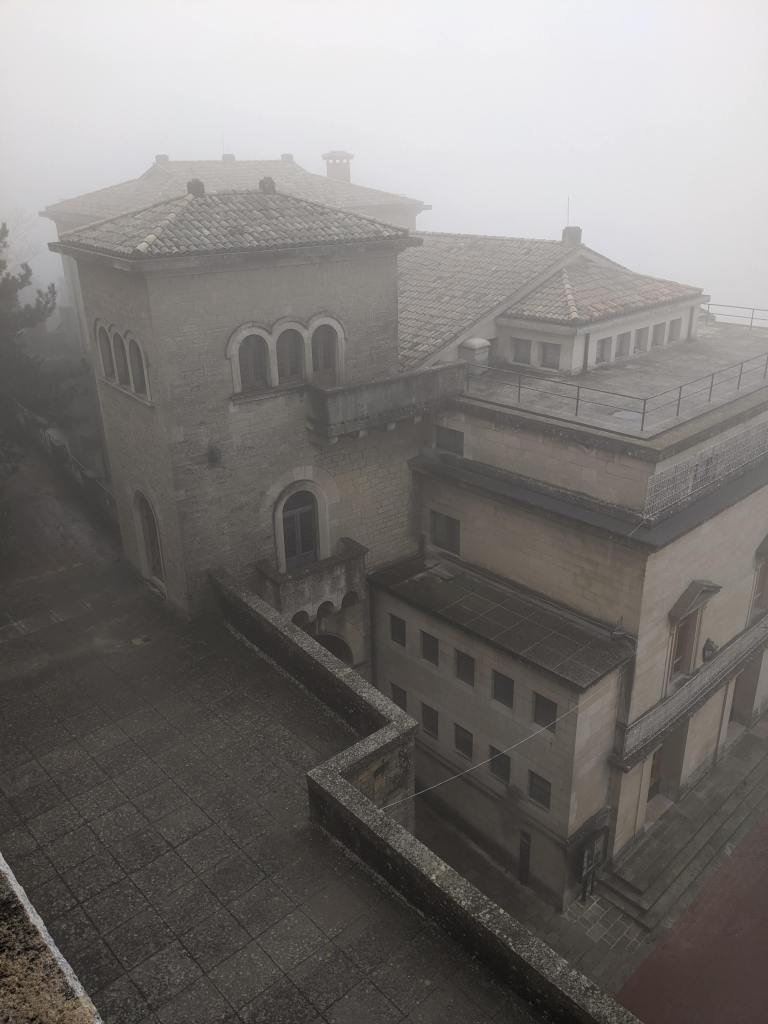
The drive along the coast from Ravenna takes one along modern highways and through charming seaside resorts before turning inland to wind through agricultural fields and vineyards. It’s pleasant. The weather forecast was for cool temperatures with a chance of rain. We knew about San Marino’s strategic location, but we were not prepared for the fog that shrouded the peak as we began the ascent.

We had seen the pictures of “The Three Towers” that cap the crest of Monte Titano, and the medieval wall that surrounds the capital, also named San Marino. We had hoped to see them outlined by blue sky, as they had appeared in the tourist guide.

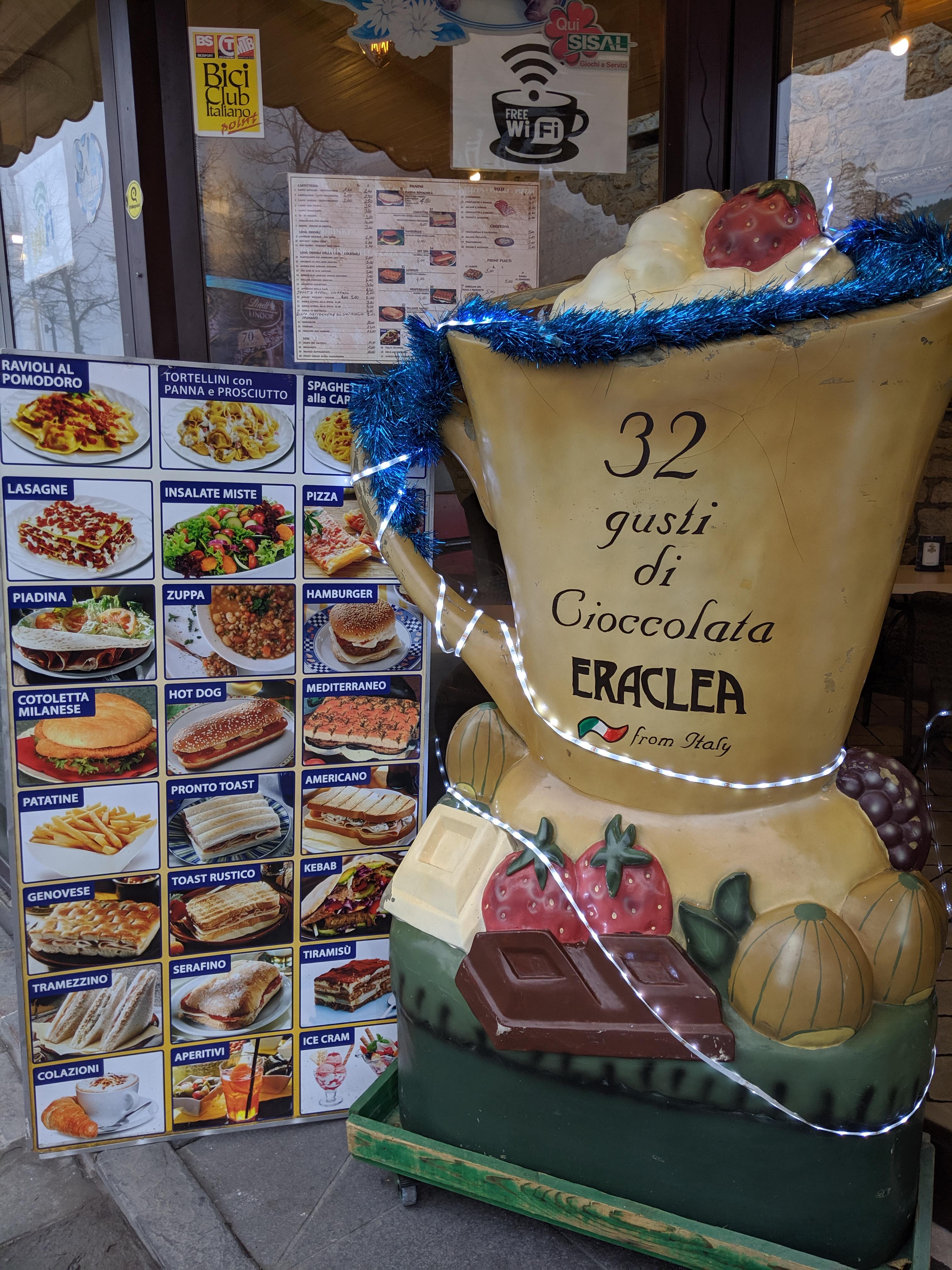
A roadside cafe on the way to the old city beckoned us, and we enjoyed steaming cups of hot chocolate with local workmen and uniformed highway police before pushing onward. It was grey and overcast, and the aerial tramway that would have whisked us to the summit on a sunny day was not running.

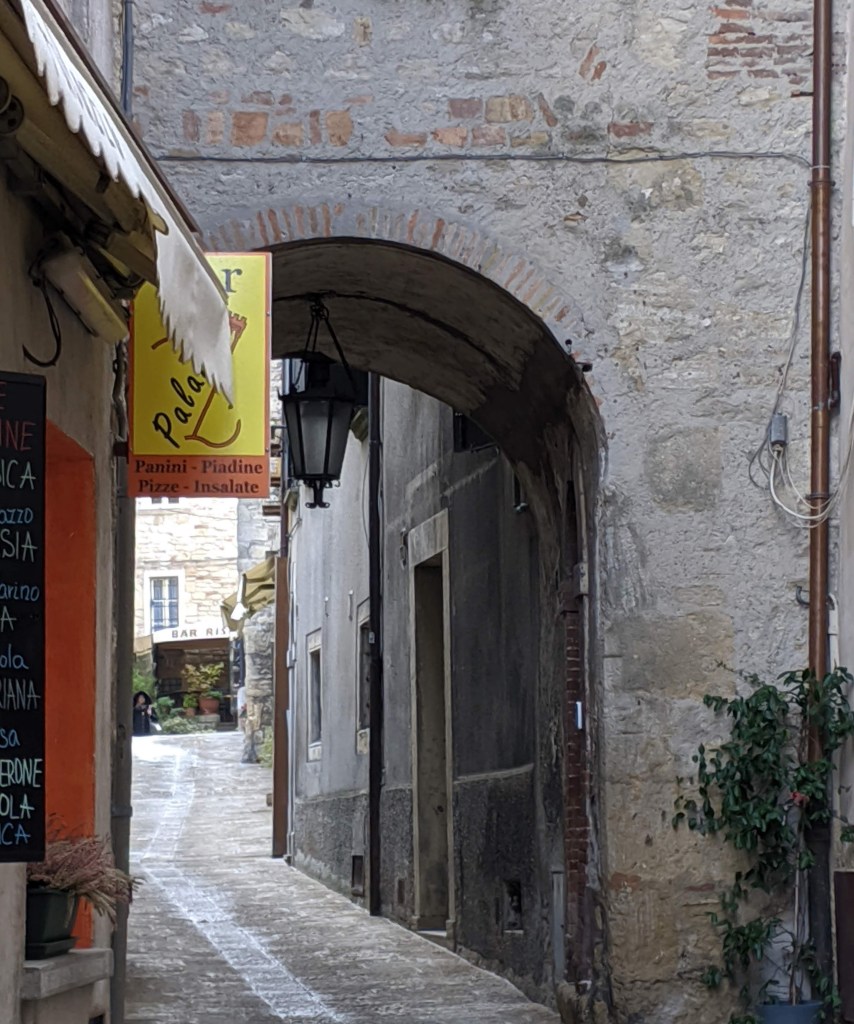
Not knowing what to expect, we pushed on and were able to park just outside the gate of the medieval city. Passing through the gate was like stepping back in time, or entering another world. Cobblestone lanes not much wider than a primitive wagon path greeted us, and even though the mist hung heavy all about, we were enchanted.

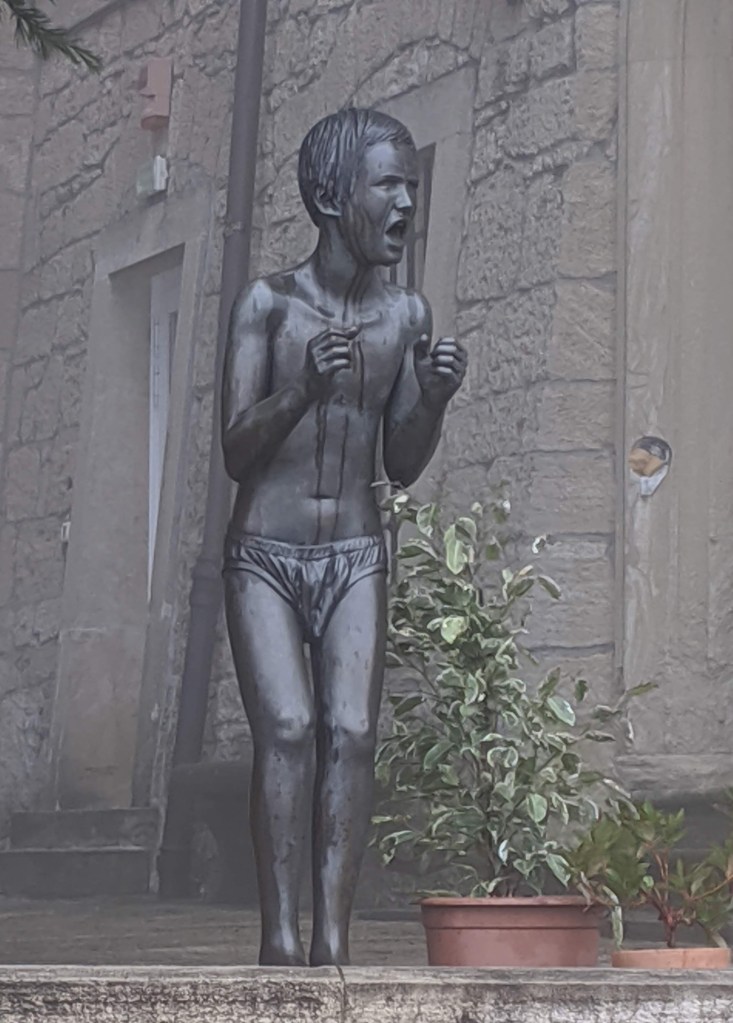
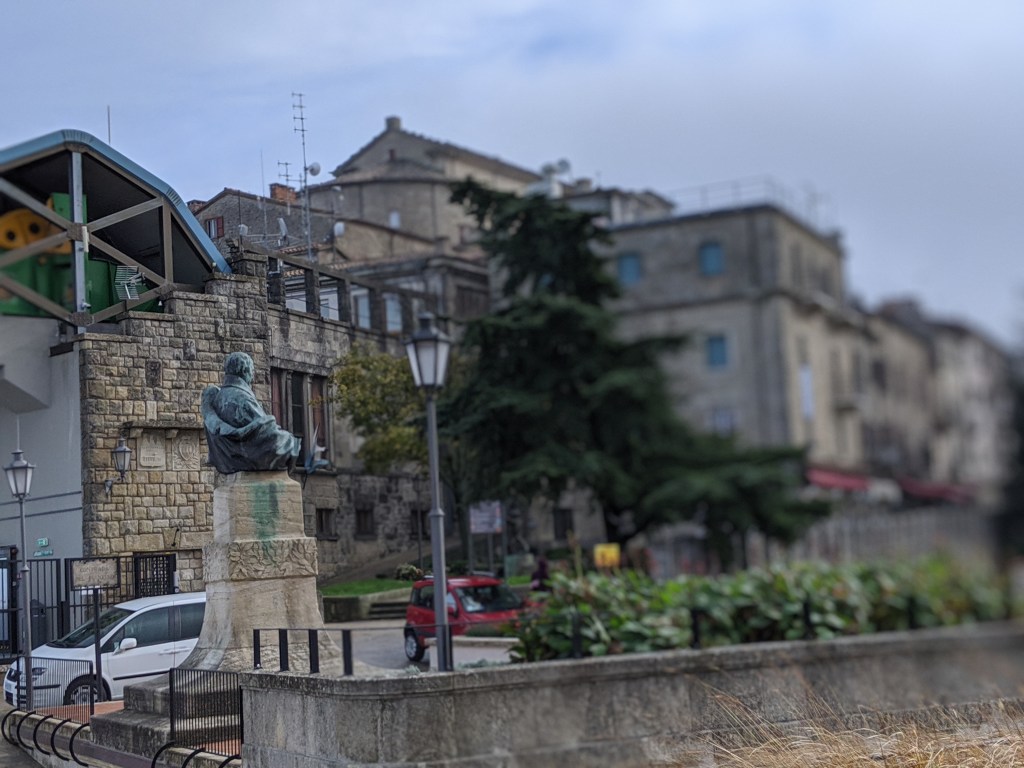
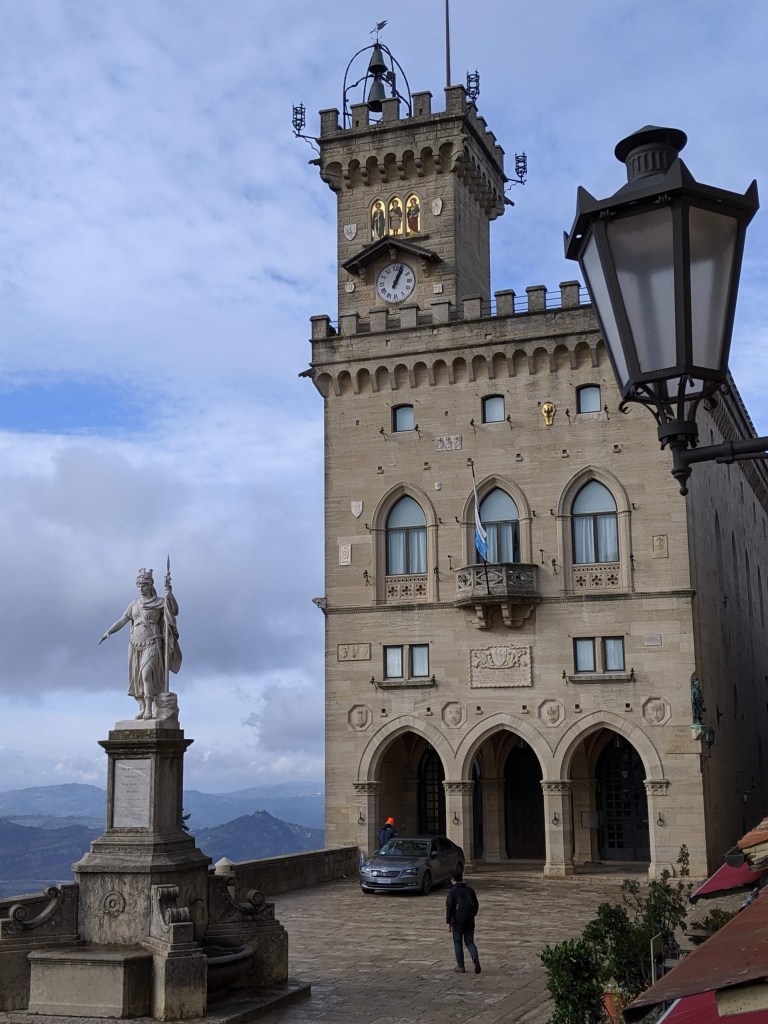
We could not see the valley below, nor could we see the crenelated towers above, but we were content to walk the steep lanes, peering into shop windows, catching glimpses of gardens and marveling at the statuary and art that punctuated plazas and wide spots along the narrow walkways.

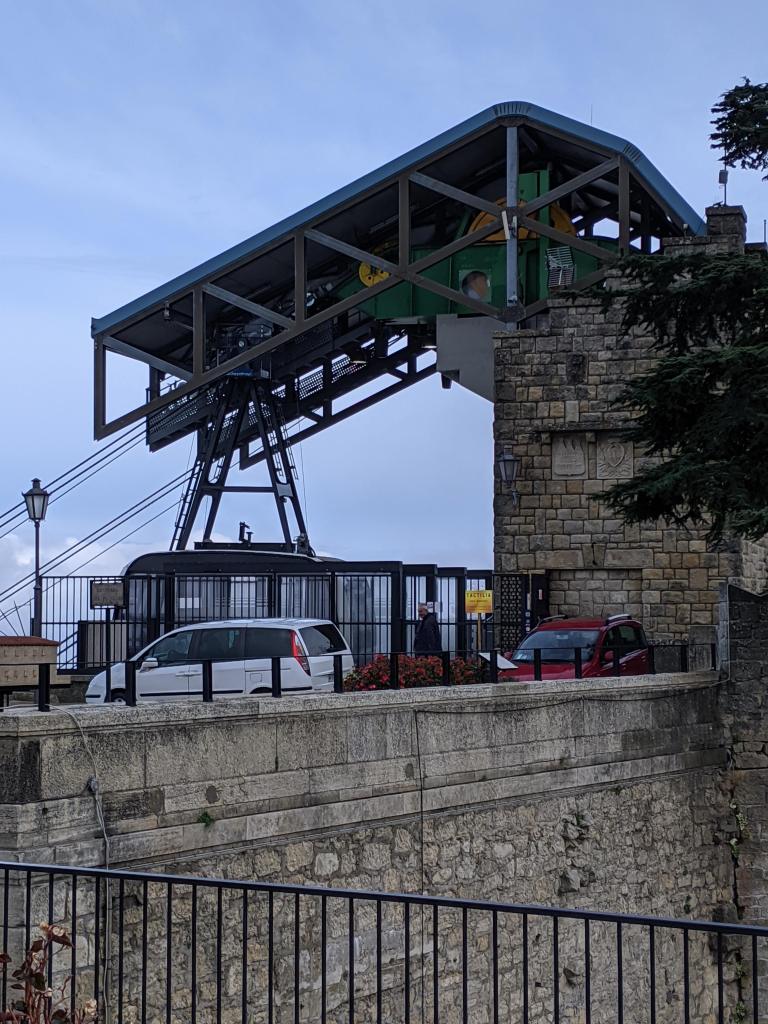
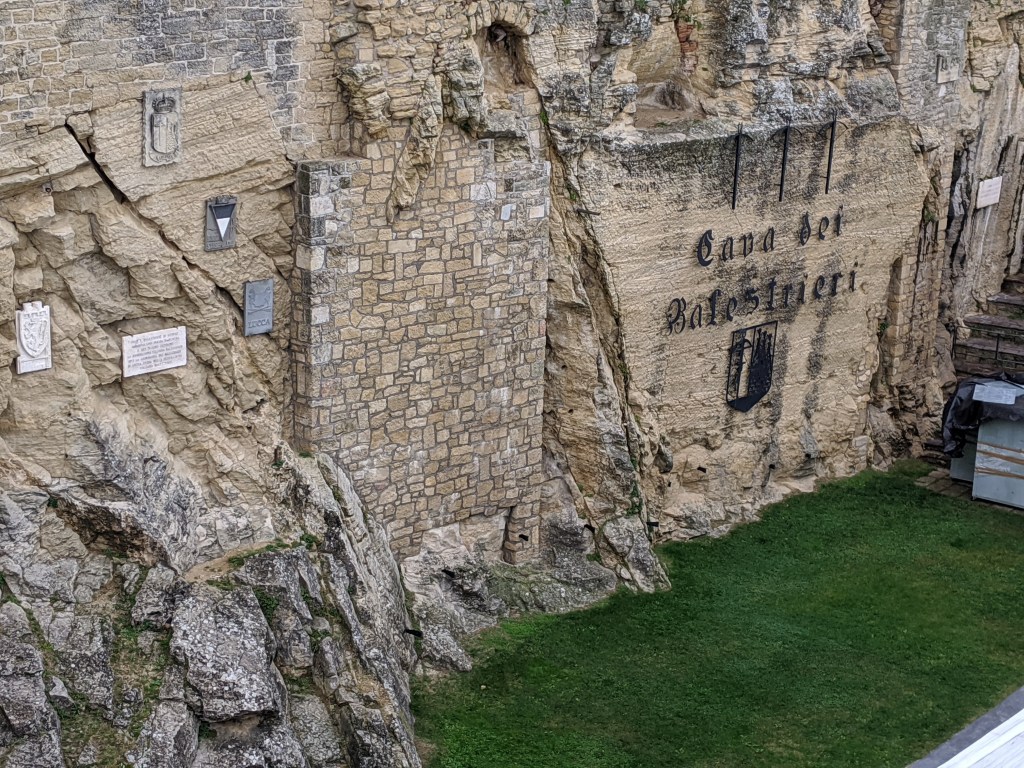
We stopped at the upper station of the tramway, impressed by the engineering expertise it had required, and we looked over the edge of the city wall, disappointed at the mist that still blocked our view of the valley below. We ducked into the nearby Visitors Center to have our passports stamped as proof of our visit.

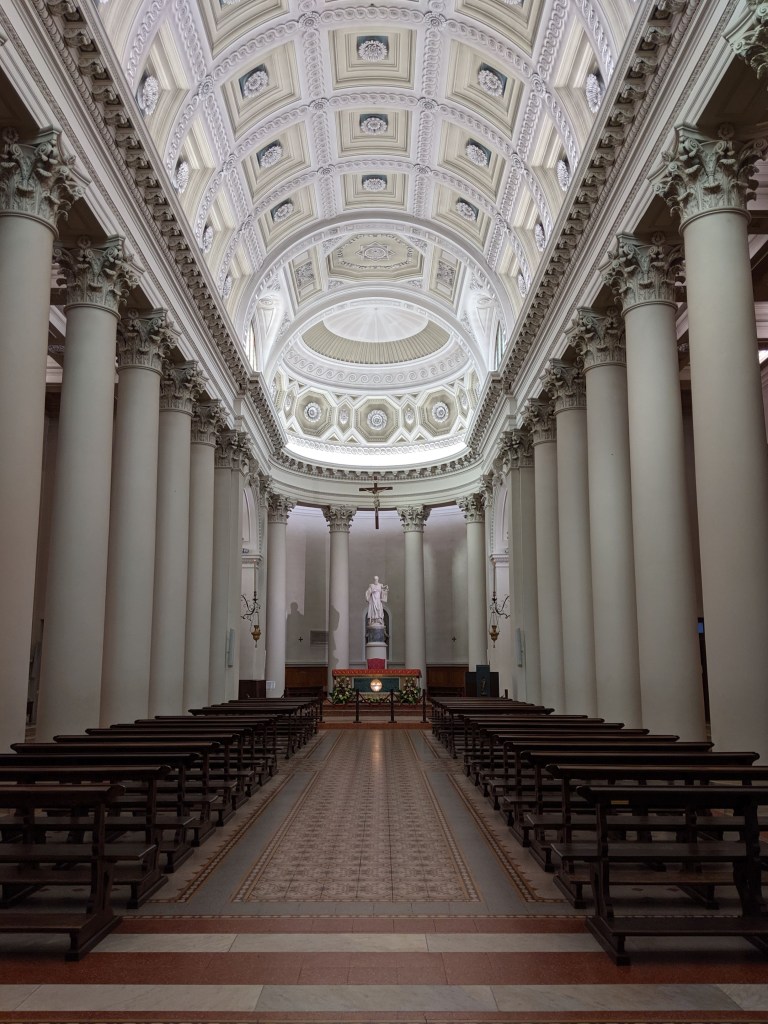
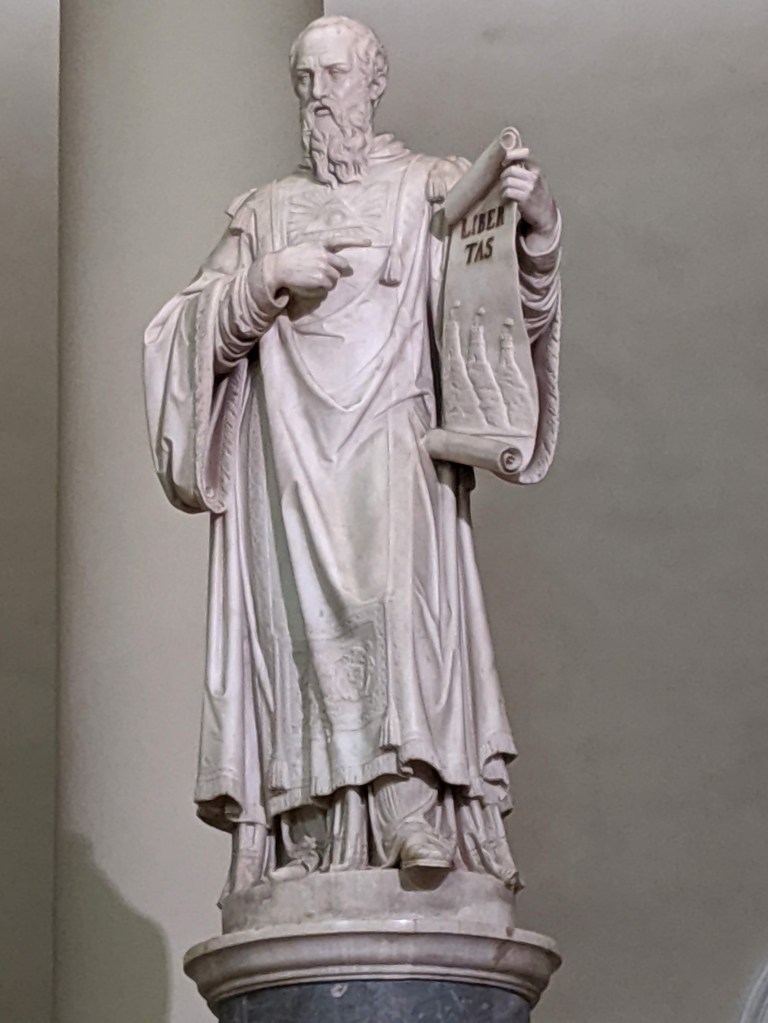
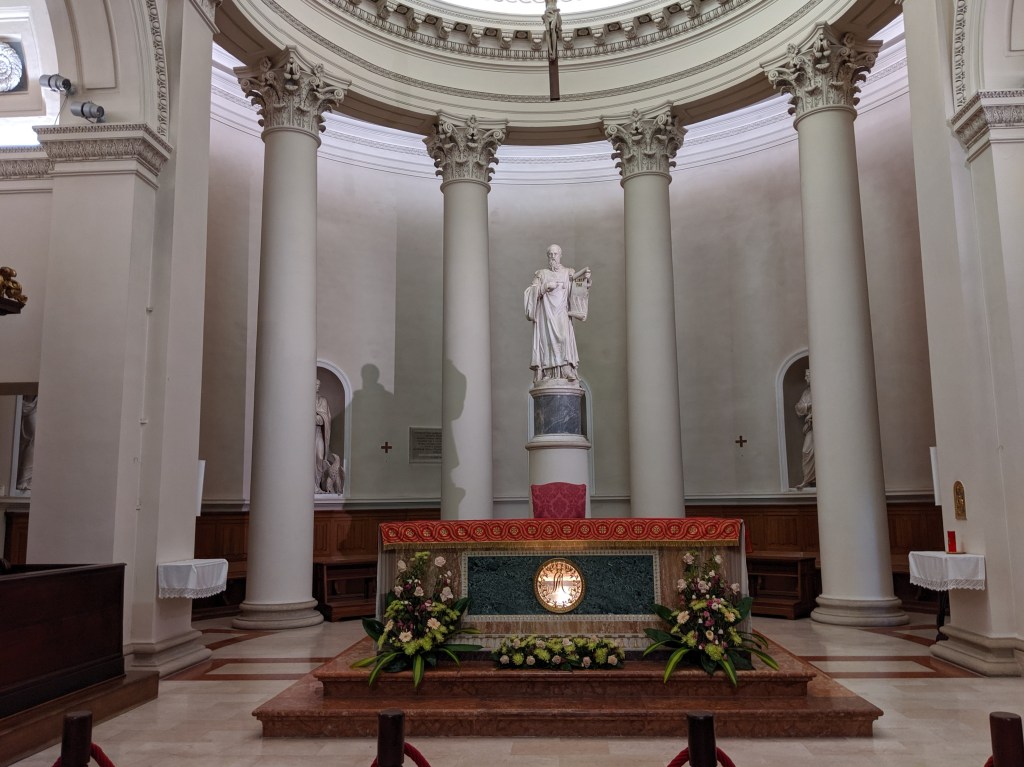
We strolled to the city’s beautiful basilica, marveling at the skill and endurance it must have taken to construct on top of the mountain in 1836, on the site of an earlier church that dated to the 7th Century. We were enthralled, and could have spent longer inside, but because we were on a strict time schedule, we decided to make our way back to our rental vehicle.

When we emerged, the clouds had lifted and the sun was shining. We could not leave without once again making our way to the city’s encircling walls to gaze in awe at the countryside far below us.

Although Ravenna has its own attractions, we were more than pleased by our decision to forego the eight UNESCO world heritage sites located there and head instead to a tiny nation-state with a long history.

It remains a fond memory.

More thoughts about Cuba

Note: Today is Election Day; the midterm elections in the United States have been much in my mind over the last week as I attempted to gather my thoughts about my recent short visit to Havana. On my way to vote this morning, I remembered how one young Cuban attempted to explain his country’s elections. They are very different from ours. This CGTN America explanation of the recent Cuban election (and an overall view of the electoral process in Cuba) is an interesting overview. CGTN is one of many international news channels run by China Media Group.

“It’s complicated.”

I can’t count the number of times we heard that phrase during our 12 hours in Havana.

Since returning from this eye-opening trip two weeks ago, I have been talking about it frequently, thinking about it constantly, trying to organize my experience into an orderly patchwork quilt of impressions.

It isn’t anywhere near complete.

The pervasive reality is that Cuba is at a crossroads, buffeted by winds not of its making. Change is in the air, even though there is no consensus about the direction of that change, or about how and when it will manifest to create a new climate for the country and its 11.5 million people.

We asked a lot of questions. We were, in many ways, surprised by the answers, even more surprised that those we met were open about their views and willing to answer all our questions.

They were eager to speak with Americans. We were eager to listen.

But, it’s complicated.

We wanted a capsule view of what daily life is like in Cuba. We didn’t get that. What we realized is that individual lifestyles vary within Cuba just as they do in the United States. Somehow, I had not expected that. I was hoping my impressions of Cuba would be easier to sort through. I expected a sort of sameness from this Communist country. That is not at all the case.

Much of the city is beautiful, if old and somewhat unkempt. Other areas are modern. City squares and broad avenues boast art and sculpture, color and design. There are parks, and people flock to them. It’s a city made for walking; however, old cobblestones, narrow streets and many people can make it difficult. There are construction cranes, scaffolds and workers everywhere; and much of the work involves modernizing historic buildings.

The cadence of life

Fidel Castro, we learned, is still very much a force of daily life, even though he died two years ago, November 25, 2016. It was eight years earlier that he resigned as president, ceding the reins of power to his brother Raul. Now, Raul has stepped down and there is a new president, elected just last year. He had no opposition.

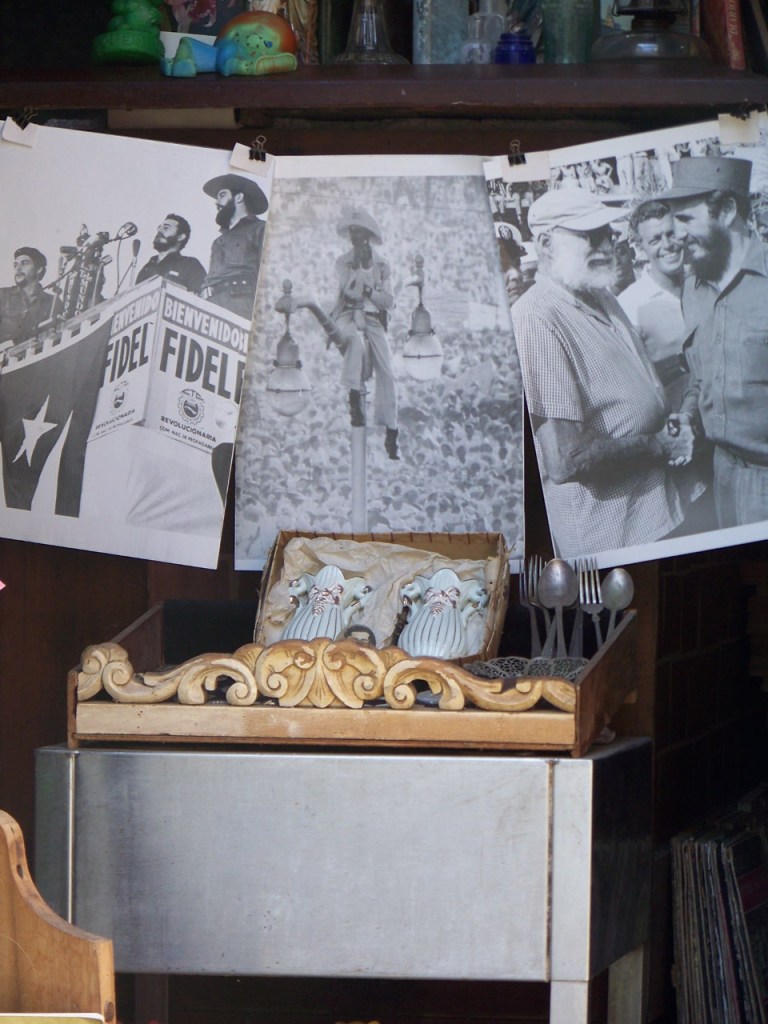
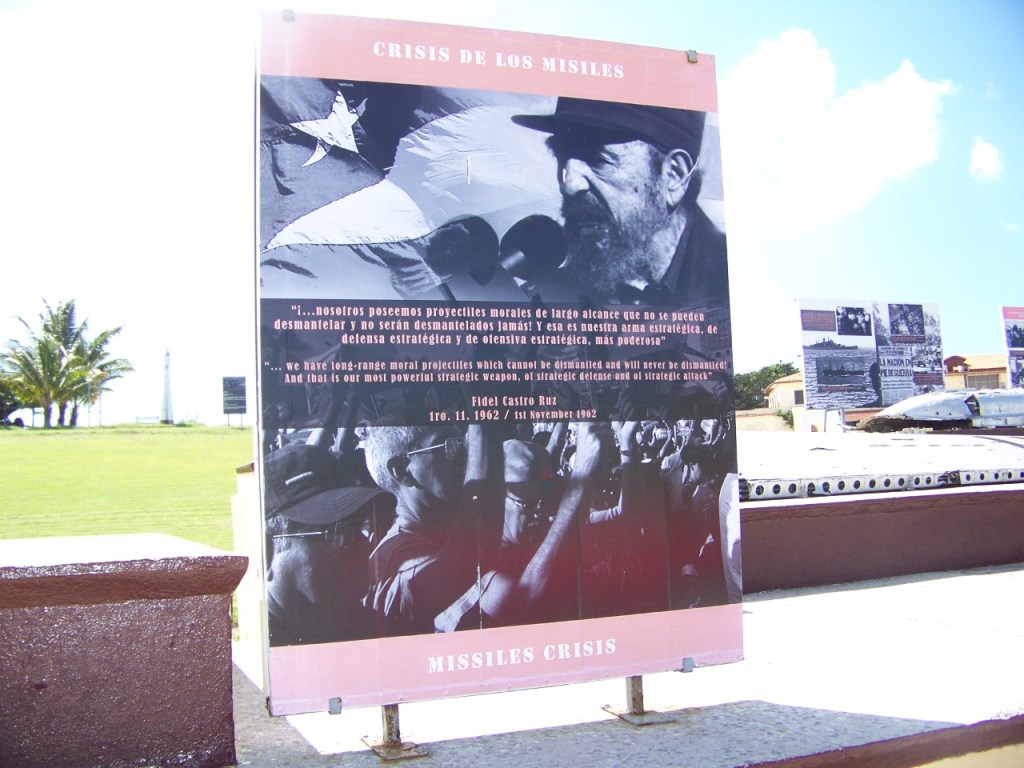
Fidel posters and other reminders of the revolution are still everywhere. Fidel — yes, first name only — is spoken of as a sort of  kindly uncle by some who were born after the revolution and grew up in his shadow. His presence was — and still is — pervasive. We heard alternately that he was a “tough” man, and the “savior” of his country. But his name is spoken with a mixture of awe and fondness.

We were told that he enriched the lives of farmers and city dwellers alike. We were told that he cared about the poor people, and that Cuban citizens would not be as well off today had it not been for the influence of Fidel Castro. We were told that although they are poor, the Cuban people have health and family, food, shelter and education because of Fidel.

We were told that Fidel did not seek power for himself; and it has been written that he did not want a “cult of personality” to surround his memory.

His ashes are entombed in a simple, but impressive 10-foot-tall boulder in Santiago, in a cemetery that he shares with the first president of Cuba, along with other well-known citizens. It is at the eastern end of the island near his family home, and there is a metal plaque that reads simply “Fidel.”

However, Cuban citizens, tourists and world leaders alike visit the site regularly, sometimes as many as 4,000 a day. Every 30 minutes, there is a military ceremony, a changing of the guard, that honors both Fidel Castro and 19th-Century Cuban patriot and revolutionary Jose Marti.

The reality of Cuba today

Young people we met recount the history of their country accurately and easily. Events from two or three decades before their births seem very real to them. They also speak of Cuba’s earlier history with pride, and most argue that, despite its imperfections, life is better today than it was prior to Fidel, even though those we met did not live through their country’s revolution.

Some older citizens were perhaps a bit more guarded in their responses to our questions, but still quite forthcoming about their lives.

Cuba is a poor country, as they freely acknowledge, but a proud one. Food, shelter, medical care and education are provided. Family is important. Material wealth, they claim, is not. Crime is almost non-existent; drug use is low, but punishment can be stiff.

Tourist trade in Cuba is big business. Today, we were told, Americans constitute the majority of foreign visitors. Surprised? We were! Everyone we met was welcoming — helpful and congenial, often greeting us with smiles and wishes for a good day.

One older woman asked, in Spanish, if I was American. When I answered yes, she took my hand and thanked me for coming.

It’s complicated.

Reuters reported this week that Cuba’s economic growth forecast has been lowered to just one percent for the year, and that austerity measures are to be instituted. Lower than expected revenues from tourism are partially responsible, but so is a decline in GDP income from sugar and mining. Trade uncertainties exist between Cuba and Venezuela, and economic growth is uncertain.

Additional observations and insights

English is taught in school to even the youngest children. We neglected to ask about other languages. There is no obvious language barrier.

News is filtered, according to our guides, even though it may not be directly censored. “We hear only bad news about the United States,” said one. Another told us of a relative who lives in Houston, and of how he would like to visit. Although it is not prohibited, he added, visas and monetary regulations make travel cumbersome, expensive and unlikely. Still, he said, he hopes one day to be able to travel beyond Cuba’s borders.

Cubans have cell phones, but they may often be without toilet paper. They enjoy afternoon mojitos , but they may have to do without water, for both drinking and other household use. A trip by bus between Havana and the eastern end of the island can take 20 hours.100_1303 (2)

“We do not have cars,” explained our guide when we asked about finding parking places in crowded Havana. And those vintage American cars: They are not often privately owned, said our driver. There are many ways to get around, though.

In fact, the red Thunderbird that we enjoyed during our afternoon tour is normally a taxi and will be out of service next month for repairs. That, unfortunately, means that our driver will be out of a job until the refurbishment is completed. He is not worried; his basic needs will be taken care of as always.

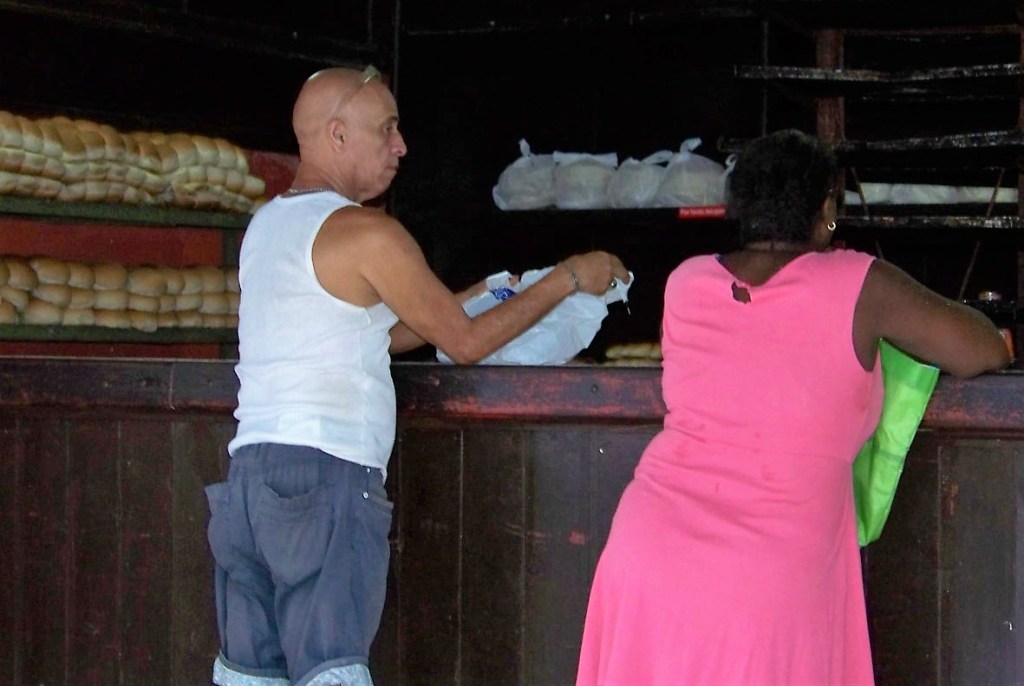
The state provides for those basic needs, but shelves are often devoid of even routine products to meet those needs. Rationing of food staples is a way of life. Foreign goods are rare, said another person: “What we buy is produced here in Cuba.

A number of products are exported. Rum, cigars, coffee and sugar, for sure; we guessed at the rest — citrus fruits, rice, corn and beans; fish and shellfish. However, the trade deficit is significant.

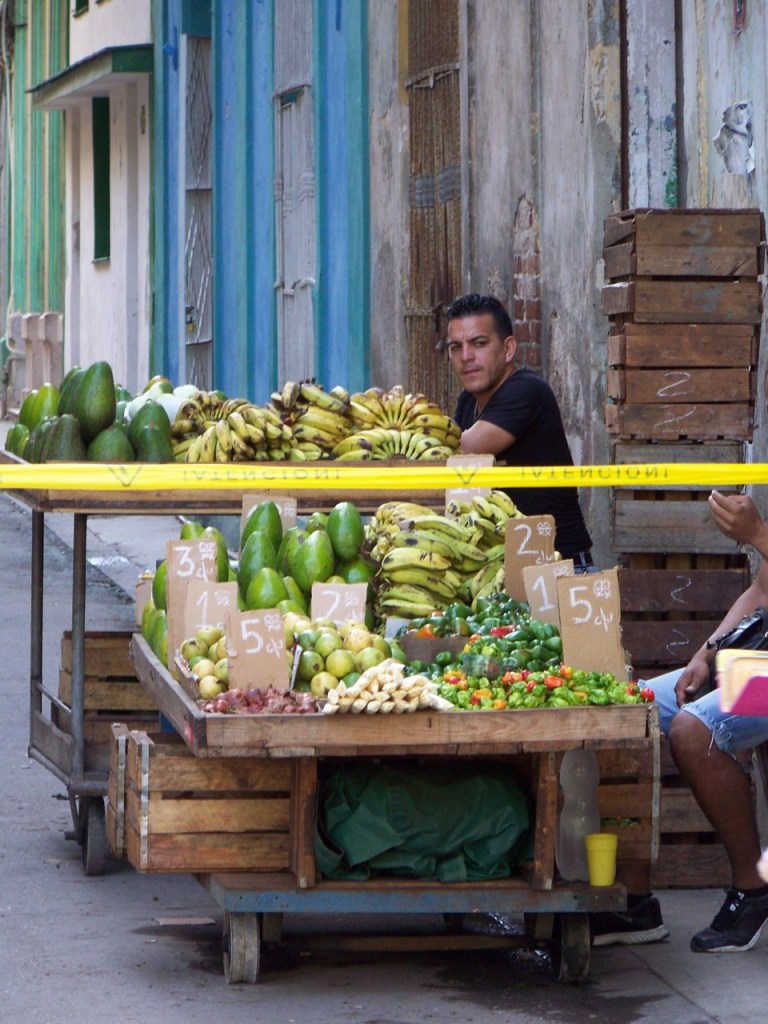
We encountered only one small street market, and a single flower seller.  But we did not have a lot of time to explore.

There are few luxury goods in Cuba. Even though smart phones are common, widespread internet is not.

The Cuban people are not exactly isolated from the rest of the world, but they are definitely not affected in any obvious way by the culture of a country only 90 miles away. Cuban culture is unique; in my short experience, it is totally different from anyplace else on the globe.

Life moves at a different pace in Havana.

Our day in the city brought us many new insights, and a lot more questions. We left with the conviction that the “cultural exchange and understanding” requirements are in place for a very good reason. Indeed, that may be the best part of the Cuban experience for Americans. Maybe it should be a worldwide travel requirement. If you’re interested in visiting Cuba on your own, there is a wealth of information available to help you plan a trip. Will we be returning? Perhaps.

But it’s complicated.