Elevator Philosophy

There is something immensely satisfying about traveling — even if it’s a kind of working vacation. But there is also a sense of relief, and enormous comfort in coming home, no matter how rewarding the journey has been.

That’s the state I find myself in now — in the middle of November — with business to attend to, goals to accomplish, stacks of notes to make sense of, scores of ideas to develop and hundreds of stories to tell.

Yet, here I sit at my computer, poring over trip photos and marveling at the wonders of  Mediterranean ports. Following two weeks of non-stop travel activity, we enjoyed a calm and rejuvenating week at sea. The Atlantic Ocean seemed to spread out in calm ripples in every direction, welcoming us daily with superb sunrises and spectacular sunsets. We couldn’t have asked for a calmer crossing, unlike some in the past, nor for more companionable shipmates.

Likewise, the varied cities we visited — full of profound history, beautiful sights, friendly people, enticing food, good wine, interesting excursions and fine weather. As Americans, we encountered no hint of hostility or malice; instead, we were greeted with friendly smiles and an eagerness to talk, even though our command of local languages was decidedly limited.

We never felt unsafe, unwelcome or threatened, whether we were on our own or part of a touring group. To be fair, we ventured off on our own more often than we joined organized groups. We occasionally heard some minor grumbling from fellow travelers, but not often, and mostly about logistics, not the people or the places.

We witnessed a calm and well-organized student protest (its purpose unknown) in Messina, Sicily, and we were in Barcelona the week before the Catalan parliament voted to declare independence. Tensions were running high. Catalan separatism was evident, with competing flags and signs everywhere. Now, there is scant news about what will happen. But I think the movement has not died so easily.

Our time there was limited; we were disoriented by the traffic and the sheer size of the city, and I have to admit that we were cautious among crowds in light of recent terrorist attacks. But we walked the streets, rode city buses, joined thousands of children and parents to attend an event at the former Olympics Stadium, and were willingly assisted by locals who helped us find our way about. I would not hesitate to return — to Barcelona and to any other place we visited.

As a side note, high school Spanish was of little use in Catalonia!

No matter what happens,

travel gives you a story to tell.

In coming weeks, I’ll tell many more stories about the trip, share other insights and detail personal observations about the places we visited, the meals we shared, the people we met, the experiences we were privileged to enjoy.

I’ll also refer again and again to the snippets of travel philosophy that were boldly displayed on elevator carpets throughout Royal Princess, the elegant cruise ship that became our home for this journey. Each one is a gem, and although I tried to ride each of the ship’s numerous elevators at least once, I’m sure I missed some. Therefore, I know I missed out on some of the wisdom that is so uniquely displayed.

For now, though, an observation by Mark Twain seems in order:

“Travel is fatal to prejudice, bigotry, and narrow-mindedness, and many of our people need it sorely on these accounts. Broad, wholesome, charitable views of men and things cannot be acquired by vegetating in one little corner of the earth all one’s lifetime.”

Samuel Clemens wrote those words in 1869, for “The Innocents Abroad.” He said it pretty well, didn’t he? His point, I think, is as pertinent today as it was when his chronicle of “the great pleasure voyage” was published.
Gold earring and the Cape

David Stanley/Flickr

There are times when armchair travel is almost as rewarding as in-the-flesh excursions.

Even firsthand accounts of adventurous trips may not quite compare with the real thing, but sometimes words and pictures convey the spirit of a place in a way that is stunning and satisfying. Researching nautical lore became a stay-at-home voyage of discovery, an exciting experience that needed no packed bag and no advance planning.

A Virtual Voyage

In December, I took a month-long journey from Los Angeles, following the Pacific coastline of the Americas to the “bottom of the world” and back north once again on the Atlantic side of South America to Rio. It was a virtual voyage via modern cruise ship.

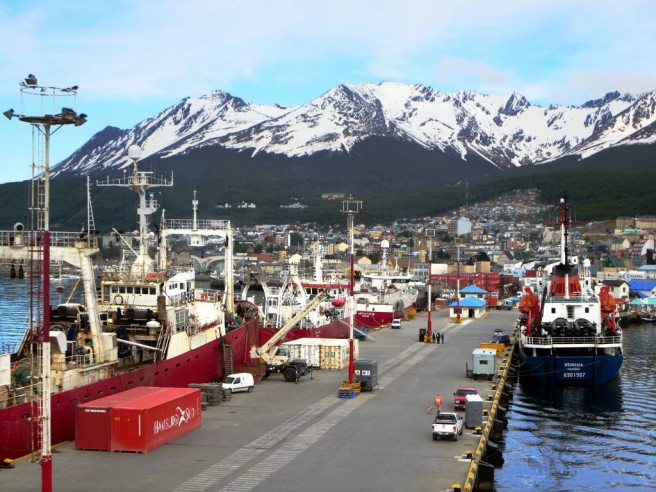
By frequently checking the vessel’s bridge cam, I was able to experience smooth seas and rolling waves, raindrops and marshmallow clouds, bright sun and midnights, the distant horizon and the nearby shore. I also got a feel for some of the ports and watched, mesmerized, as the fog cleared over the craggy mountainous backdrop of Ushuaia, the southernmost outpost in the world.

It was not the same as actually being there. But it was good; reading filled in some of the blanks. I’m planning for the future, and because of my virtual voyage and my research, I know better what to expect. Yesterday, on the solstice, I thought about Ushuaia again. It’s winter now at the bottom of the world, and I’m sure the air is frigid.

Planning Ahead

I’ll be reading more books and poring over more pictures of all the cities along the route prior to booking the trip. I’ll read more geography and history, more about past civilizations and current governments. I’ll learn more about local food and drink and culture. You can bet I’ll read more about the HMS Beagle before cruising through Beagle Channel at the bottom of South America.

I’ll also study up a bit more on nautical lore. That’s one of the reasons this particular voyage was so appealing: The itinerary included crossing the equator as well as rounding Cape Horn.

There was a time when sailing superstitions were honored, when nautical traditions held sway in everyday life, when seagoing ritual was honored on land as well as on the seven seas, in every corner of the globe.

Now, not so much.

Nautical Superstitions

But some customs are still practiced by modern navies; cruise ships indulge in time-honored ceremonies when crossing the equator or the international date line. Even “airships” mark those occasions with a nod to tradition — an announcement from the captain or, sometimes, a certificate. Today, it’s all strictly for fun. Or is it?

Old salts might tell you otherwise. More superstitious sailors wouldn’t think of eating a banana on board, never whistle while they work, dread sharks but welcome dolphins, and are careful to speak first to any redhead within earshot. There are also plenty of pleasure boaters who are wary of changing a vessel’s name and, curiously, never wish fellow travelers “good luck” before a planned journey.

We still live close to our mythology in other ways — throwing salt over a left shoulder, for instance; acknowledging a sneeze with “gesundheit,” not having a 13th floor in buildings, nor a Deck 13 on most modern cruise ships.

Nowhere is the mythology closer than at sea.

Sailing Tradition

Just as I am still searching for a tattered nautical chart with the notation “BHBD,” I also have a sort of “bucket list” that has more to do with half-forgotten habits than with destinations:

  • I want to wear a gold hoop earring in my left ear as testament to my voyage around Cape Horn. There are many versions of this tradition, and while I have no illusions about being able to qualify for the Amicale des Capitaines au Long Cours Cap Horniers (AICH),  I do intend to stand in Ushuaia, sometimes termed “the end of the world,” and look towards Antarctica.
  • I want to sail across the International Dateline, gaining (or losing) an entire day in an instant. I want a certificate to hang on my wall in commemoration of the feat.
  • For old salts, a sparrow tattoo marked a milestone of 5,000 nautical miles traveled. I have already earned the right to at least a couple of sparrows, and I still have more miles to travel. However, I’m a coward when it comes to ink on my skin. Maybe, when I qualify for a host of sparrows . . .

In 2017, I will be traveling in other directions, but I still have my eye on a spectacular gold hoop earring, and I’m already deep into research for 2018!

Photo of Harbor at Ushuaia, Terra del Fuego, Argentina, 2014, by David Stanley/Flickr

The dream dies hard, but the memories live on

It looms large on the horizon, the hulk of the S.S. United States, as she lies in port in Philadelphia. Her stacks rise above the neighboring dock buildings, and it’s possible to use them as landmarks rather than following GPS directions as you chart a course to see the once grand ship in her current forlorn and decrepit state.

This ship — and the search for a traditional Philly cheesesteak — took us to the city of brotherly love this summer.

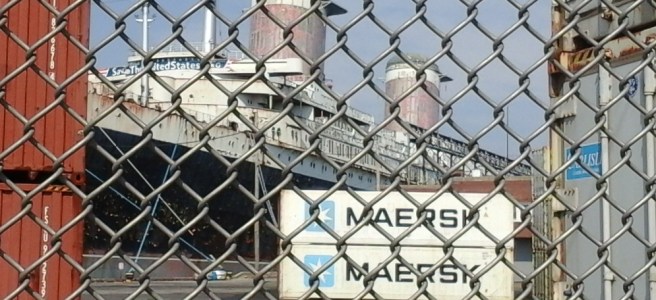
We found our ship with ease, and we lingered there. Remembering our first encounter with this vessel, my husband and I didn’t speak. We just gazed through the chain links at this once gleaming passenger liner with a history that is irrevocably intertwined with ours.

We met the S.S. United States, and one another, on the same day in August 50 years ago at the port in Le Havre, France. The ship was just a teenager at the time. We were young as  well, and impressionable.

She was a looker, massive and shiny and silent, but aswarm with crew going about their duties. We were impressed by her presence and by her glamor; she took our breath away. We had some other experiences with her, but her days at sea came to an end barely three years later.

Our story continues.

This summer, as we mapped our road trip north, it became a priority for us to see the grand old ship. Philadelphia was miles out of the way, but we took the detour. Our hearts were in our throats as we first spied those distinctive smokestacks. We were buoyed by the hope that this old lady might actually sail the seas once again.

Unfortunately, early this month, we learned that the plan to refurbish her as a cruise ship is not feasible. The S.S. United States has been out of service for 47 years; she has languished at the dock in Philadelphia for more than 20 years now, longer than she sailed! And, though she is deemed still structurally sound, the dream that she might again carry passengers has died.

There is still some hope that the S.S. United States will be saved from the scrap heap and turned into a floating “history book.” She is, after all, an engineering marvel; this last American flagship set a world speed record on her maiden voyage. It has never been broken. Is it so hard to believe that others could be inspired by looking up at her towering stacks, standing at her railing, or exploring her labyrinthian interior? Not for us.

The experience certainly stayed with me and my husband throughout our years!

As we again gazed at her with awe, she sat behind locked gates, no longer shiny and glamorous, but impressive nonetheless!

We left the docks finally, and found a Philly cheesesteak at a tiny Tony Luke’s on Oregon Ave., almost in the shadow of Interstate 95 South. There were only seven or eight tables inside, but the line snaked through the building and extended into the parking lot beyond. It took some time to reach the order window, but not long at all for our traditional beef and melted cheese sandwiches to be ready. Miraculously, there were two seats at a table. The wait was worth it; Philadelphia’s signature food treat was the second delight of the day!

We had come to Philly for the memories. And we left well satisfied.

Remembering when the earth rumbled

Botanica-Florida 2009 early 118 - Copy

STS 133.

I’ve been taking trips down memory lane — I don’t know why exactly. But planning new trips (which I do, it seems, every winter as the walls start closing in) somehow just naturally calls to mind previous adventures.

STS 133. The 133rd flight of a U.S. space shuttle. The last voyage of Discovery. The 35th mission to the International Space Station.

They called it an “Express.” As if others made interim stops! That makes me smile.

The backstory . . .

For as long as I can remember, I have looked up at the sky and dreamed of traveling into space. Spacecraft and rocket launches never fail to mesmerize and excite.

In February 2009, we were traveling south on Florida’s Intracoastal Waterway; we had hoped to be near enough to Cape Canaveral to witness a shuttle launch, but there were weather delays. Without a firm target date, we made no firm plans.

In early March, though, somewhere near Titusville, Florida, we witnessed the liftoff of a Jupiter 2 rocket, “at 2248 from Pad 17 Bravo,” according to the U.S. Coast Guard in a security zone broadcast alert to boaters that evening. We saw the flash on the horizon, bright and perfect, as we lay at anchor.Bahamas-March-April 2009 180

In mid-March of that year,  we were docked at Port Lucaya in the Bahamas. After weeks of continuing delays, STS 119, a flight of the Space Shuttle Discovery, was finally scheduled for launch at 7:43 p.m. the evening of March 15. From 60 or so miles away, we saw the light in the night sky that signaled another perfect launch.  A cheer went up from the mostly American crowd, from vessel decks throughout the marina, and we watched until the glowing cloud of light dissipated.

The real meaning of “earth-shaking”

Not quite two years later, the launch was scheduled for 4:50 p.m. Thursday, February 24, 2011. There was a 10-minute window; official NASA records put liftoff at 4:53:24. That’s pretty close to on time.

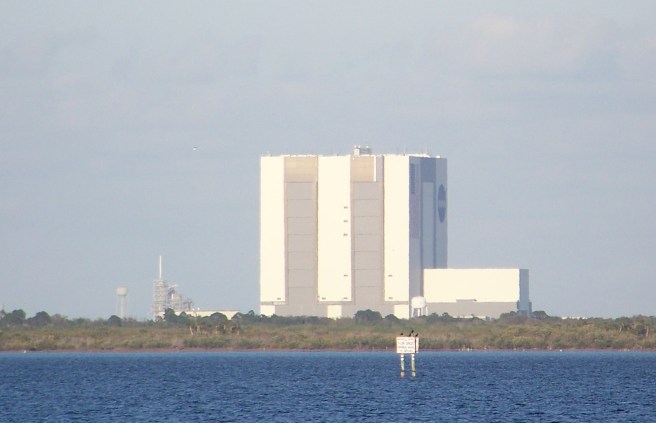
There were other boats all around; all gathered at a perfect vantage point to witness one of the last shuttle launches of the American space program. It felt like a block party. The day was calm and beautiful, and we had a “front-row seat” in a small cove a few miles east of Cape Canaveral with a clear view of Merritt Island and the Cape just beyond. We could see the busloads of tourists heading for viewing sites. The air of anticipation was palpable. Radios blasted the latest news as the minutes ticked down.

I remember the anticipation. I remember seeing the smoke; then hearing the sound; then FEELING the blast; in that order. Yes, even though we were cushioned by the water, we felt the earth tremble beneath us.

And then the shiny, slender white rocket rose steadily into the upside down bowl of blue sky to begin its journey into space.

Raw power of that sort is hard to describe. Words don’t do it justice.

Launch Day at Canaveral 058 (2)A moment in time

I remember the cheers. No one dared speak. Even breathing was difficult. All eyes, trained on binoculars or straining to focus through a camera lens, followed the arcing path over the Atlantic until the rockets and the shuttle were just a pinpoint with a trail of white that drifted back towards the home planet. It was gone in only minutes, but witnessing that launch was an experience not easily forgotten.

History was made that day. Discovery’s story was completed 12 days later, when it returned to Earth at Kennedy Space Center just before noon on March 9. Six men were on board that mission.

Between 1984 and 2011, Discovery flew a total of 39 missions, carried 252 crew members into space, launched the Hubble Telescope and, finally, was retired to the Smithsonian Institution where the public can view it. Discovery was the third of five shuttles built and the first to leave active service. Read more about Discovery’s last mission.

Space Shuttle Endeavor’s final launch was May 16, and Atlantis flew July 8 under the NASA designation STS 135, ending America’s shuttle program after 30 years.

The saga continues

I still look up at the sky. I still dream of traveling into space, although I know that, for me, it is only a dream. But for others .  . . . Let us not forget that the missions continue. The International Space Station orbits our Earth approximately every 90 minutes. You can look up and see it; or you can view your planet as the astronauts see it, in real time.

Note: My husband and I were liveaboard boaters at the time, traveling eastern U.S. waters on an almost three-year epic journey that took us from Florida north to Maine and the Canadian Maritimes, saw us in the Chesapeake and on the Potomac, in the Carolinas and Florida and the Bahamas, ending our journey finally in Mobile, Alabama, on the Gulf Coast. Our adventures on Gypsy Spirit, our 44-foot aft-cabin power vessel, were the stuff of dreams; we occasionally browse our log books to rekindle fond memories of those times.


SOS — Saving a Grand Old Ship

By Frederic Logghe [GFDL], via Wikimedia Commons

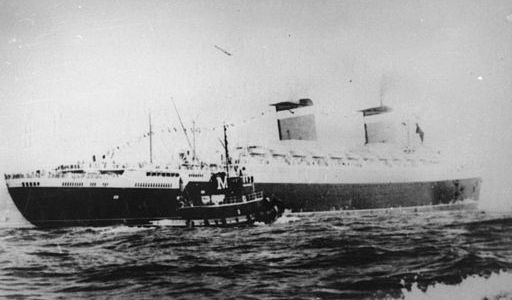
A long-ago time, and in faraway places, the S.S. United States was a bright and shining example of American ingenuity, achievement and spirit. She is still grand and imposing, but her shine has given way to age; her paint is peeling, her interiors are empty; she has suffered greatly from years of sitting still.

There are those of us who would dearly love to see her live on, to enjoy another incarnation so that present and future generations could be awed by the sight of her — her size, her beauty and her story.

But, I fear that is not to be.

Three news networks this week have told her story. Those who are desperately trying to save her say that the deadline is near – maybe less than two weeks away – when they will be forced to give up the fight. Rent alone at her dock costs $60,000 a month, and before Christmas this year, the money will have run out.

Susan Gibbs, executive director of the conservancy that is seeking a benefactor, says the end of October marks the deadline. After that, she notes, negotiations with a “responsible recycler” will begin. This is not a new development, but it is no less disturbing. The ship has faced the wrecking ball before. But she has, in the past, been granted a “stay.”

For Ms. Gibbs, it’s personal. She is the granddaughter of the ship’s designer, naval architect William Francis Gibbs.

It’s personal for me too.

In a very real sense, the U.S. United States was a matchmaker; she was the reason I met my future husband almost 50 years ago.

At that time, she had been called into service to help move American servicemen and their families out of Europe, and specifically to move them home from France. She was still carrying paying passengers as well, but in some cases, American military families made a five-day passage to New York aboard this swift liner. They ate in the elegant dining rooms, were served by impeccably uniformed staff, and experienced a lifestyle that only a few tourists of the time shared. Luxury ocean liner travel then was the domain, for the most part, of the rich and famous.

But when General DeGaulle of France decreed on March 10, 1966, that foreign military in his country must withdraw or submit to French control, a massive logistical effort began almost immediately to relocate military families. The one-year deadline loomed large; time was of the essence. Even though air travel could accommodate the humans, shipment of household goods and automobiles had to be by sea. At the time, utilizing available staterooms and the cavernous below-deck holds of this great ship made a lot of sense.

So it was that the paths of one young U.S. Army lieutenant and one young working journalist converged one day on a dock in Le Havre, France. He was newly-assigned to help meet the deadline, charged with the responsibility of scheduling military travel and moving belongings. I had a story to write about the huge effort.

No, it wasn’t romantic; we were not her passengers. But she loomed large on the docks in Le Havre as we looked along her more than three-football-fields length and up at her 12-stories above-the-water countenance.

Just a little more than one year later, when there were no military personnel left in France, it was largely due to the S.S. United States and the numbers of people and tons of belongings that she transported back to American shores.

Yes, she was impressive then.

She is still impressive now. Her peeling paint and her empty decks do not detract from her presence and her lines. She still looms larger than life, even though she has sat silent far longer than she ever plied the seas. She was in service only from 1952 through 1969, silenced when she was only 17.

My personal story continues with her. In another tale of endings, my parents considered themselves fortunate to be among her passengers on a scheduled North Atlantic crossing in November 1969. They enjoyed the experience immensely, and they disembarked in New York. The ship was bound for Newport News and a refurbishing “furlough,” but she never returned to service. My father thought it ironic, in his later years, that he had sailed on one of the last troop-carrying voyages of Cunard’s Queen Mary, as it ferried American servicemen home after World War II, as well as on the final crossing of the S.S. United States.

S.S. United States, Philadelphia, 2005

The rebirth of cruising vacations came too late.

Today, the irony is that more people than ever before take to the sea for vacations. Cruising ships have grown larger, accommodations more deluxe, and onboard amenities overwhelming. The S.S. United States was the last American-flagged passenger vessel afloat. She was also the largest ship ever to be built in the United States. She is substantial even by today’s standards, although her passenger load was not quite 2,000 in 692 staterooms, with a crew of just over 1,000. But, she had a distinctive look about her, with two stacks towering almost 65 feet above her decks. And she was fast. She remains the Blue Riband-Hales Trophy winner. She set the speed record for crossing the North Atlantic on her maiden voyage in 1952, snatching it away from the Queen Mary. It has not since been broken!

Both Cunard’s Queen Mary and the S.S. United States were known for elegance and speed. Both were designed for passenger comfort, but built to carry troops in case of need. Both served well. Both today are listed on the National Register of Historic Places.

View a slideshow of the S.S. United States.

There the similarities, unfortunately, end. The Queen Mary is now a popular hotel and tourist attraction in Long Beach, Calif. The S.S. United States rots at the dock in Philadelphia.

Surely, she too has value as a destination resort, a museum, an office building, a shopping center, or a funky condominium development. Or, am I just out of touch with reality?

As Susan Gibbs and others have stated in recent news interviews, “We have never been so close to saving her; and we have never been so close to losing her.” Save Our Ship (SOS) efforts are ongoing. But, hopes are beginning to fade.

I will continue to hope. Yes, it’s very personal.