
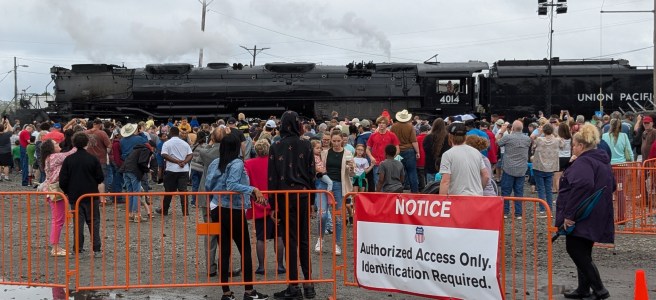
I made my way as close as possible to the railroad tracks earlier this month, as eager as children half my height, for a close-up view of Union Pacific’s “Big Boy” 4014 steam locomotive. It was at rest in the rail yard in North Little Rock, a scheduled stop along its 2024 Heartland of America Tour. The route takes it through nine states, with “whistle stops” in more than three dozen different communities. You might also see it passing through the countryside, but visitors are admonished to stay “at least 25 feet back” as the massive locomotive travels along the rails. View the route and tentative schedule.

This relic from the glory days of transcontinental railroad commerce and loaded freight trains is the last operating steam locomotive of 25 built between 1941 and 1944 for the Union Pacific Railroad.
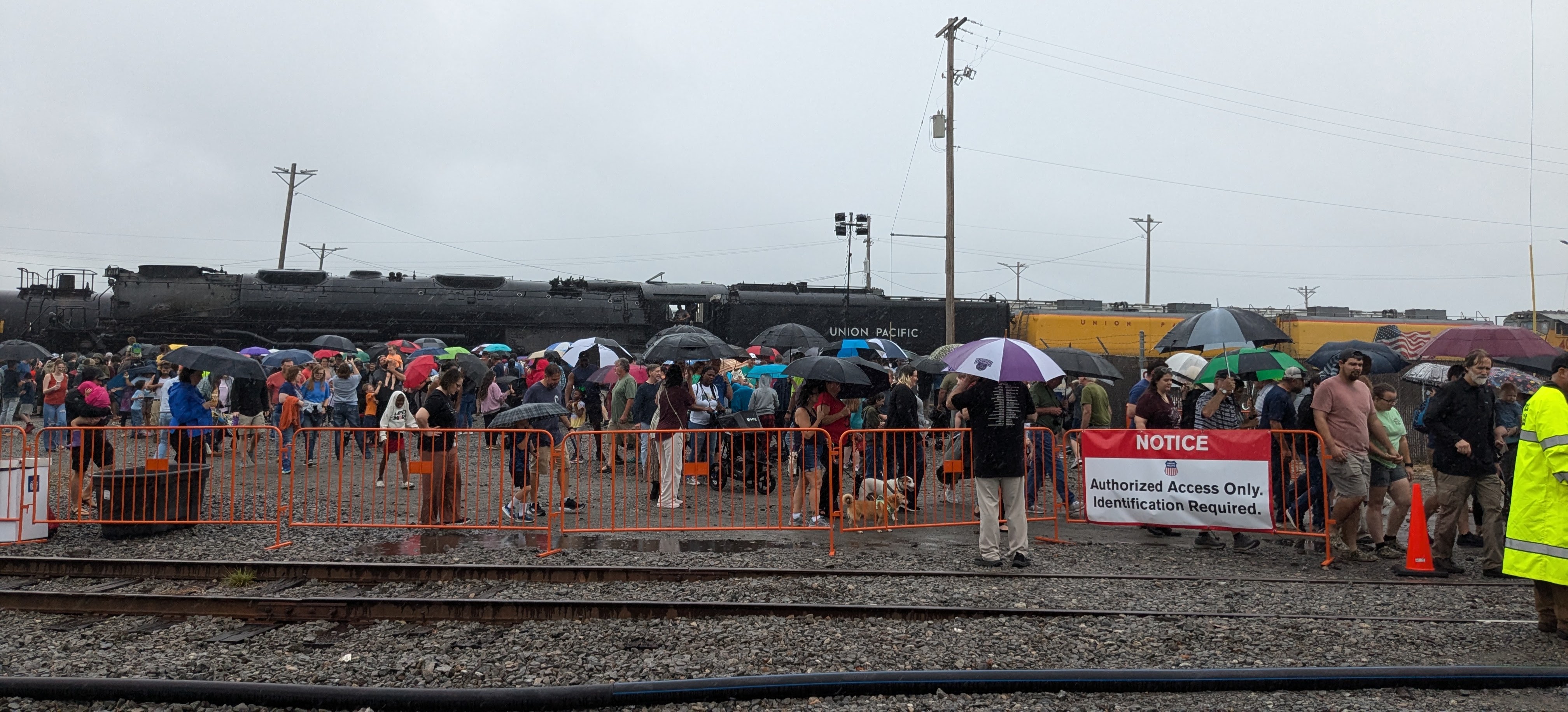
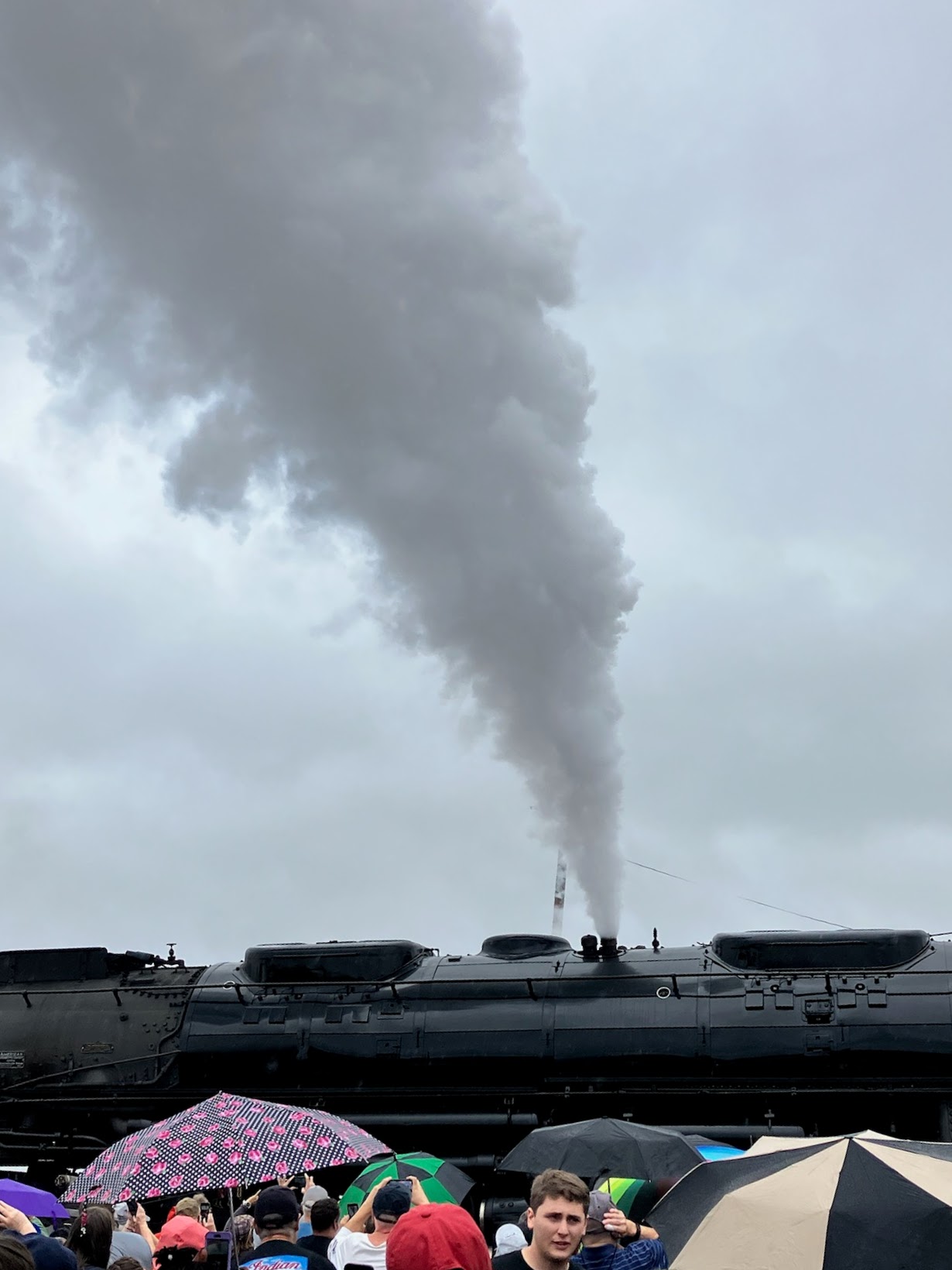
The public was invited to view the glistening black behemoth from 5 to 7 p.m. on September 15, during an overnight visit to one of the railroad company’s major modern servicing facilities. The facility is busy 24 hours a day, sorting freight cars that arrive and depart from across the country. It was a cloudy, grey afternoon, but hundreds of people, young and old alike, turned out to see the historic steam locomotive. The round-trip “rolling tour” began August 28 in Cheyenne, Wyoming, and will end back in Cheyenne in late October.
Some visitors parked blocks away, but a walk over uneven gravel and through a sea of mud puddles did not dampen their enthusiasm. Even the unrelenting drizzle was just a minor annoyance. Ed Dickens, senior manager of Union Pacific Heritage Operations, is the locomotive’s chief engineer for the tour. From all appearances, he was having as much fun as the viewers, waving to children and snapping his own photos of the crowd. Occasionally, he sounded the mournful whistle, and laughed as young children covered their ears.
People of all ages stood transfixed, the younger ones beside me pushing against the barricades. Many of them had probably never before been close enough to even wave at a train. There were aging men and women with canes and walkers, and others in wheelchairs. A layer of colorful umbrellas formed a spotty canopy above the heads of the crowd. Children sporting hoodies and ear-to-ear smiles clasped grown-up hands, and toddlers perched expectantly on their fathers’ shoulders.

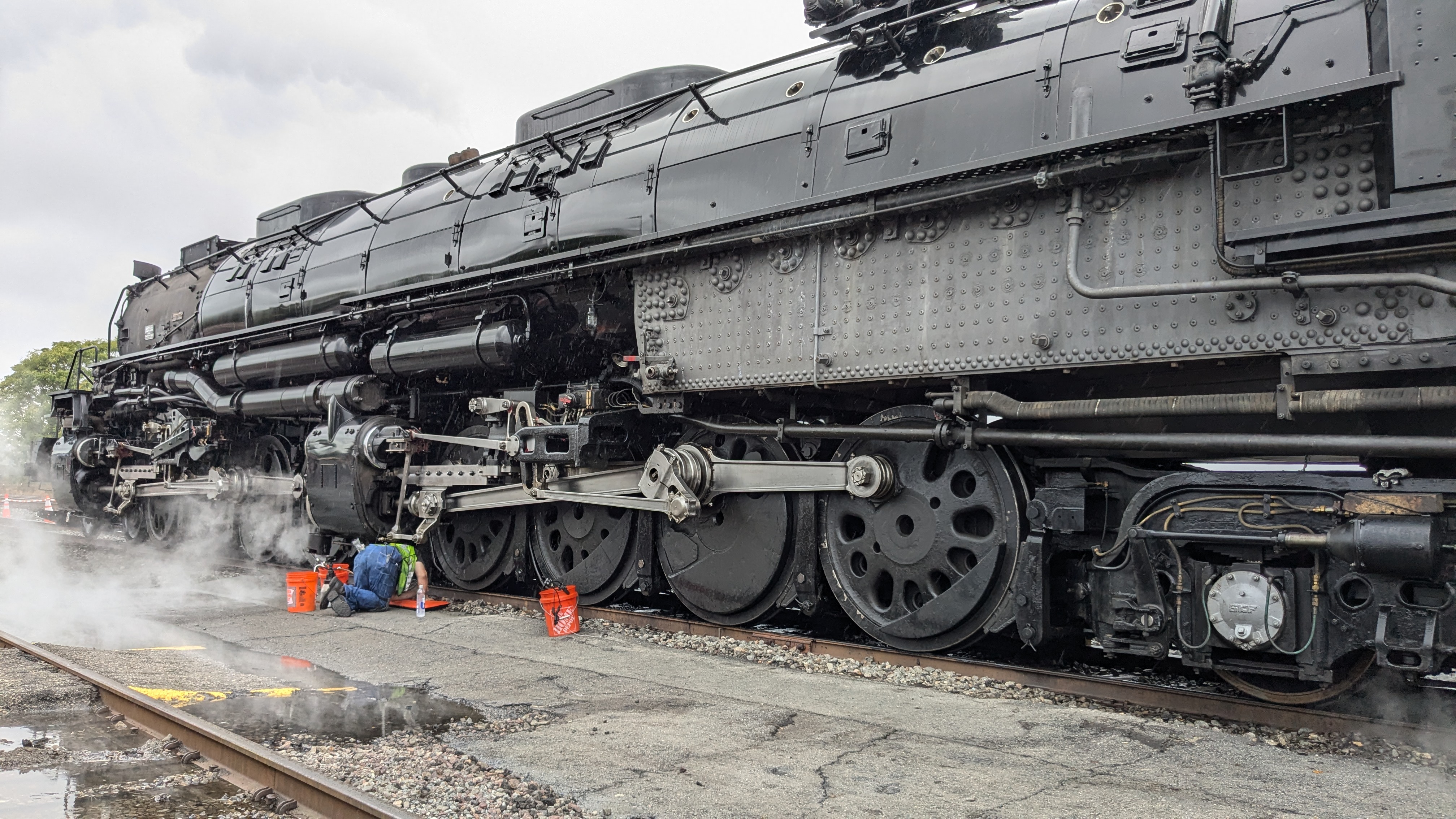
A service crew was busy at work, even as raindrops continued to fall. The engine belched billows of steam into the sky and more steam drifted between the wheels along its underbelly.
A Return to Days Long Gone
Some of us who grew up watching freight trains rumble through small towns still love the “choo-choo” sounds of the wheels as much as the “melodies” of the whistles. Note: This recording is a blast of the whistle on another steam locomotive in Union Pacific’s Heritage Fleet, Number 844, the only one never to be officially “retired” from active service. Smaller than the Big Boy, it is used to pull expedition trains from its home base at the Union Pacific Museum in Council Bluffs, Iowa.
I have numerous train-related memories. My husband, who grew up in Maine, remembers placing pennies on railroad tracks near a rented summer beach house, waiting for a train to pass, and then retrieving the flattened, elongated pieces of copper.
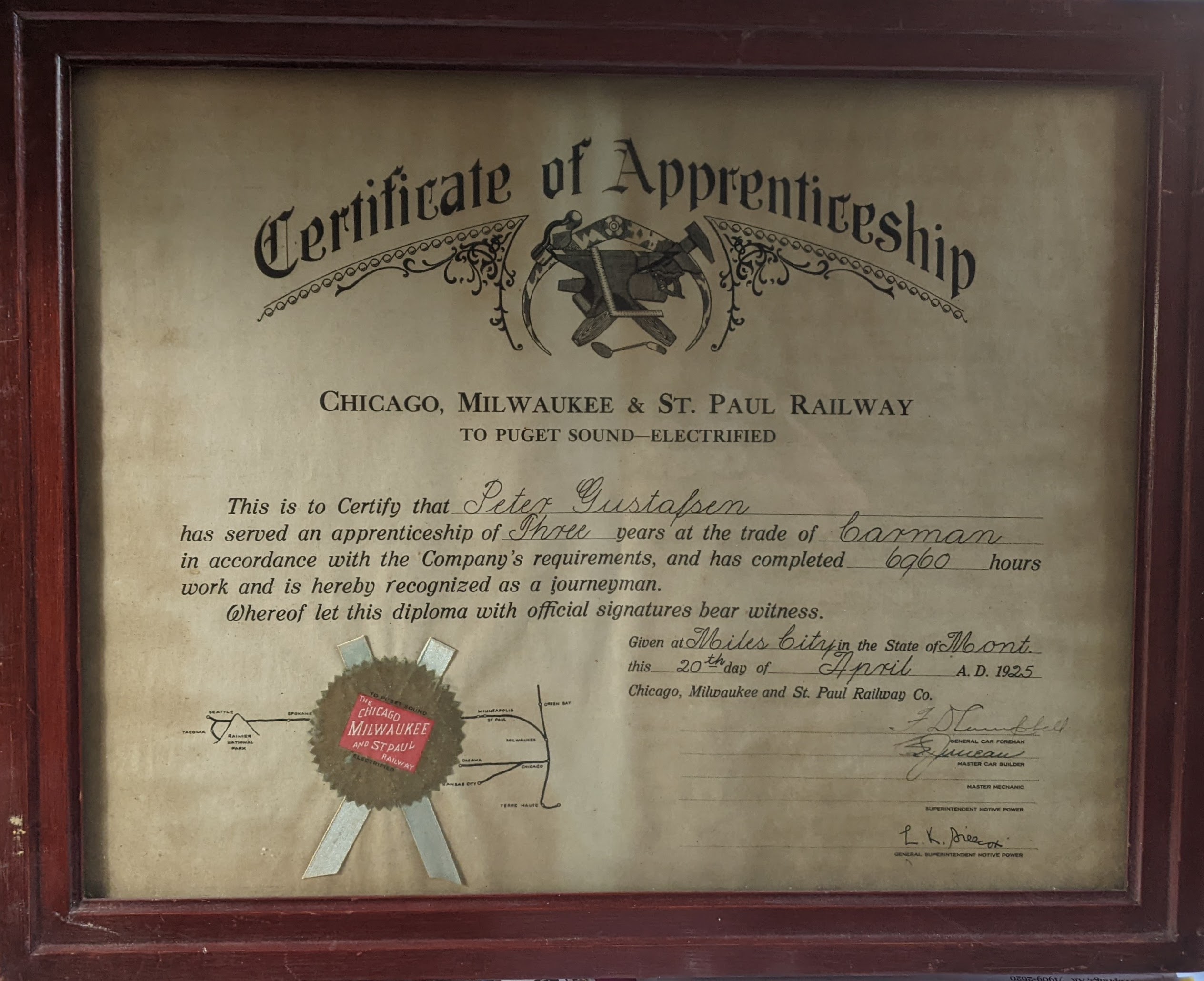
One of my grandfathers completed a three-year apprenticeship as carman for the Chicago, Milwaukee & St. Paul Railway Co., to “Puget Sound—Electrified” in April 1925. Today that certificate hangs on my office wall, along with a photo of yet another early steam locomotive. I confess that I still wave at trains, although I typically don’t expect a return wave from the engineer. Sadly, the brakemen on those cabooses of long ago have also now disappeared. Most trains no longer even have a caboose; they have been replaced by electronic small-box sensors.
I remember passenger trains as well as long-haul freight trains, and I sometimes yearn for those days of “slow travel,” observation cars, and meals served by white-gloved waiters in dining cars with linen tablecloths and distinctive china, silver, and sturdy glassware. Seeing this locomotive, the last and largest of its type still in use anywhere in the world, represents a step back into much-loved childhood memories for me.
The trains that now speed along tracks adjacent to the nation’s highways no longer have the same appeal, but freight trains still serve the needs of modern commerce and transport our country’s freight. The market is expected to reach $400 billion in 2024, with growth to more than $510 billion by 2029. There is also a growing resurgence in railroad tourism in some parts of the United States, and travel by high-speed rail in other countries is increasingly popular.
Saved from the Scrapheap
The Big Boy is the largest articulated steam locomotive ever constructed, and it was designed specifically to pull heavy loads over the steep grades of the Wasatch Mountains in Utah. Constructed by American Locomotive Company, with development input from Union Pacific, the Big Boy was designed to handle heavy freight loads, conquer the mountain grades of the routes through western mountain states, do it all at a reliable speed with no need for an auxiliary engine, and deliver the goods to western destinations on schedule.
Twenty were delivered to Union Pacific and placed in service in 1941, largely in support of the second world war effort. Another five were delivered in 1944, but the last of the Big Boys was pulled from service by 1962. Number 4014 completed its last revenue run in July 1959, and was officially retired in December 1961 after 17 years of active service, exactly 20 years after its first run.
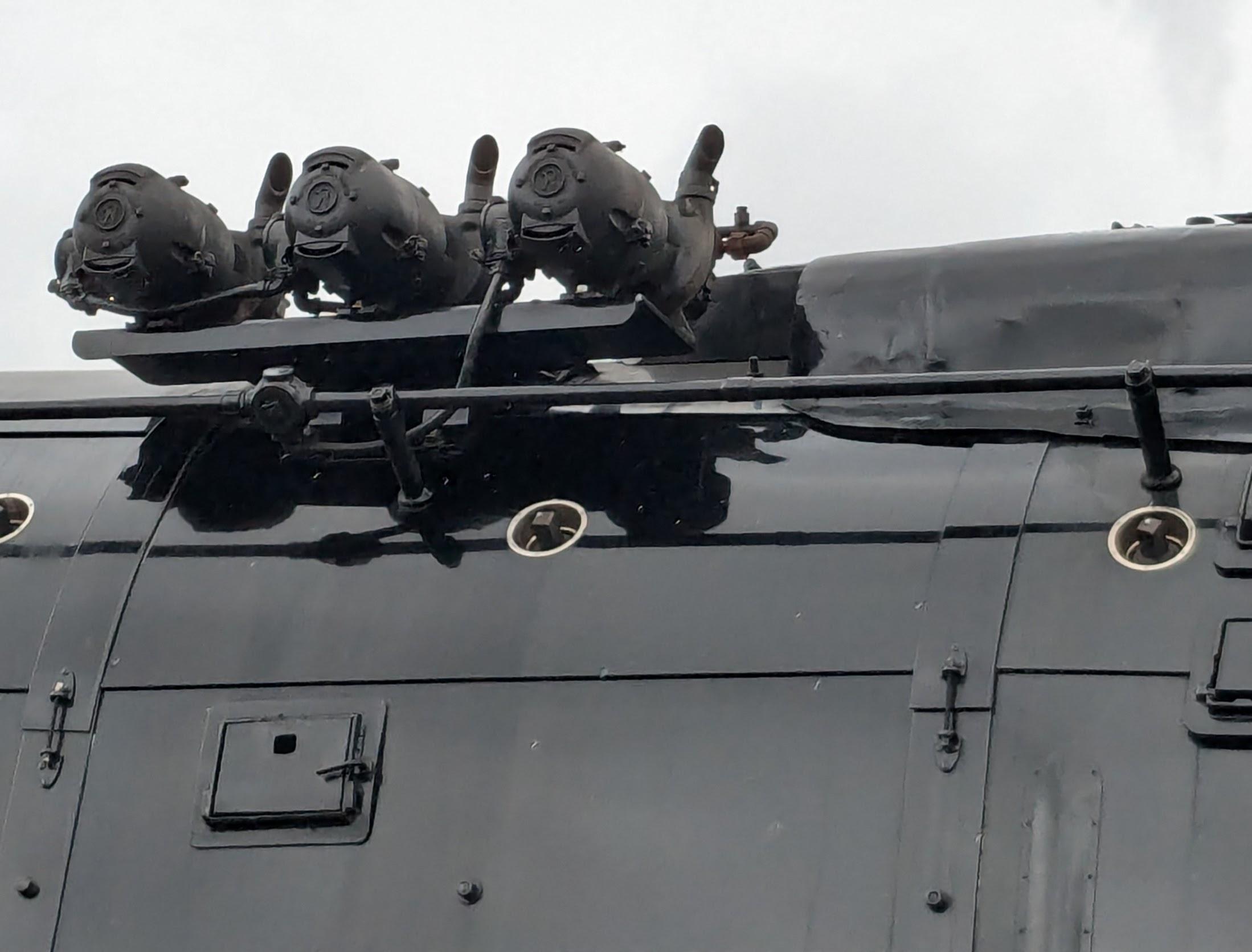
Union Pacific launched a five-year-long restoration of Big Boy 4014 when the company reacquired it from a museum in California in 2013. The locomotive was moved from southern California to Cheyenne, where it sat idle for nearly two years as plans were completed for its restoration. Not only did the facility require expansion and updating to accommodate the Big Boy, but the locomotive had to be totally disassembled. In some cases, new parts were fabricated, and it was converted from coal to run on more efficient, less expensive diesel fuel.
Otherwise, however, the locomotive has been restored to its original design and configuration.
In the spring of 2019, a test-firing was successful, and Number 4014 moved “under its own power” for the first time in nearly 60 years. The revitalized Big Boy locomotive made a first test run the next evening from Cheyenne to Nunn, Colorado.


The rest, as they say, is history. And now, the public can share that history on annual runs that typically attract thousands all along the designated routes.
When the restoration was complete in 2019, Big Boy 4014 embarked on an inaugural tour to commemorate the 150th anniversary of the Transcontinental Railroad’s completion. The locomotive was then placed in excursion service as a member of the Union Pacific Heritage Fleet. Today, it is said to be Union Pacific’s primary public relations tool. Earlier this year, the locomotive completed a “Westward Bound” tour to California, passing through five states and culminating with an excursion for paying guests. Such special events help underwrite the railroad’s museum operation.
Who Cares about an Old Steam Engine?
Although Big Boy locomotives were said to be capable of speeds up to 80 miles per hour, there is no confirmation that they ever actually traveled that fast. They typically ran well under 60 mph, often chugging along at a much lower speed, but they did so reliably and consistently for nearly two decades.
Many of them traveled a million miles or more. Number 4014 logged 1,031,205 miles during its years in service. Astoundingly, the Big Boy locomotive is nearly 133 feet in length and weighs 1.2 million pounds. The primary advantage was its power. It is still robust and, for all its size and power, it is able to maneuver mountain curves because it is articulated, or “hinged” at strategic points.

This is no ordinary engine. And a lot of people care. I have fond memories of traveling by train both in this country and abroad, but the passenger trains I remember, with their sleek diesel engines, are a totally different breed from the steam locomotives that served as the iconic workhorses of the railroads.
Big Boy 4014 is the only one of 25 built that is still in operation. And it is the largest operational steam locomotive in the world today.
Ed Dickens of the train’s crew notes that the locomotive, with a weight of approximately 600 tons, “runs like a Swiss watch,” even though it can easily pull a train five miles long on flat ground. He says that it was designed to be simple to operate, adding that “you drive by the seat of your pants – you smell the brakes,” and the crew becomes familiar with the sounds.
If you’re interested in learning more about Big Boy 4014, and the history of the steam engine era, tune in to this episode of Jay Leno’s Garage on You Tube. You’ll love it!
Finally, if you’re interested in seeing Big Boy 4014, its home base is in Cheyenne, Wyoming, when it’s not on tour. Other Big Boy locomotives can be viewed in Denver CO, St. Louis MO, Scranton PA, Green Bay WI, Frisco TX, and Omaha NE, just across the river from the Union Pacific Railroad Museum in Council Bluffs, Iowa. If you’re a fan of old trains, though, and you go to Council Bluffs, plan to spend the better part of a day there. And you’ll leave wanting to return.
 Good Food and Faraway Places