We had invited an assortment of neighbors and friends to join us for a potluck get-together at our home last Sunday — Easter Sunday — and they all arrived promptly at the appointed time.
The sky was grey, but it did not seem threatening at that moment.
Darkening gray clouds had not dampened spirits in the slightest as our group of 12 assembled. However, dinner was destined to be delayed as the existing tornado watch was upgraded to multiple tornado warnings for our area, including the Hot Springs, Arkansas, area and the Village we call home.
At that time, Hot Springs Village was not included in the “take cover” area. But that changed before long.
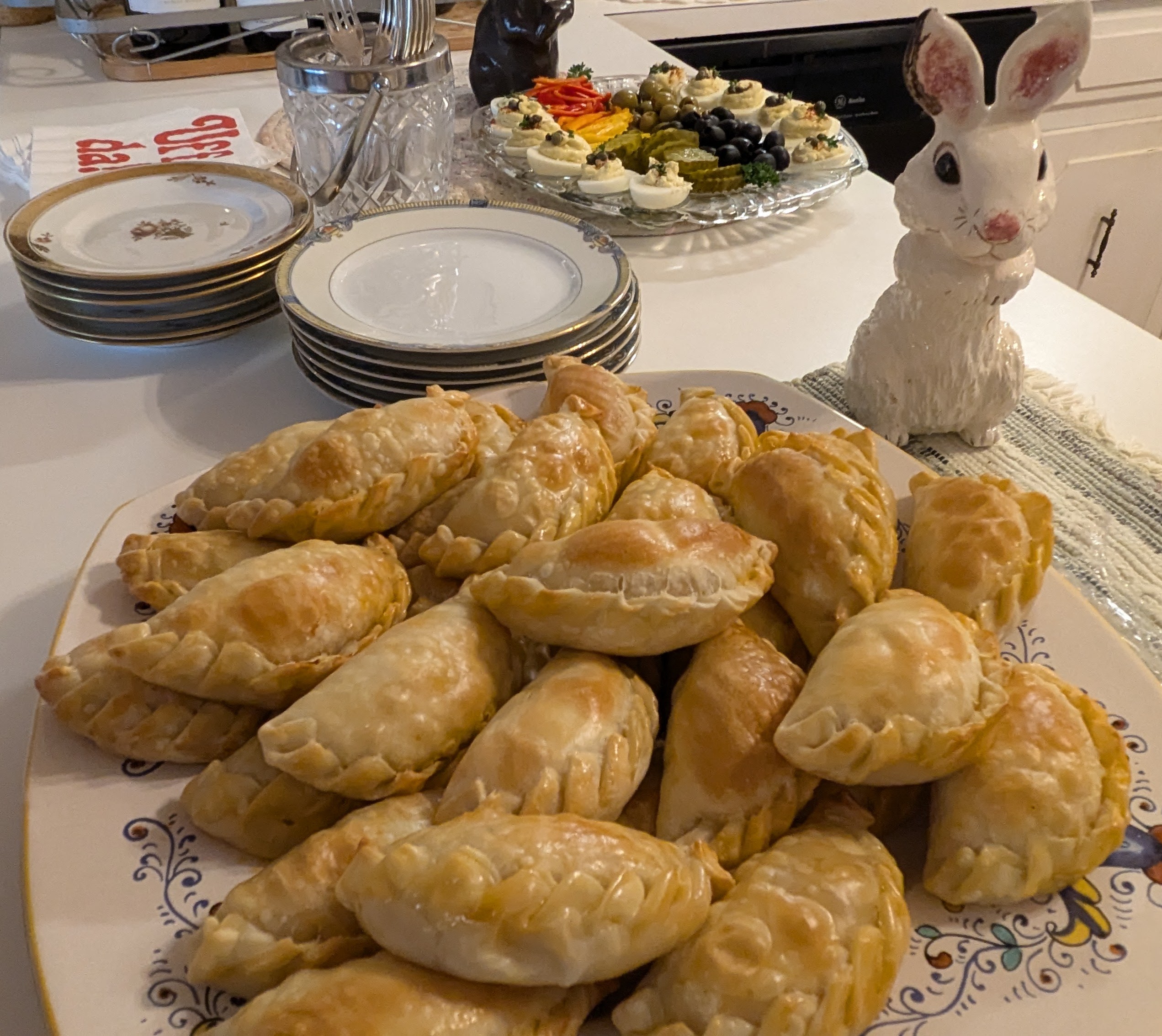
With celebratory glasses of champagne or wine in hand, and a buffet well-stocked with hors d’oeuvres, we resolved to delay serving dinner until the severe threat had passed. Conversation was lively, and the appetizers alone could have served as our meal. We kept a watch on outdoor conditions and listened to the continuing weather updates, while sampling Argentine empanadas, deviled eggs, salmon-topped cucumber slices, toast points topped with savory olive tapenade, and an assortment of pickles, olives, and peppers.
Great appetizers kept us company during the storm watch.Our friends and neighbors are creative chefs.
We all knew there was more food to come, but somehow the worsening weather spiked our appetites.
The screen was ablaze with red and yellow blobs of color in our viewing area. Place names seemed eerily close and familiar, but the sky was still light, the air was calm, and no rain was falling. However, the weather forecaster repeatedly recommended that area residents take shelter.
The warnings kept us all informed of the storm’s progression through our area.
The 12 adults gathered in my living room and screened porch looked questioningly at me and my husband as the wind picked up and raindrops began to fall. Together, we explained to our guests that getting to our “safe place,” a room we use strictly for storage, involved going outside and walking down an incline that becomes treacherous in the rain. It is definitely not a place of comfort. It has no television, and it has a large window.
We had no intention to gathering in our designated “safe room” with plates filled with game hens, wild rice, peas and carrots, and fresh-from-the-oven homemade rolls. Instead, we gathered loosely around the television, and continued to catch up on one another’s lives and activities since we had last been together.
The consensus was to remain where we were, closely watching the TV coverage, monitoring our phones for the latest information, and enjoying our holiday get-together. We agreed that, should a confirmed tornado veer in our direction, we would all gather in the single interior room in our home, the guest bathroom.
It’s adjacent to a concrete block fireplace wall and chimney, has no windows, is fortified by plumbing pipes and drain lines, and boasts at least two walls in every direction between the interior and the outdoors.
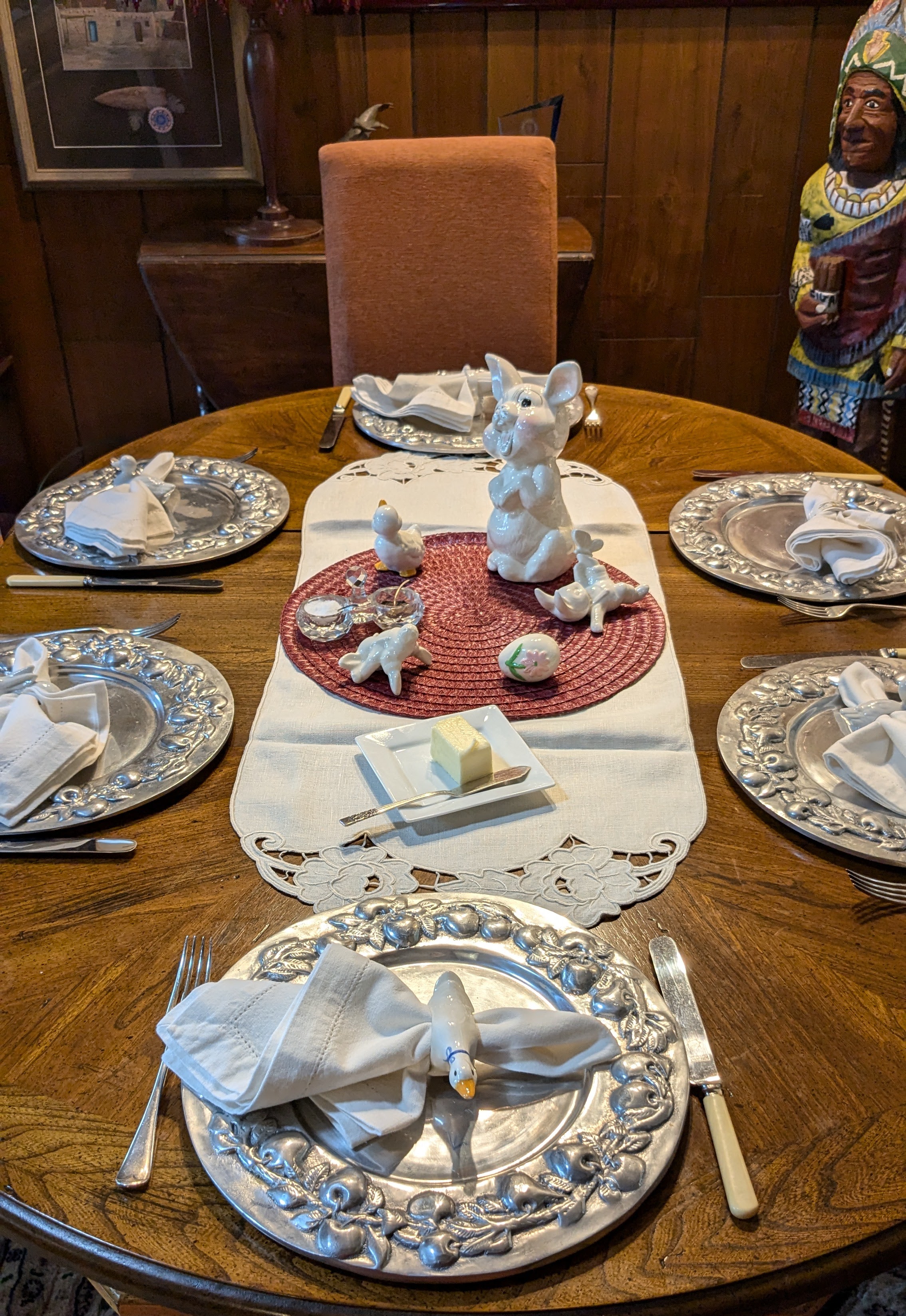
The settings, complete with bunnies and chicks, invited conversation.Our Easter tables were upscale, but also playful.
Once or twice, 12 cell phones served up a cacophony of high-pitched weather alerts along and the concerned faces of our local news station weather forecasters filled the television screen. Weather alerts continued to preempt the scheduled golf coverage on television.
As the minutes ticked by, we all remained comfortable, albeit watchful; some surveying the clouds and breathing in the fresh odor of falling rain. The assortment of appetizers continued to disappear, wine glasses were refilled, and interesting conversation flowed non-stop.
When the tornado threat was deemed to be beyond our geographic area, we drank another toast to friendship and fine food, moving to take our places at tables adorned with ceramic bunnies and white linen napkins, a casually elegant setting combined with a playful sense of humor.
We enjoyed our dinner, with a sense of camaraderie and thankfulness.
We could, at last, give thanks for the holiday celebration — and for the friendships — that are anything but ordinary. This year has already brought our state, and the entire nation, repeated weather events that have been far from ordinary. We will hope that as spring moves into summer, weather patterns calm and we can enjoy the beauty of the seasons to come.
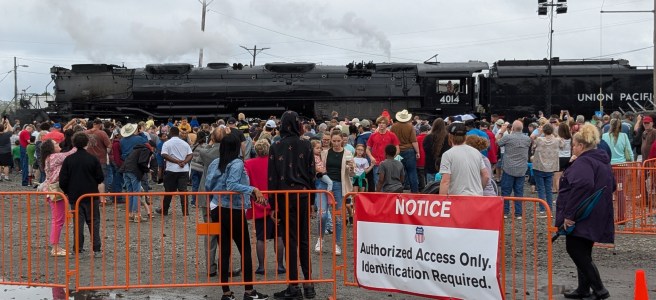
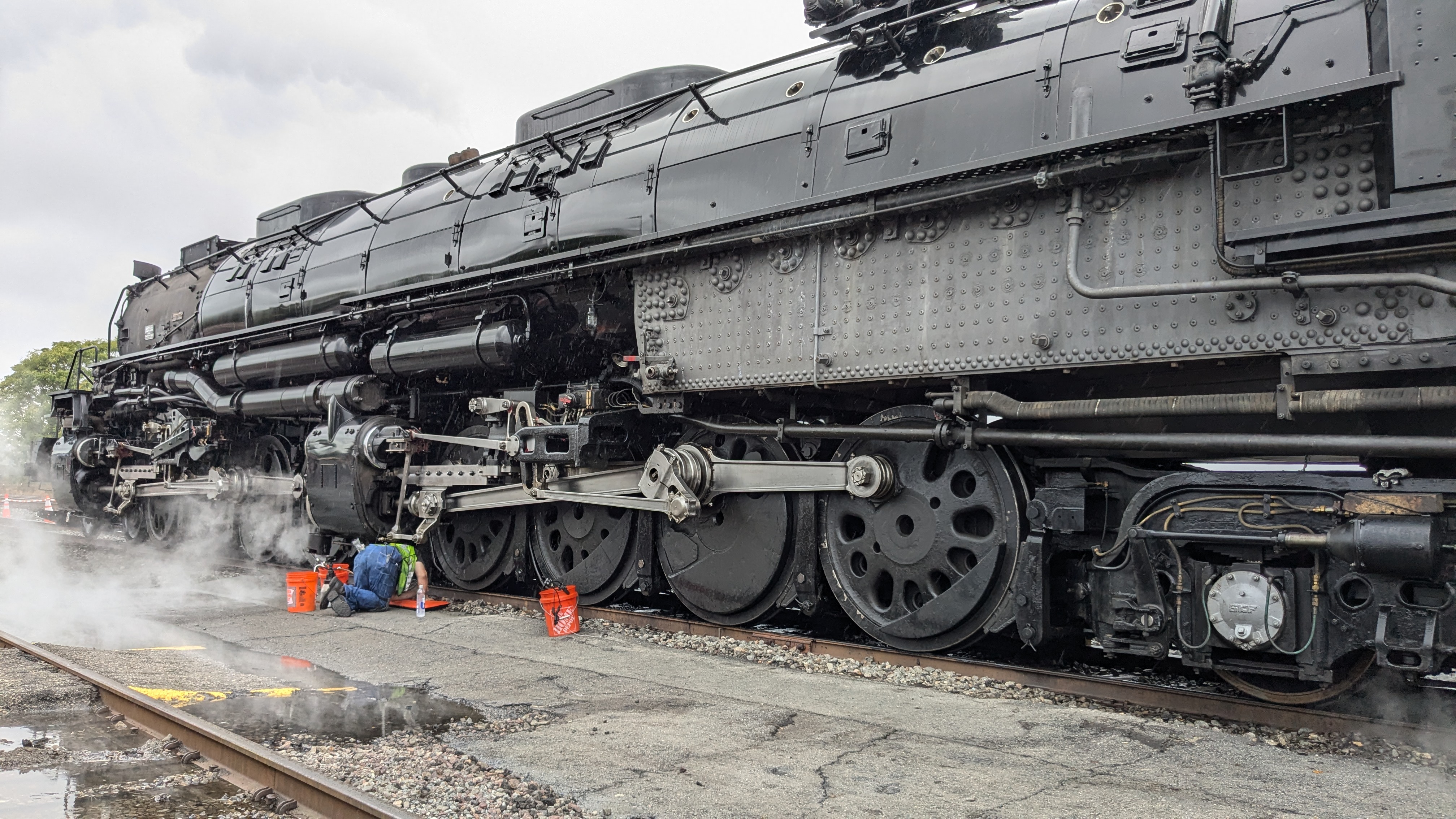
I made my way as close as possible to the railroad tracks earlier this month, as eager as children half my height, for a close-up view of Union Pacific’s “Big Boy” 4014 steam locomotive. It was at rest in the rail yard in North Little Rock, a scheduled stop along its 2024 Heartland of America Tour. The route takes it through nine states, with “whistle stops” in more than three dozen different communities. You might also see it passing through the countryside, but visitors are admonished to stay “at least 25 feet back” as the massive locomotive travels along the rails. View the route and tentative schedule.
This relic from the glory days of transcontinental railroad commerce and loaded freight trains is the last operating steam locomotive of 25 built between 1941 and 1944 for the Union Pacific Railroad.
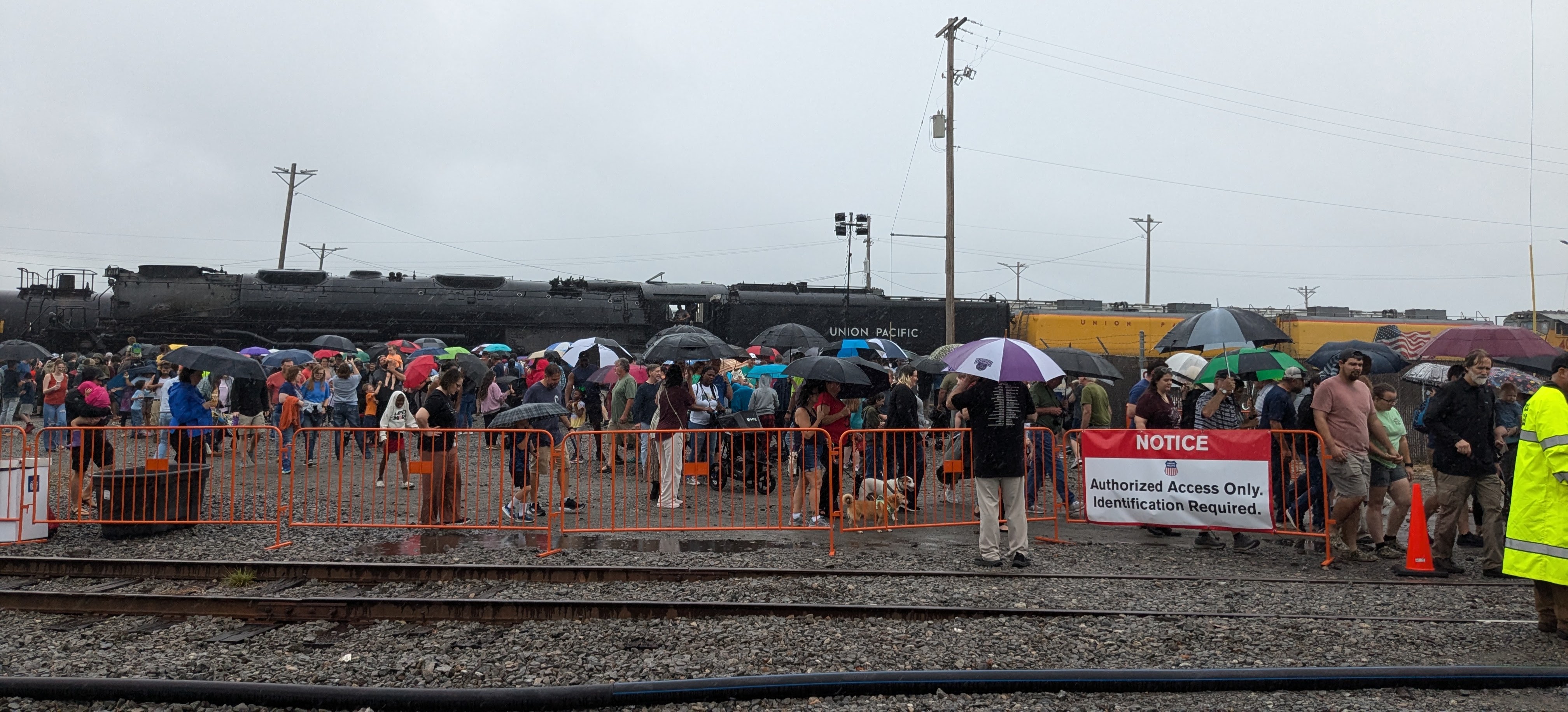
The public was invited to view the glistening black behemoth from 5 to 7 p.m. on September 15, during an overnight visit to one of the railroad company’s major modern servicing facilities. The facility is busy 24 hours a day, sorting freight cars that arrive and depart from across the country. It was a cloudy, grey afternoon, but hundreds of people, young and old alike, turned out to see the historic steam locomotive. The round-trip “rolling tour” began August 28 in Cheyenne, Wyoming, and will end back in Cheyenne in late October.
Some visitors parked blocks away, but a walk over uneven gravel and through a sea of mud puddles did not dampen their enthusiasm. Even the unrelenting drizzle was just a minor annoyance. Ed Dickens, senior manager of Union Pacific Heritage Operations, is the locomotive’s chief engineer for the tour. From all appearances, he was having as much fun as the viewers, waving to children and snapping his own photos of the crowd. Occasionally, he sounded the mournful whistle, and laughed as young children covered their ears.
People of all ages stood transfixed, the younger ones beside me pushing against the barricades. Many of them had probably never before been close enough to even wave at a train. There were aging men and women with canes and walkers, and others in wheelchairs. A layer of colorful umbrellas formed a spotty canopy above the heads of the crowd. Children sporting hoodies and ear-to-ear smiles clasped grown-up hands, and toddlers perched expectantly on their fathers’ shoulders.
A service crew was busy at work, even as raindrops continued to fall. The engine belched billows of steam into the sky and more steam drifted between the wheels along its underbelly.
A Return to Days Long Gone
Some of us who grew up watching freight trains rumble through small towns still love the “choo-choo” sounds of the wheels as much as the “melodies” of the whistles. Note: This recording is a blast of the whistle on another steam locomotive in Union Pacific’s Heritage Fleet, Number 844, the only one never to be officially “retired” from active service. Smaller than the Big Boy, it is used to pull expedition trains from its home base at the Union Pacific Museum in Council Bluffs, Iowa.
I have numerous train-related memories. My husband, who grew up in Maine, remembers placing pennies on railroad tracks near a rented summer beach house, waiting for a train to pass, and then retrieving the flattened, elongated pieces of copper.
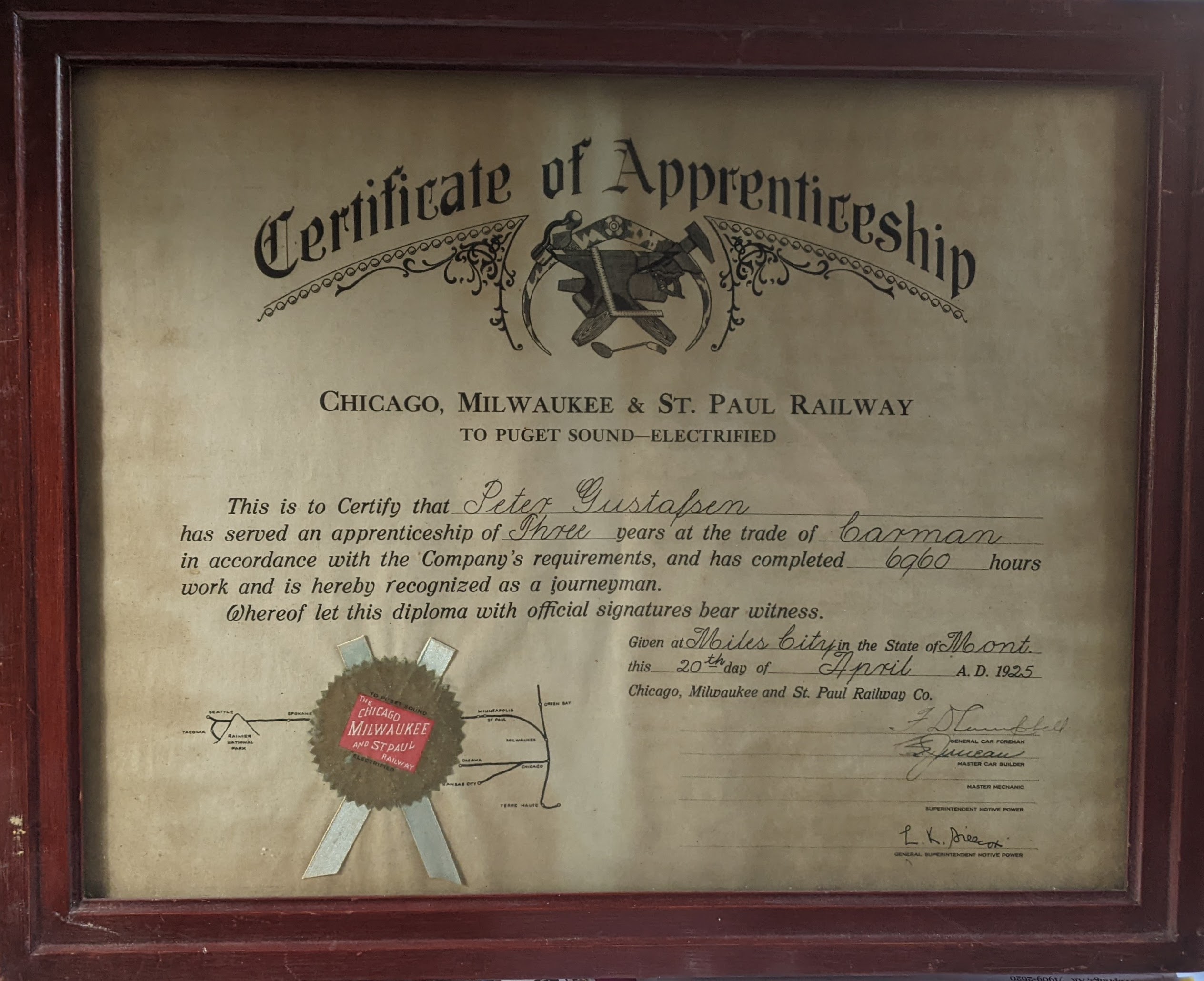
One of my grandfathers completed a three-year apprenticeship as carman for the Chicago, Milwaukee & St. Paul Railway Co., to “Puget Sound—Electrified” in April 1925. Today that certificate hangs on my office wall, along with a photo of yet another early steam locomotive. I confess that I still wave at trains, although I typically don’t expect a return wave from the engineer. Sadly, the brakemen on those cabooses of long ago have also now disappeared. Most trains no longer even have a caboose; they have been replaced by electronic small-box sensors.
I remember passenger trains as well as long-haul freight trains, and I sometimes yearn for those days of “slow travel,” observation cars, and meals served by white-gloved waiters in dining cars with linen tablecloths and distinctive china, silver, and sturdy glassware. Seeing this locomotive, the last and largest of its type still in use anywhere in the world, represents a step back into much-loved childhood memories for me.
The trains that now speed along tracks adjacent to the nation’s highways no longer have the same appeal, but freight trains still serve the needs of modern commerce and transport our country’s freight. The market is expected to reach $400 billion in 2024, with growth to more than $510 billion by 2029. There is also a growing resurgence in railroad tourism in some parts of the United States, and travel by high-speed rail in other countries is increasingly popular.
Saved from the Scrapheap
The Big Boy is the largest articulated steam locomotive ever constructed, and it was designed specifically to pull heavy loads over the steep grades of the Wasatch Mountains in Utah. Constructed by American Locomotive Company, with development input from Union Pacific, the Big Boy was designed to handle heavy freight loads, conquer the mountain grades of the routes through western mountain states, do it all at a reliable speed with no need for an auxiliary engine, and deliver the goods to western destinations on schedule.
Twenty were delivered to Union Pacific and placed in service in 1941, largely in support of the second world war effort. Another five were delivered in 1944, but the last of the Big Boys was pulled from service by 1962. Number 4014 completed its last revenue run in July 1959, and was officially retired in December 1961 after 17 years of active service, exactly 20 years after its first run.
Union Pacific launched a five-year-long restoration of Big Boy 4014 when the company reacquired it from a museum in California in 2013. The locomotive was moved from southern California to Cheyenne, where it sat idle for nearly two years as plans were completed for its restoration. Not only did the facility require expansion and updating to accommodate the Big Boy, but the locomotive had to be totally disassembled. In some cases, new parts were fabricated, and it was converted from coal to run on more efficient, less expensive diesel fuel.
Otherwise, however, the locomotive has been restored to its original design and configuration.
In the spring of 2019, a test-firing was successful, and Number 4014 moved “under its own power” for the first time in nearly 60 years. The revitalized Big Boy locomotive made a first test run the next evening from Cheyenne to Nunn, Colorado.
The rest, as they say, is history. And now, the public can share that history on annual runs that typically attract thousands all along the designated routes.
When the restoration was complete in 2019, Big Boy 4014 embarked on an inaugural tour to commemorate the 150th anniversary of the Transcontinental Railroad’s completion. The locomotive was then placed in excursion service as a member of the Union Pacific Heritage Fleet. Today, it is said to be Union Pacific’s primary public relations tool. Earlier this year, the locomotive completed a “Westward Bound” tour to California, passing through five states and culminating with an excursion for paying guests. Such special events help underwrite therailroad’s museum operation.
Who Cares about an Old Steam Engine?
Although Big Boy locomotives were said to be capable of speeds up to 80 miles per hour, there is no confirmation that they ever actually traveled that fast. They typically ran well under 60 mph, often chugging along at a much lower speed, but they did so reliably and consistently for nearly two decades.
Many of them traveled a million miles or more. Number 4014 logged 1,031,205 miles during its years in service. Astoundingly, the Big Boy locomotive is nearly 133 feet in length and weighs 1.2 million pounds. The primary advantage was its power. It is still robust and, for all its size and power, it is able to maneuver mountain curves because it is articulated, or “hinged” at strategic points.
This is no ordinary engine. And a lot of people care. I have fond memories of traveling by train both in this country and abroad, but the passenger trains I remember, with their sleek diesel engines, are a totally different breed from the steam locomotives that served as the iconic workhorses of the railroads.
Big Boy 4014 is the only one of 25 built that is still in operation. And it is the largest operational steam locomotive in the world today.
Ed Dickens of the train’s crew notes that the locomotive, with a weight of approximately 600 tons, “runs like a Swiss watch,” even though it can easily pull a train five miles long on flat ground. He says that it was designed to be simple to operate, adding that “you drive by the seat of your pants – you smell the brakes,” and the crew becomes familiar with the sounds.
If you’re interested in learning more about Big Boy 4014, and the history of the steam engine era, tune in to this episode of Jay Leno’s Garage on You Tube. You’ll love it!
Finally, if you’re interested in seeing Big Boy 4014, its home base is in Cheyenne, Wyoming, when it’s not on tour. Other Big Boy locomotives can be viewed in Denver CO, St. Louis MO, Scranton PA, Green Bay WI, Frisco TX, and Omaha NE, just across the river from the Union Pacific Railroad Museum in Council Bluffs, Iowa. If you’re a fan of old trains, though, and you go to Council Bluffs, plan to spend the better part of a day there. And you’ll leave wanting to return.
It has been more than a decade since I lived in Santa Fe. But it’s a city one cannot easily forget. In many ways, it’s a city that I will always miss. I fell in love with Santa Fe the first time I visited, about 1975, and I still cherish the years that I lived and worked there.
Long described by both residents and visitors as “The City Different,” Santa Fe was known by its earliest inhabitants as “The Dancing Ground of the Sun.” Those of us who arrived to become new residents when it was still a relatively small town were attracted by its culture, its lifestyle, the spectacular sunsets, and the people. We were mesmerized by the changing seasons, the landscape, the diversity, and by city’s traditions and timeless quality. We hoped it would remain so forever.
But change is inevitable, and Santa Fe’s growth and growing popularity prompted many changes, some of them good and some not so well received. Over a span of nearly 20 years, the population grew by more than 20,000, with new residents from every state and many other countries. No longer was it a quaint New Mexico town with a predominantly Hispanic and Native American population. It became much more cosmopolitan, and more complex.
Prices increased, of course, not only for housing, but for all goods and services. New businesses opened, and new philosophies of growth, development, and government were born. Tourism thrived, and Santa Fe became an increasingly popular destination. Some “old-timers” feared then that Santa Fe would lose its appeal and become “not so different” from other prominent tourist destinations around the world.
Change and Growth Are Not Always Negative
Recently, my husband and I revisited Santa Fe. Our time was limited, but we made the most of the opportunity to see old friends, neighbors and business associates. We found, happily, that Santa Fe’s charm has not been diminished. The opposite is true.
Surprises still exist seemingly around every corner. Some of our favorite restaurants and old “haunts” have disappeared, but many are still there. New ones have opened and become popular, adding a new dimension. Annual celebrations and the festivals that we loved so much are still on the calendar — Summer’s Wine and Chile Festival, the traditional Spanish and Indian Markets, and the annual burning of Zozobra. This year marked the 72nd year of Spanish Market in July, and more than 1,000 artists from 200 tribes were featured at the 102nd Indian Market, held mid-August. But now, there are festivals and markets year round. The Holiday Folk Art Market complements summer’s International Folk Art Market, and popular Artists Markets are held near the Railyard Saturdays from May through December.
We found a large and lively market with fresh vegetables and crafts, much to our delight, when we visited, and our friends touted the appeal of new galleries, Meow Wolf, local pubs and breweries, and additional public art installations.
Historic buildings, parks, galleries, and art dominate the Santa Fe scene. New streets and highways make it easier to get around — and to get lost. We thought it would be easy to revisit our favorite places. Time and memory seem to have altered our perceptions. We found it difficult at times to even navigate to the addresses we once called home.
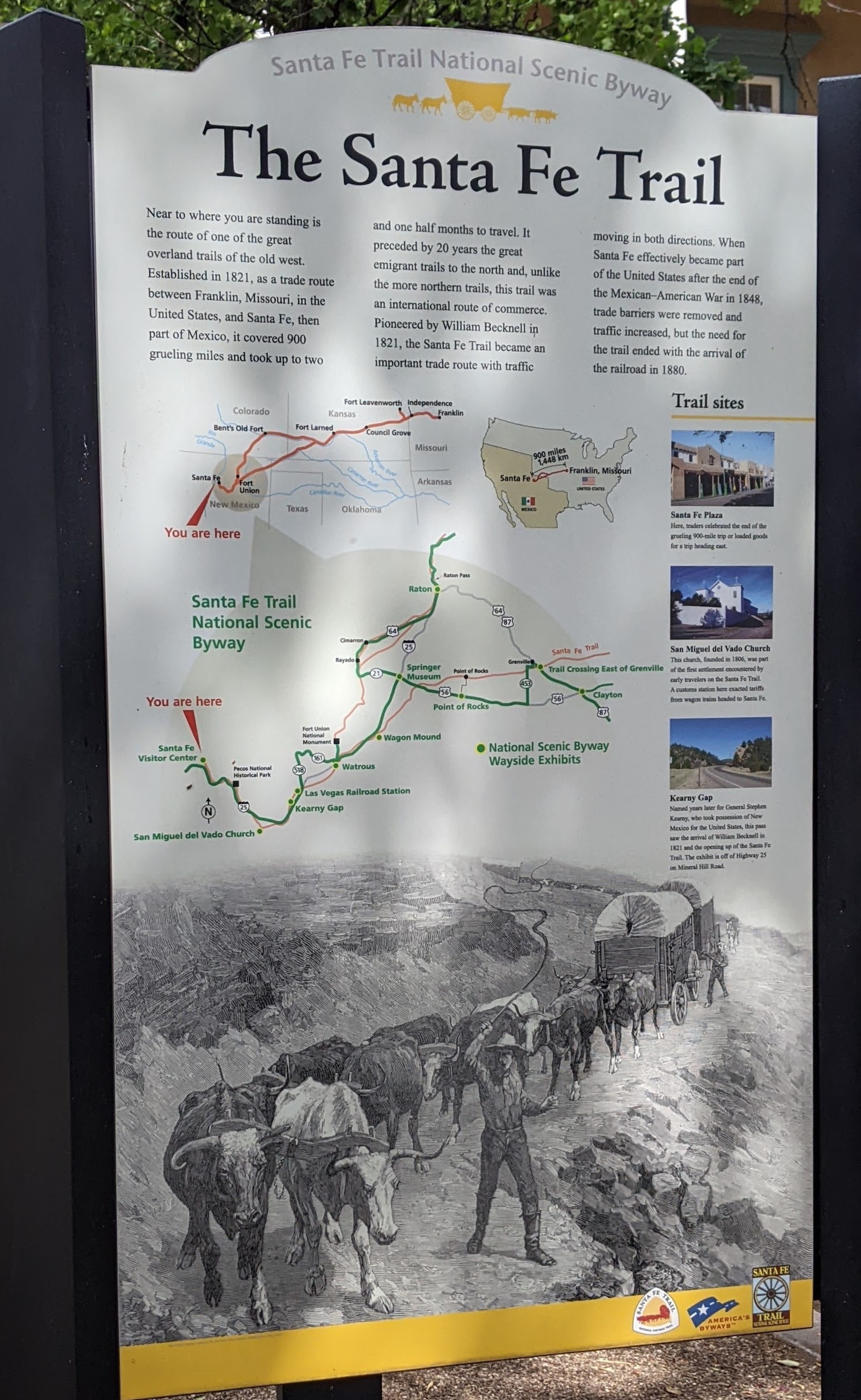
Santa Fe still proclaims itself The City Different and it remains unlike most other vacation destinations. There is a special vibe that’s difficult to resist, with much to see, do and learn in and around Santa Fe. Three historic travel routes converge in the city. It’s the end of the 900-mile Santa Fe Trail that began in Missouri and traversed the Great Plains, allowing goods and settlers to move westward. The pre-1937 Route 66 ran through Santa Fe on its path from Chicago to California, and the 1,600 mile route linking Mexico City, Spain’s colonial capital at the time, to its northern outpost at Santa Fe, was designated as an historic trail — El Camino Real de Tierra Adentro — by the U.S. National Park Service in 2000.
The city resonates with history, art that is sometimes quirky, and charm, and you’ll find wonderful food and a distinctive cultural experience no matter what time of year you visit the city.
What to Do in and Around Santa Fe
Whether you go to Santa Fe for two days or two weeks, there’s plenty to keep you busy.
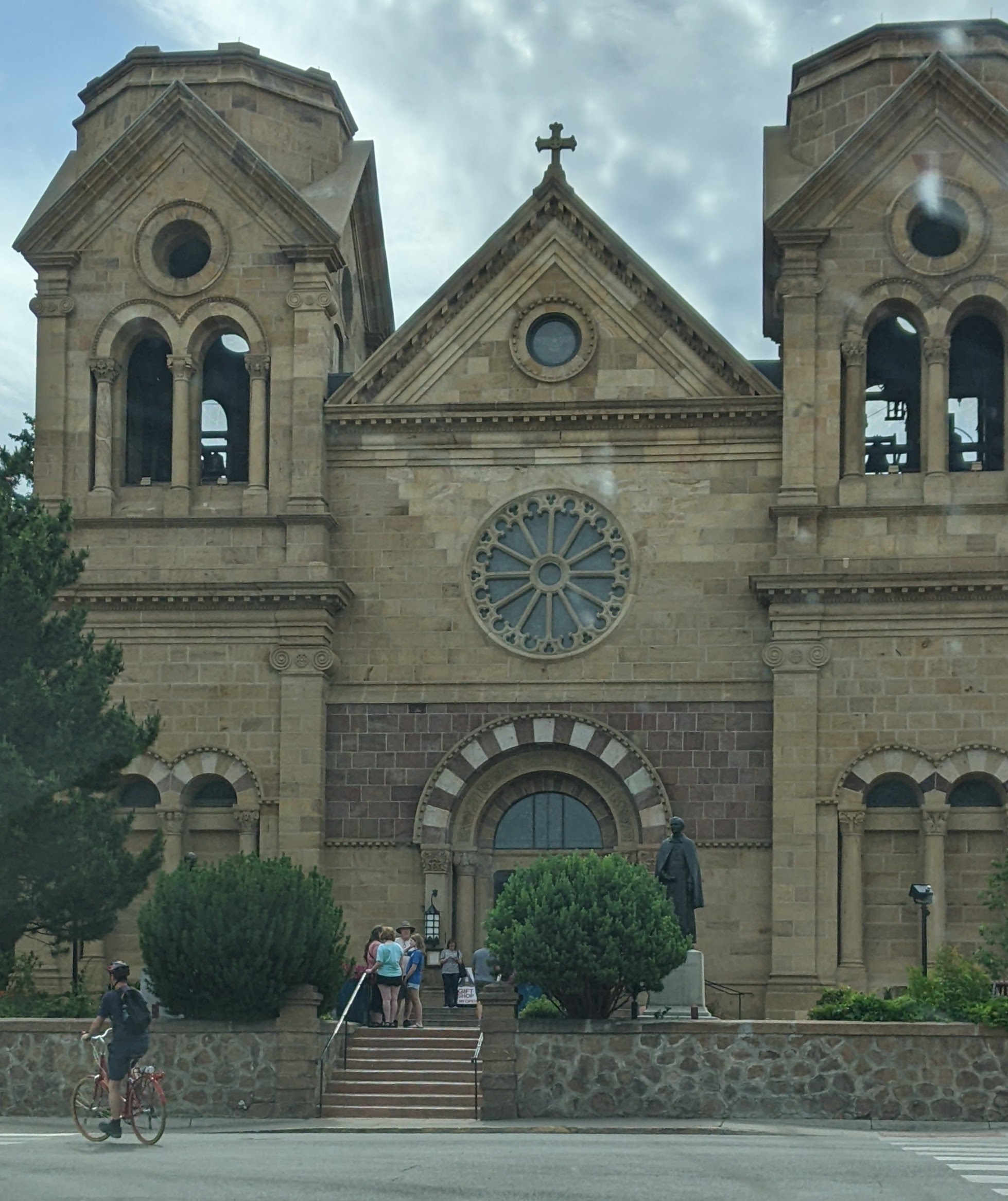
Visit museums and art galleries, weekend markets, downtown shops and the stunning open-air Opera House just outside of town. Savor local food specialties. Talk with shopkeepers, artists, bartenders and street vendors. Purchase art and jewelry from galleries or directly from artist studios. Talk with the artists and artisans who sell their creations from the portal at the Palace of the Governors. Attend a service at the Cathedral, or step inside the 400-year-old San Miguel Chapel, known as “the oldest church.” Visit the Georgia O’Keefe Museum. Explore Santa Fe’s distinctive neighborhoods.
Stroll the Plaza and Canyon Road. Be awed by the imposing Cathedral Basilica of St. Francis of Assisi and the impressive and mysterious staircase at Loretto Chapel. Have a drink or a meal at the sprawling Hotel La Fonda, which is conveniently located at one corner of the city’s downtown Plaza. Embrace the weather, the sights, the history, Pueblo and Territorial architecture, the scents of pinon or roasting chiles in season. Bask in the natural beauty of the site and breathe fresh mountain air.
Take the “white knuckle” drive up the winding road to the Ski Basin. Nearby Chimayo, Los Alamos, La Cienega, Las Vegas (yes, New Mexico), and Madrid are worth a day trip. See ancient pueblo cliff dwellings at Bandelier National Monument or go fishing at Cochiti Lake or along the Rio Chama. Hike the Sangre de Cristo or Jemez Mountains in the summer. Ski or snowmobile on mountain trails in the winter.
Learn about Santa Fe’s history, and visit a nearby Pueblo, especially if there’s a celebration or special ceremony scheduled. Most welcome visitors, but be respectful of their customs and regulations. Schedule a spa treatment or soak under the stars in a hot tub at 10,000 Waves. Sample street food or pub fare. Enjoy it all. Santa Fe is unique in any season.
Next week I’ll write more about where to stay, where to “play” and where and what to eat while in The City Different. Follow me to receive timely email notifications about future posts.
Getting to Santa Fe
Despite its popularity as a tourist destination, getting to Santa Fe, and getting around the city once you’re there, can be problematic. Public transportation is, for all practical purposes, non-existent. Unless you stay in the heart of the city, you will want a car.
You can fly into Santa Fe; there are direct flights from Houston, Denver, Phoenix, and Dallas. If you fly into Albuquerque, you can rent a car there — it’s an easy drive to Santa Fe and will take little more than an hour. There’s a train that runs between the cities, and it’s an interesting ride, but it’s better as an excursion than as a comfortable, reliable way to arrive in the city for vacation.
Finally, most tourism guides will warn you that lodging and meals are expensive in Santa Fe. And they can be. But more modest accommodations are available, including B&B’s or private “casitas,” and it can be worth the effort to search them out. Also, be sure to ask for dining recommendations from shopkeepers or guides. Savor delightful breakfast places and long-established local favorites for distinctive dishes and ethnic specialties. Learn what “Christmas” means when asked how you want your burritos served.
Santa Fe Today
Santa Fe has become a cosmopolitan city with an estimated 2024 population of just under 90,000, but its soul is still “small town,” rooted in the traditions of its more than 400-year history. It was originally established in 1610 as the capital of Nuevo Mexico, a province of New Spain. That was 13 years before Plymouth Colony in Massachusetts was settled by pilgrims who arrived on the Mayflower. Its history, however, began long before that.
Santa Fe boasts not only the oldest public building in the United States, the Palace of the Governors, but also the oldest community festival, first celebrated in 1712 to commemorate the Spanish reconquest of New Mexico in 1692. This year’s Fiesta de Santa Fe is scheduled August 31 through September 11. The city was built on the ruins of an earlier Indian Pueblo, and it’s not only the earliest European settlement west of the Mississippi but also the oldest state capital in the United States.
Want information about things to do in Santa Fe? Here are some specific suggestions, whether your interests are primarily arts and culture, outdoor activities, foodie experiences, or shopping. You might also want to order a copy of the Official Visitors Guide to help plan your trip. And when you’re in town, stop by TOURISM Santa Fe, located downtown at 201 W. Marcy St., for the best up-to-date information about local special events and exhibitions.
Daylight lasts longer in the summer and weather is typically more predictable, even if it’s predictably hot. Close-to-home day trips or spur-of-the-moment, loosely-organized one or two-night excursions, are a welcome treat. Getting away, particularly to someplace new just seems easier, not to mention more fun. The goal, of course, is to choose a destination that promises captivating sights, provocative activities, stimulating people, and, of course, a local food adventure.
My husband and I found all that and more just a few hours from our home. Our destination — Alexandria, Louisiana — is a relatively small city in a state just to the south of Arkansas. We planned our route along a scenic highway. No interstates to navigate. Minimum traffic to contend with. As much as we enjoy road trips, we wanted this drive to be easy. The bonus? Close friends had recently relocated to Alexandria from our community in Arkansas. We missed them. After helping them pack boxes before their departure, we wanted to see them settling into their new home. We were curious.
Although we were happy to accept the offer of a guest room, we stipulated only hot coffee in the morning. We wanted to sample local eateries, and requested no homemade meals.
Finding Distinctive Local Food
Our first impression, as we drove into town, was positive, but our first decision involved food. We had skipped breakfast that morning, opting instead for take-along coffee and a relatively early start to our journey. When we arrived, we were ready to quell our growing hunger pangs, so the priority became food over friendship.
A quick online search yielded a convenient address and favorable customer reviews.
Spirits Food & Friends
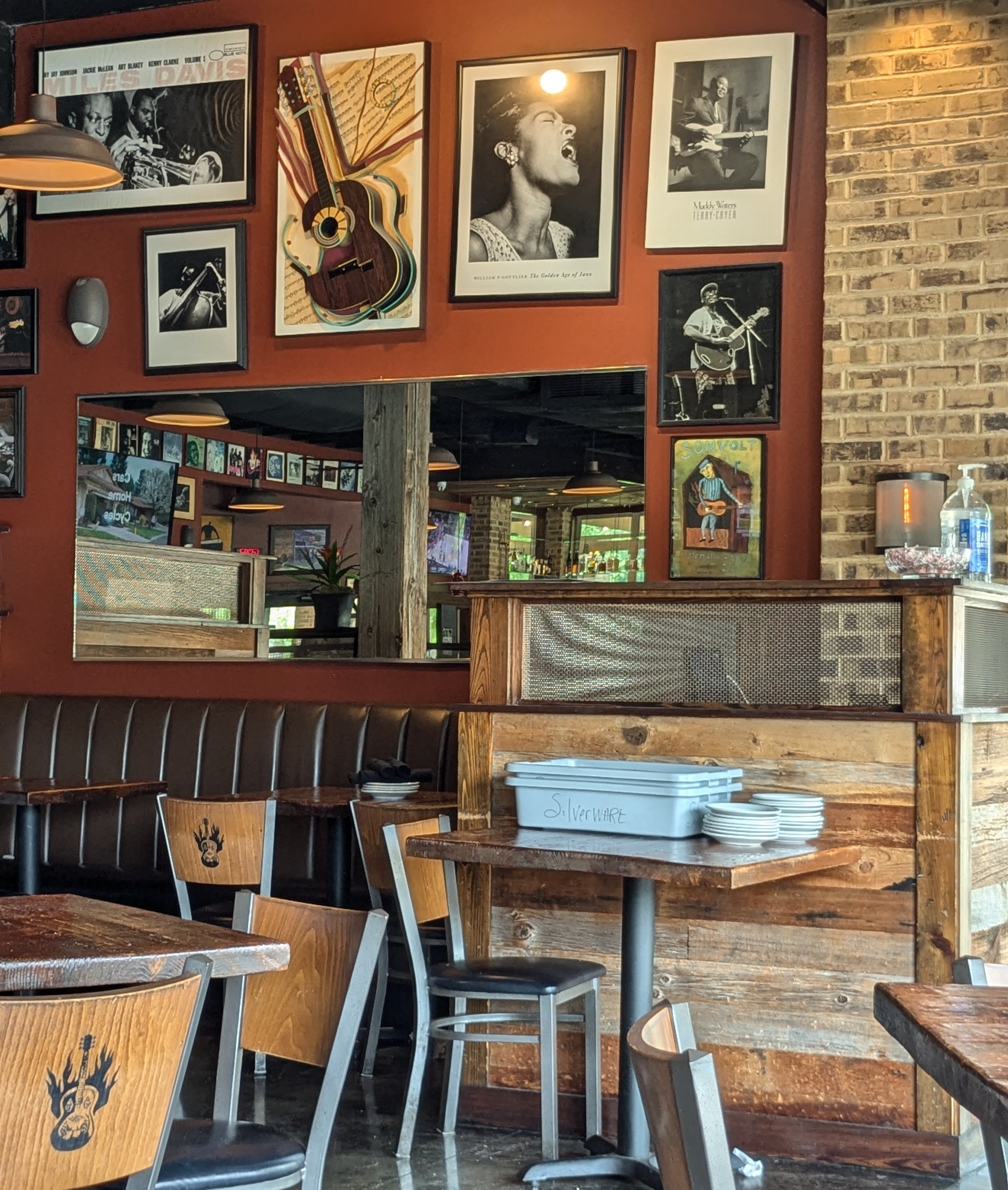
The dining area was far from filled in the early afternoon, but our initial impressions of Alexandria were boosted immeasurably by the “look and feel” of this eatery. Other diners seemed to be having a good time. An amiable and informative waiter greeted us warmly and seated us promptly.
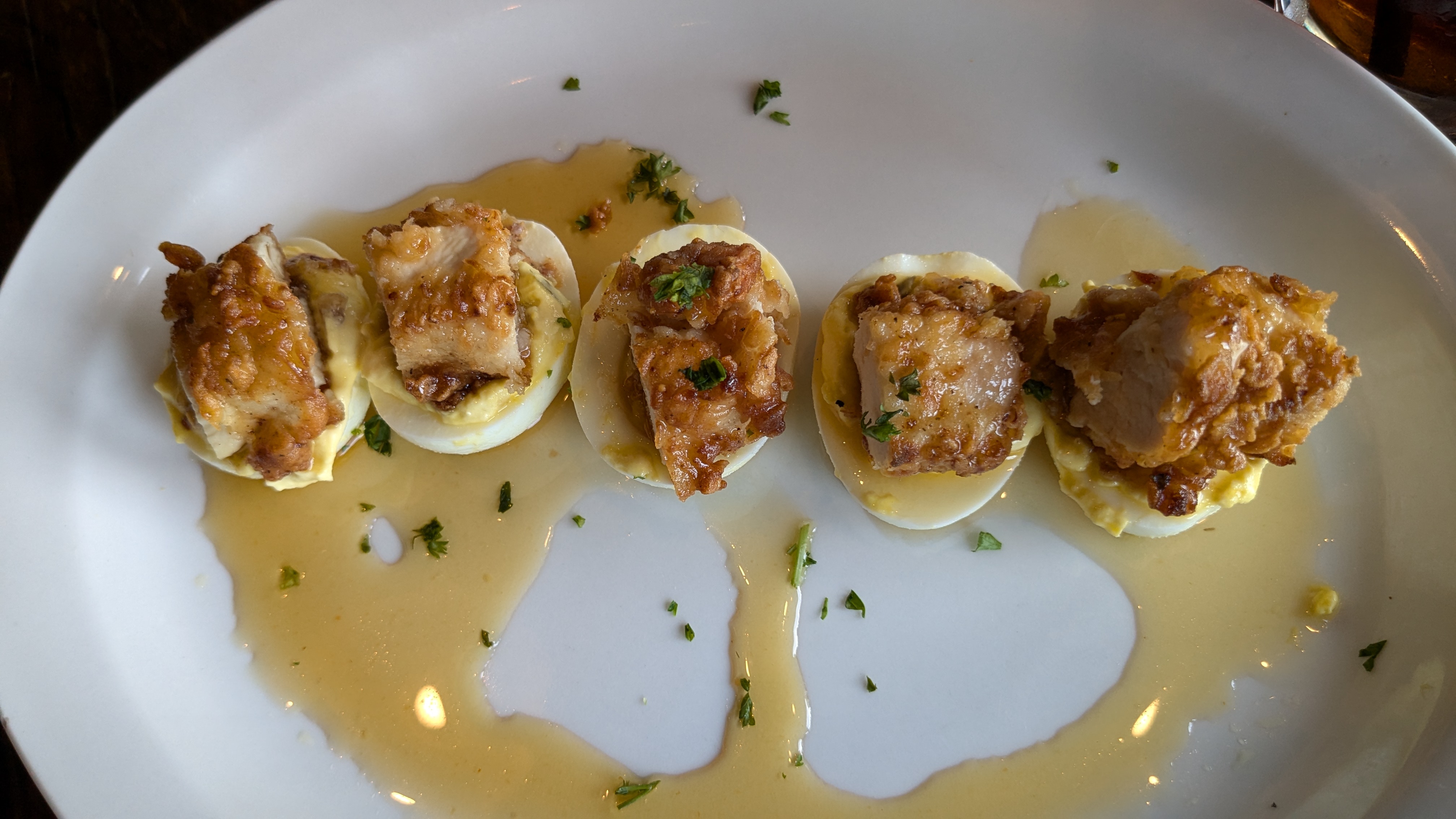
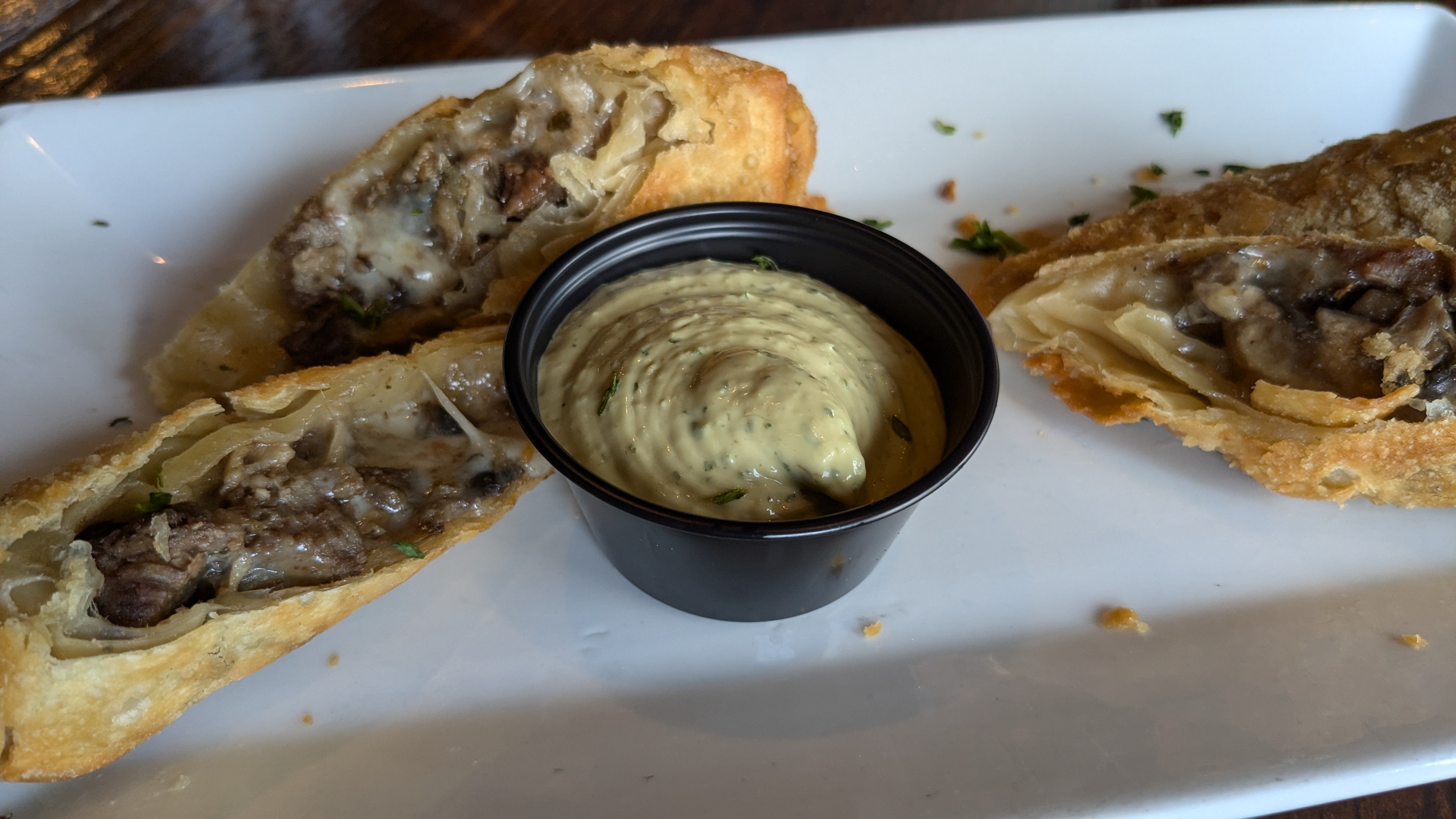
We chose not to order a complete meal, but instead selected appetizers to share from the extensive menu. An order of “Which Came First” Deviled Eggs, topped with fried chicken bites, bacon jam and sweet chili sauce, combined both breakfast and lunch in a unique way, and unusually good Philly Cheesesteak Eggrolls with creamy avocado ranch dressing more than satisfied our hunger.
Our server kept our glasses of iced tea and lemonade full, and he answered all our questions about things to do and places to go in the city. We chatted about the history and growth of the “family-owned, Alexandria-grown” establishment.
We were captivated by our first taste of local food and hospitality and more than pleased with our choices. We also asked for suggestions about where to dine that evening, and were treated to a “mini-course” in local culture and history.
Our visit to Alexandria was off to a great start. We were beginning to understand the reasons our friends had chosen this city on the banks of the Red River as their new home. Cajun food and culture are certainly part of the appeal. But, as we discovered, there’s much more to savor about Alexandria.
The Cottage
Another day — another lunch. The Cottage proved to be another delightful surprise.
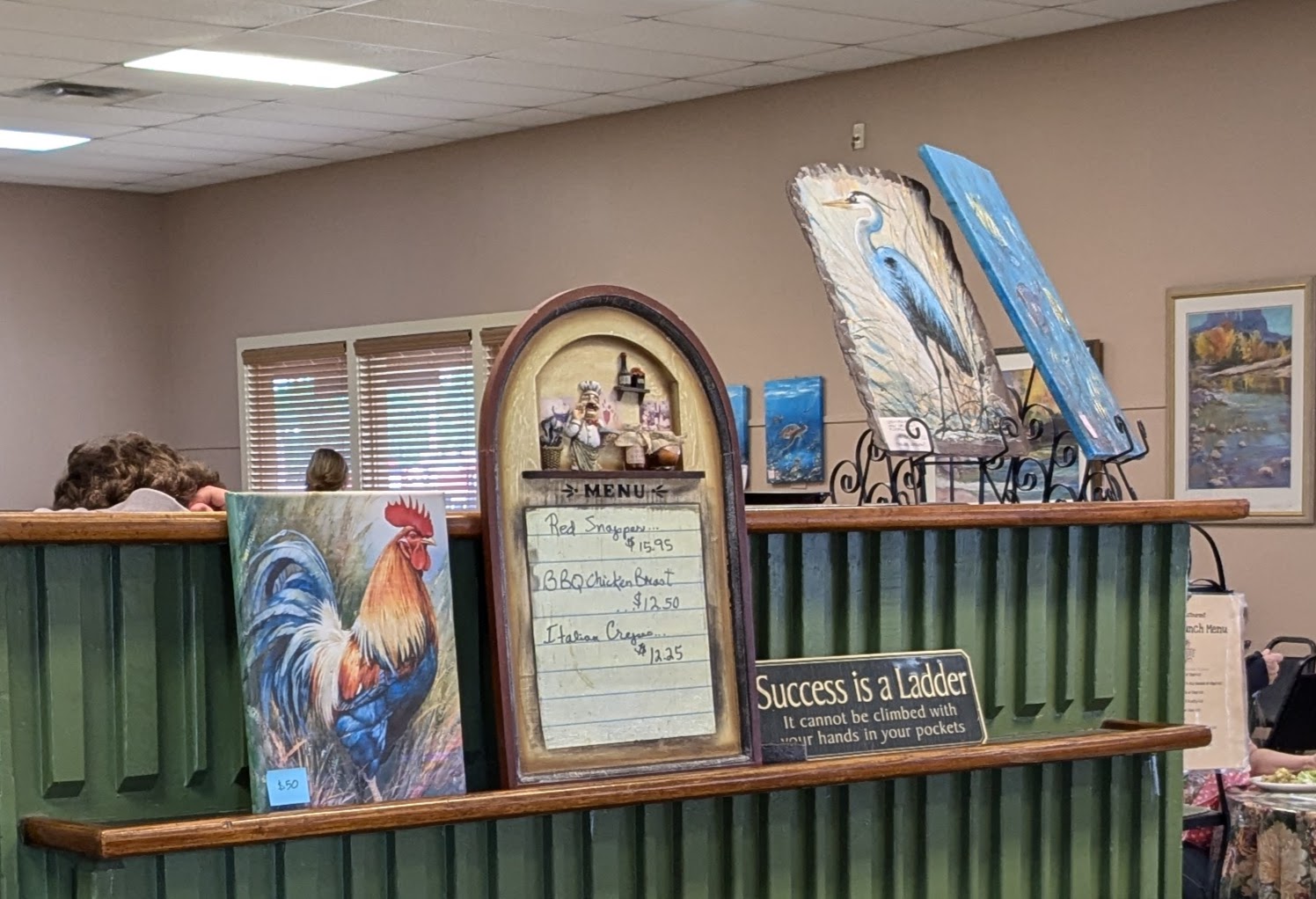
Renowned for its specialty cream of shrimp soup available in sizes from a “demi” cup to a large bowl, The Cottage features daily luncheon specials. Although the compact lunch-only spot looks somewhat like a ladies’ tea room, its clientele runs the gamut from suited businessmen to golfing foursomes to families with children. Personalized service is one key to its popularity, but the food lives up to the reputation it has built. Dishes are full of fresh flavor and served with flair.
Just one note of caution. A special of fresh fish with spinach salad and cottage potatoes had been listed online at a price substantially lower than the price that was charged. We noted the discrepancy with great surprise when the bill was presented. Although restaurant staff honored the lower (and incorrect) online price, it is probably always a good idea to confirm special prices before ordering.
Beer and wine are available, but the specialty almond iced tea was exceptional. We didn’t try any of the homemade dessert offerings, but I’m willing to bet they’re wonderful as well. Next time, I’ll have a hard time deciding between a Strawberry Crepe and the P-Nutty Oreo Pie.
Know that The Cottage is only open from 11 a.m. to 2 p.m. Monday through Saturday. Would we return? Absolutely!
Tunk’s Cypress Inn
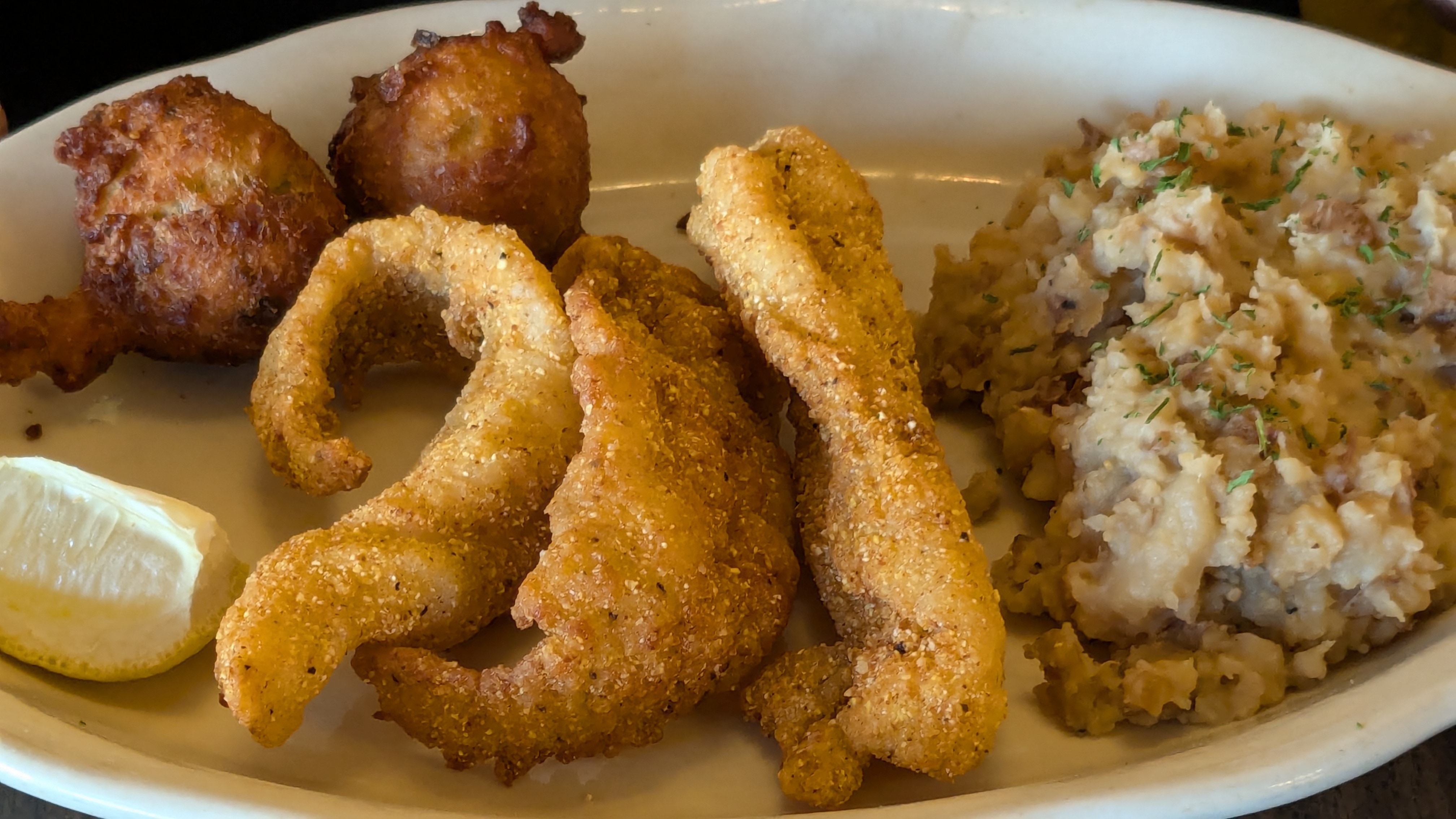
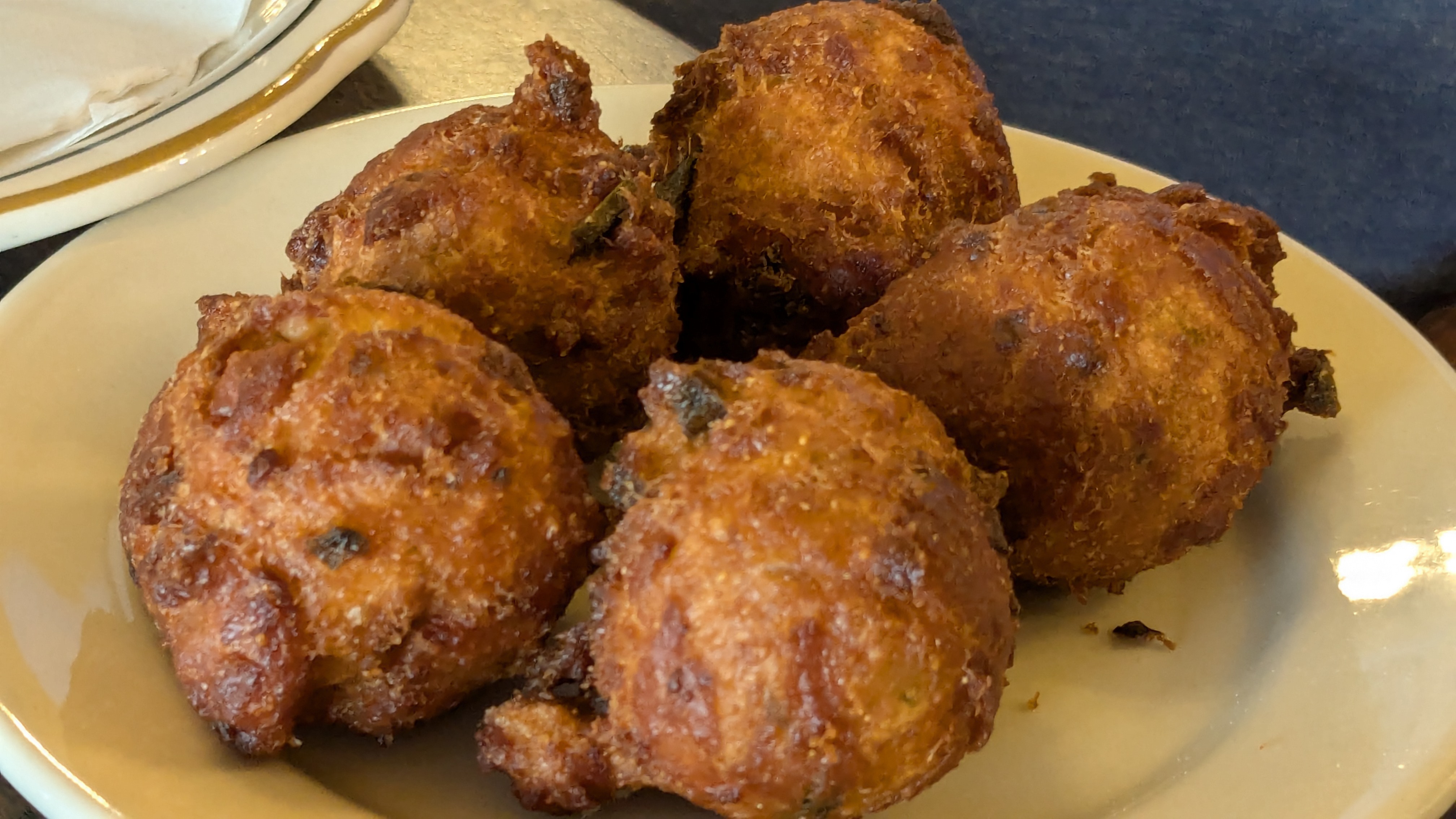
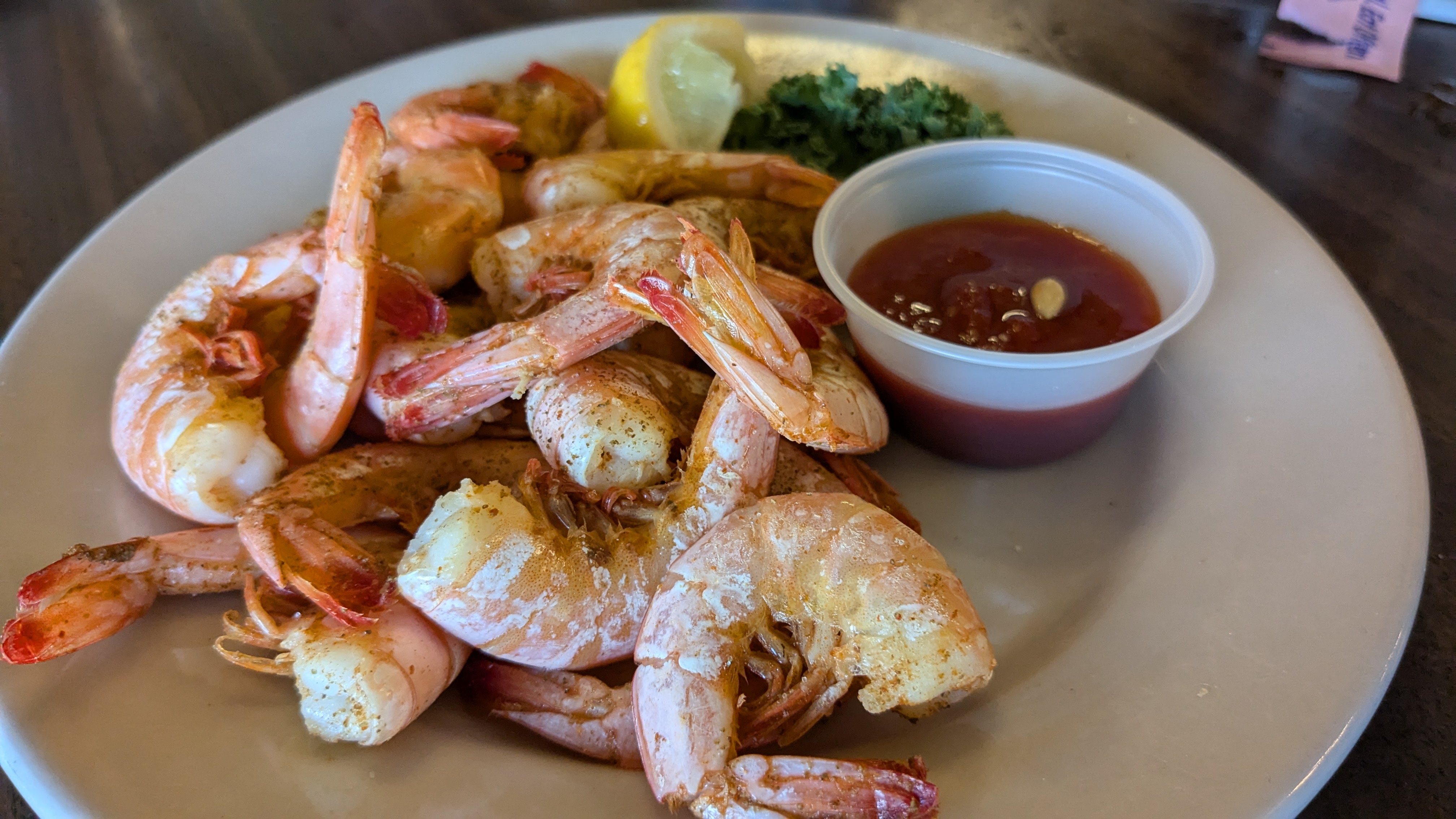
It would be worth visiting Tunk’s Cypress Inn & Oyster Bar just to sit on the deck with a cool drink while gazing at the serene view. However, to miss the food would be almost criminal. The Oyster Bar, right at water level, even features a choice of Po-boys as a Thursday night special. We missed that, but what we had — shrimp-topped fried green tomatoes with basil pesto cream sauce, boiled shrimp, fried catfish, seafood gumbo, and hush puppies — more than compensated for any disappointment we felt about missing the Poboy Special.
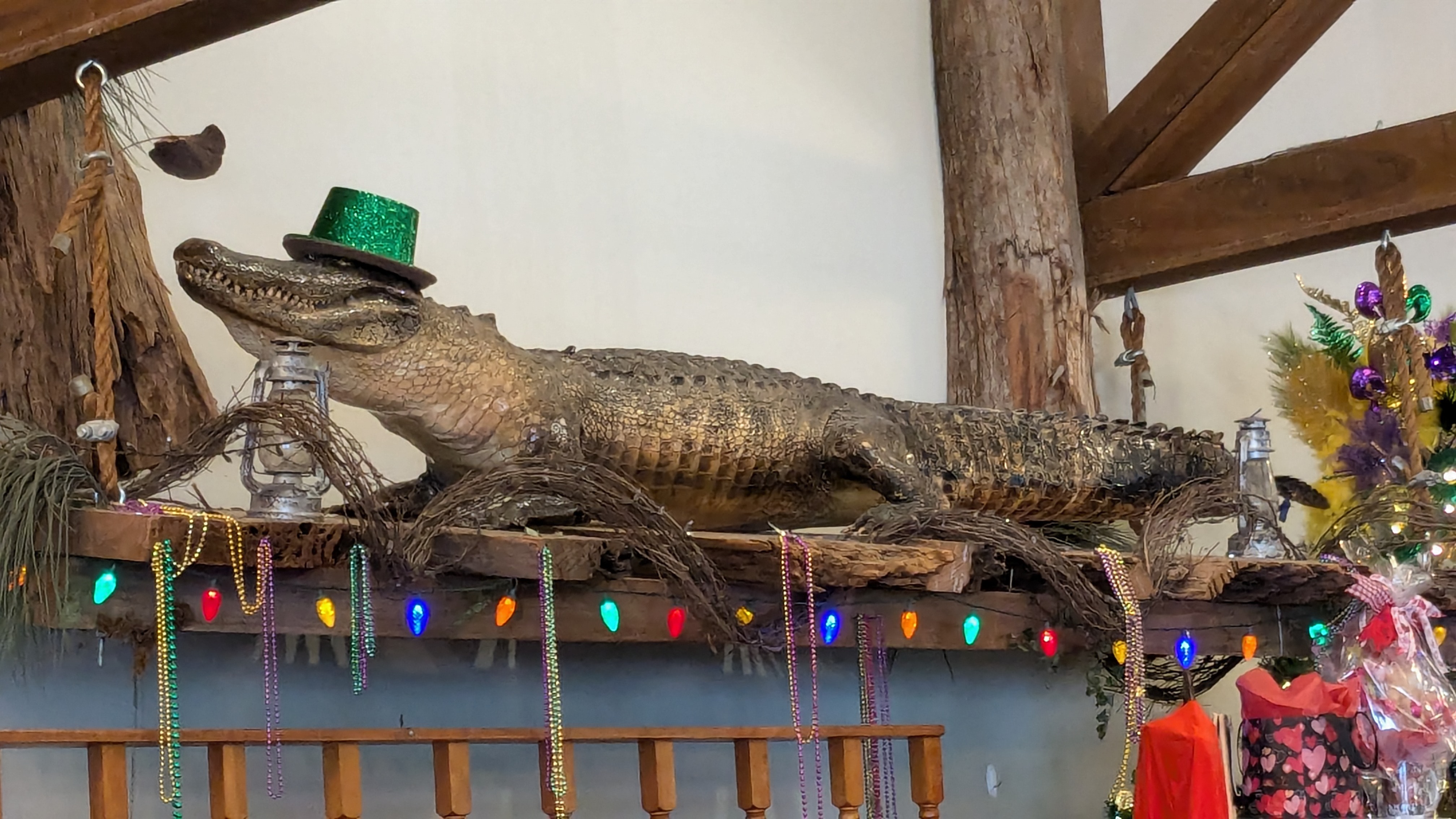
In case you’re wondering, the alligator, dressed in Mardi Gras finery, oversees the dining room on a perch adjacent to a pine tree trimmed in traditional purple, green and gold. And “the good times roll” here, we’re sure, all year long.
Mardi Gras colors, along with beads and memorabilia, are not necessarily limited to Tunk’s. You’ll find reminders of the “good times” throughout Alexandria. It’s part of Louisiana’s mystique, along with Cajun and Creole food and music.
Rosie Jo’s
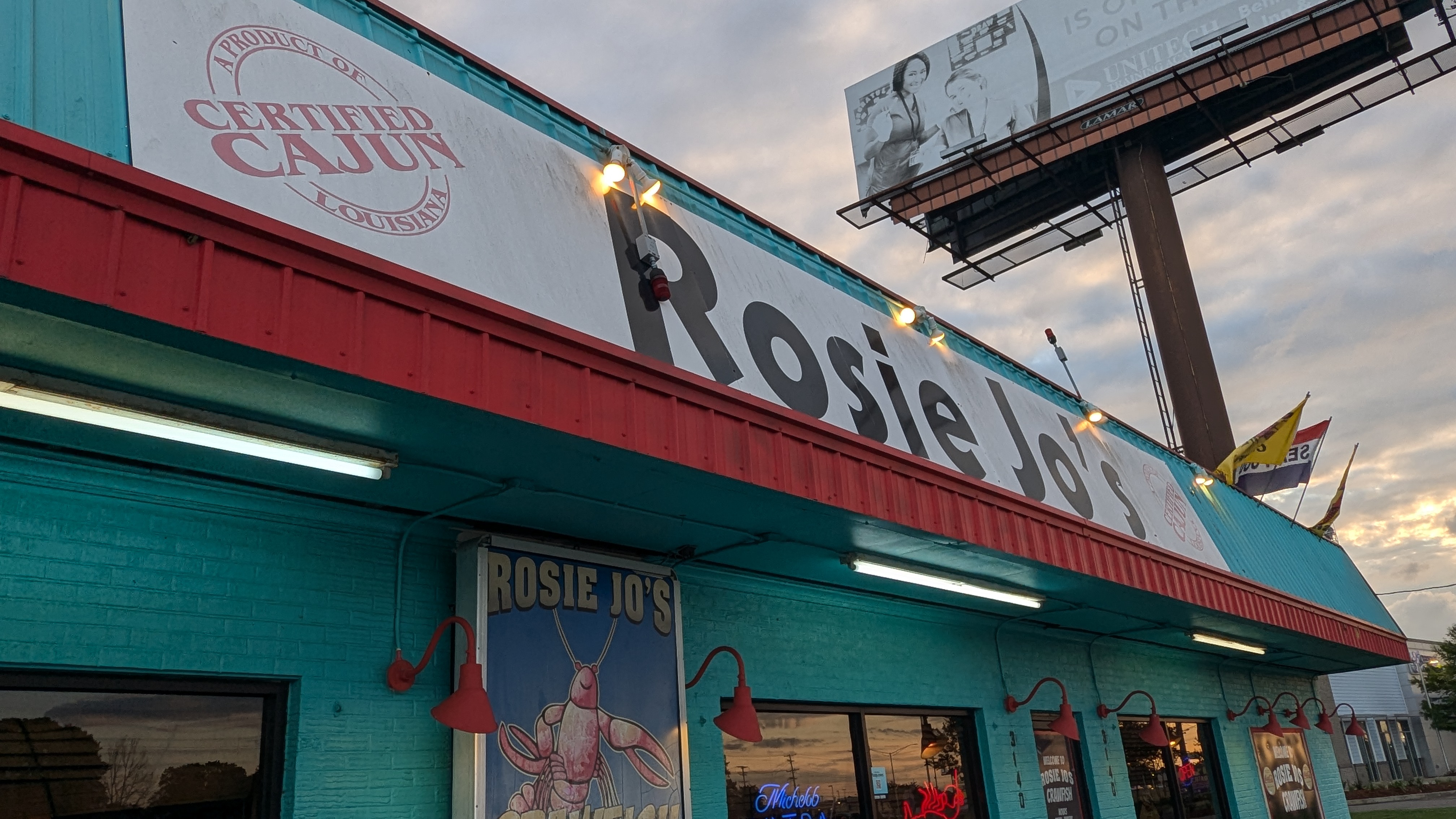
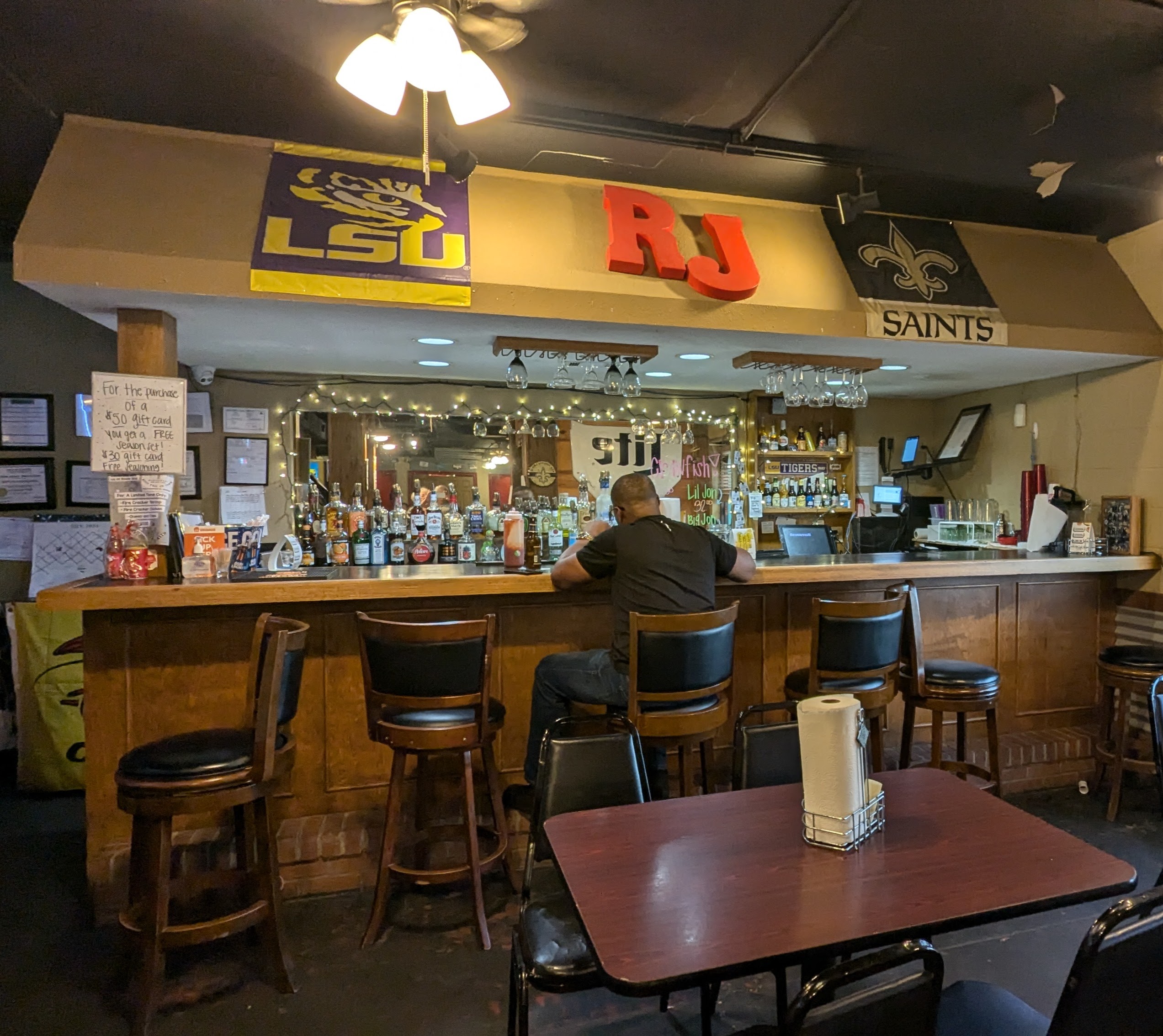
Rosie Jo’s looks like a roadside diner from the outside, and the interior has some of the ambience of an after work watering hole, or a late night honky-tonk. But don’t let that keep you from going. It’s hip, friendly, busy, and fun. And the food — everything we ordered — was well-prepared, hot, and delicious. Service was on point, as well. So, for the pure fun of it, as well as the quality, we heartily add our names to the list of local recommendations we received about Rosie Jo’s.
We visited Rosie Jo’s during crawfish season and and, even though we didn’t order a bucket to share, plenty of other diners did! As I looked around, I realized that not many crawfish go uneaten! If you go, you might want to time your visit so that you can have the experience!
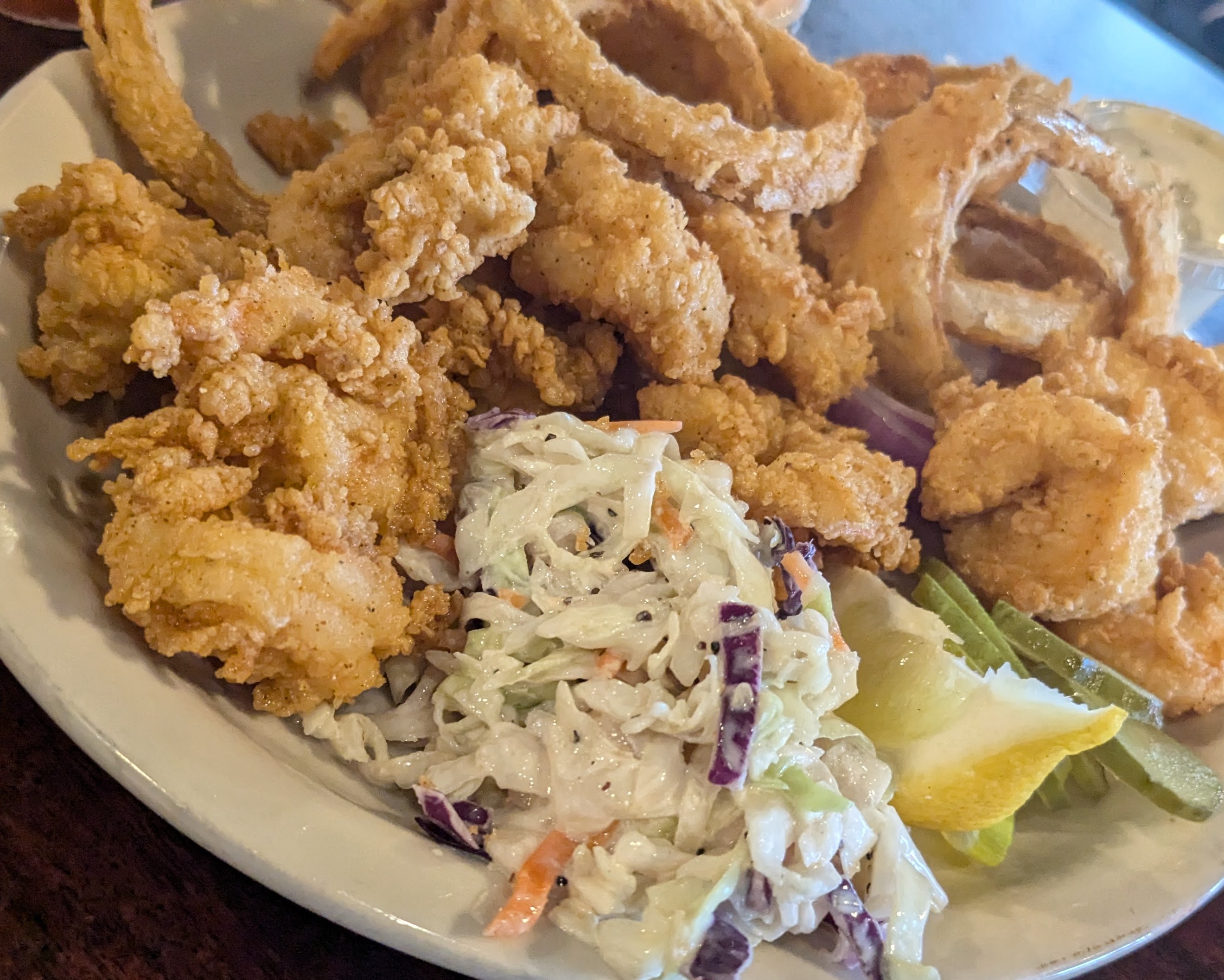
We thoroughly enjoyed what we did order. I’m not sure I wouldn’t choose the hearty Shrimp and Grits again, but it’s a large order, suitable for sharing. Others in our group chose Fried Shrimp, complete with onion rings and coleslaw, and Pistolettes, fried pockets of dough stuffed with boudin and covered in shrimp etouffee.
Needless to say, samples all around were willingly shared.
Even though the city lies to the north of what is considered “Cajun Country,” there’s plenty of good Cajun food to be found. Over the course of the next two days, we sought recommendations from everyone we met and were rewarded with a list of options that would satisfy even the most discerning diners. There are fine, upscale restaurants as well. And we understand that food booths and food trucks are there for the festivals.
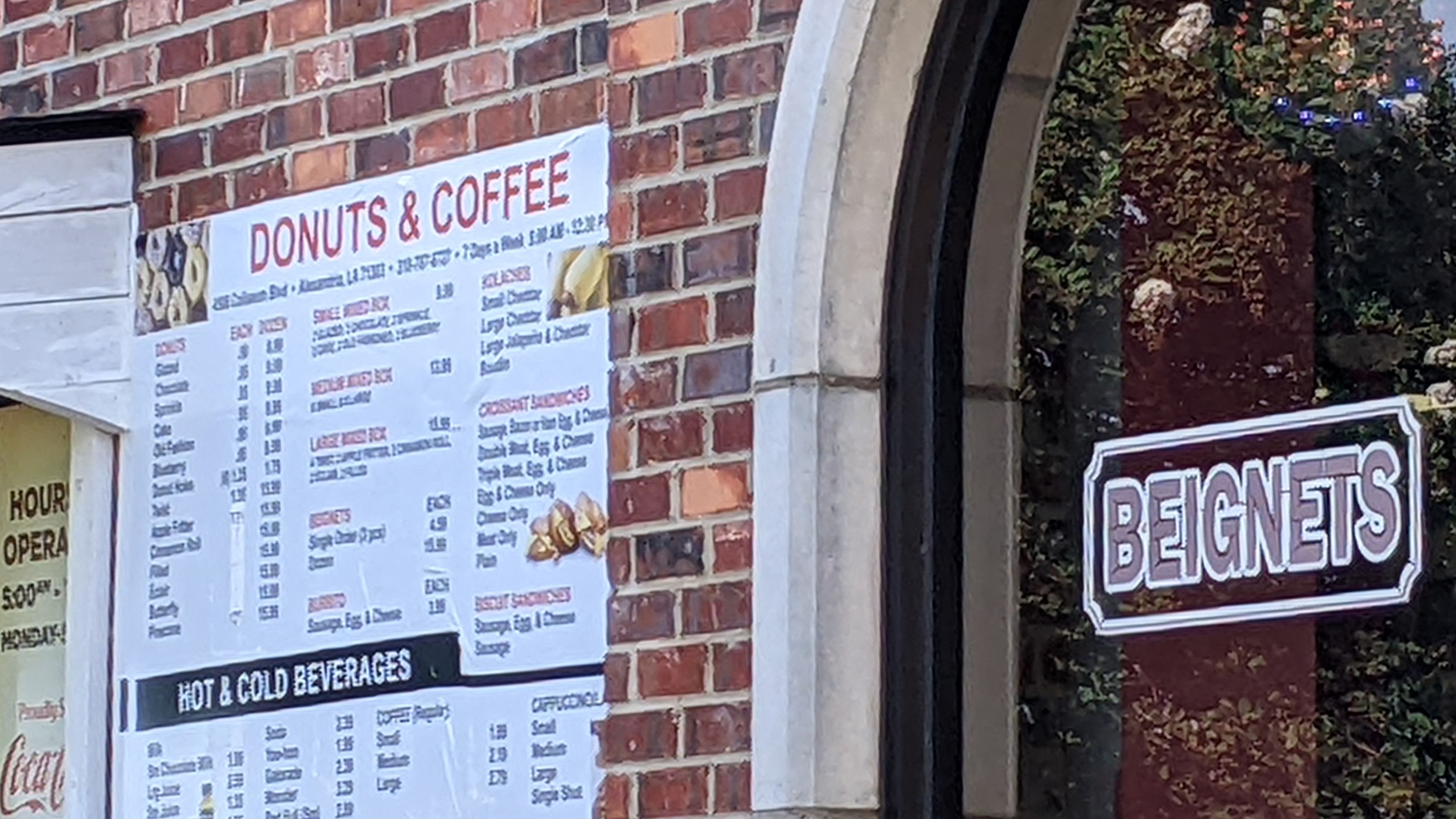
Our final morning came too soon. After leisurely coffee and conversation with our hosts, we made ready to leave. Previously, we had spied a neighborhood Coffee and Donut Shop. We couldn’t resist stopping. Served fresh and piping hot, three to the order, the large beignets drenched in powdered sugar reconfirmed that Louisiana residents definitely know how to enjoy the good things in life. One more reason to return.
On our return trip to Arkansas, we passed through the charming town of Ruston, not quite two hours north of Alexandria. Home to Louisiana Tech University, it seemed a good place to stop for a bite to eat — home was approximately another four hours away. Our friends had recommended Ponchatoulas, with a convenient downtown location. Another chance to sample “the flavor of Louisiana” was tempting, to say the least. We had been forewarned, however, that we might have to wait for a table, and that was the case.
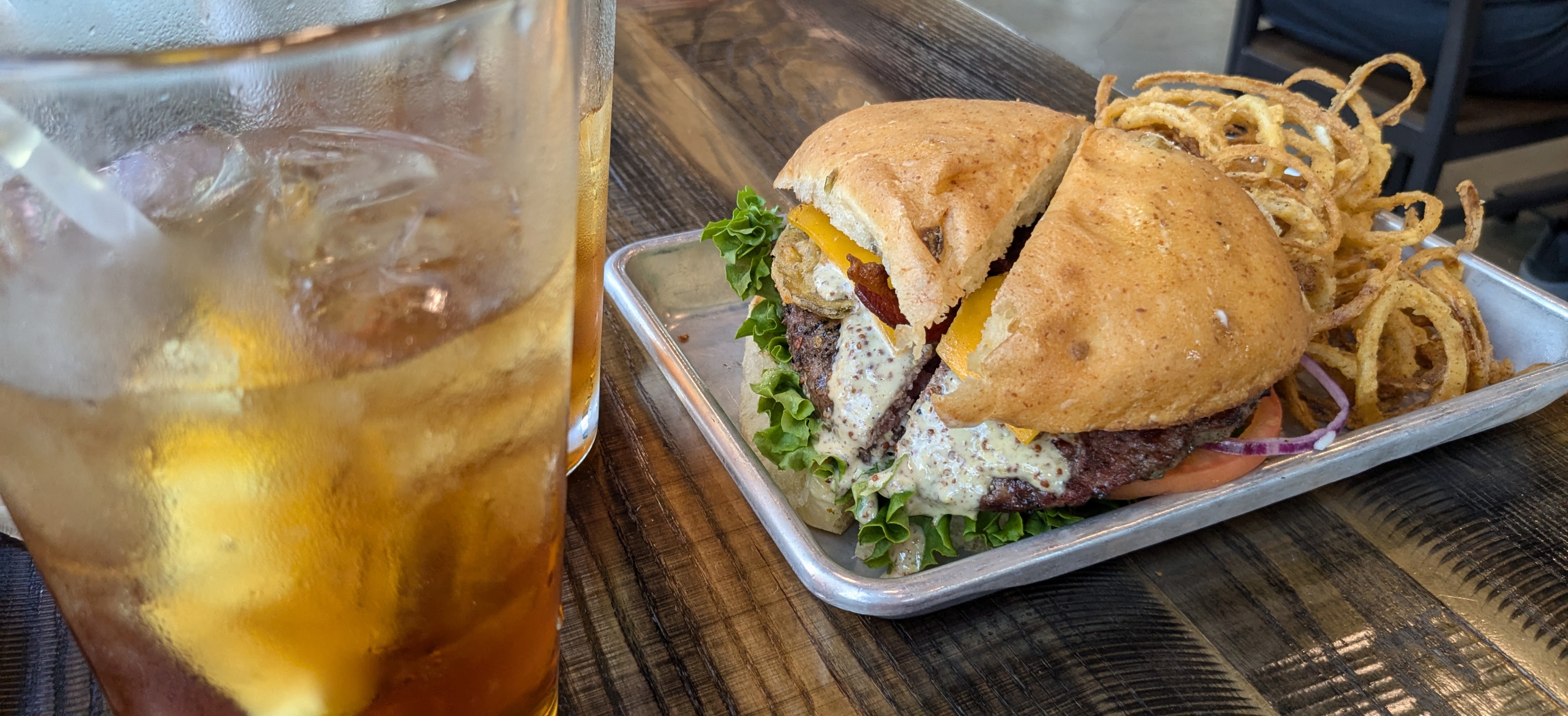
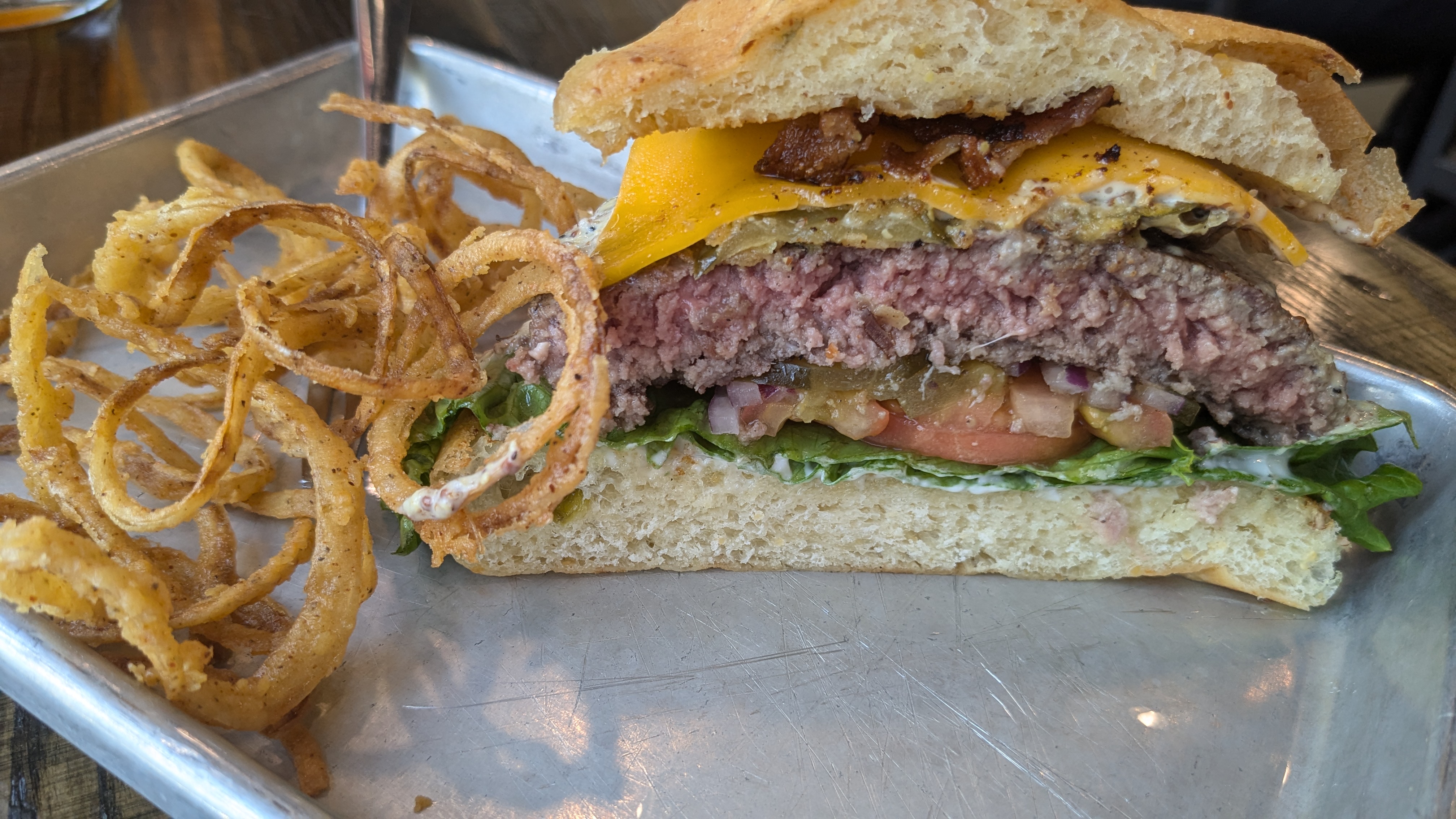
Another quick online search yielded results: Dawg House Sports Grill. It has a tempting menu of burgers and was easy to find. Obviously popular with students and sports fans, there were also a fair number of families there to watch Sunday games. Although tempted by menu items like Boudin Egg Rolls, Fried Green Tomatoes, or a Shrimp Poboy, we settled on a Bulldawg Burger with Onion Strings, after our server’s assurance that it was large enough to share.
It was indeed! We felt confident we would not have to worry about dinner that evening.
“On the Road” Learning
Driving home, we reviewed everything we had packed into the all-too-brief road trip. Importantly, we had learned that there’s more than food to love about Alexandria, but that food is an important aspect of any good travel experience.
We knew our two-day time frame would allow little time to do more than scratch the surface of Alexandria. We had hoped to explore some of the city’s casual eateries, with the goal of finding, at minimum, interesting food options and Cajun flavors. A variety of Poboy choices and local brews would have satisfied us.
What we found was so much better. We hadn’t expected a food dilemma, but there simply are too many good options, it seems, for the time or appetites we had.
We left wanting to know more about this distinctive Louisiana city. There’s a plantation house that dates to pre-Louisiana purchase days, a grand century-old hotel that must have many stories to tell, a highly-rated zoo and art museum, an undergrad campus of Louisiana State University, and several popular annual celebrations, including Mardi Gras. Alexandria also boasts a fascinating military history. It was near here that thousands of soldiers trained prior to World War II and many different types of aircraft flew out of the former England Air Base that has been “recycled” as a regional international airport.
Alexandria seems like a “happening” place to be, any time of year. It’s now certain that we’ll return.
Strengthening the ties of friendship with former neighbors was important to us, and we vowed not to allow much time to pass before doing it again. Getting away for fresh experiences in unfamiliar places is good for the soul.
And sampling new foods definitely adds spice to life.
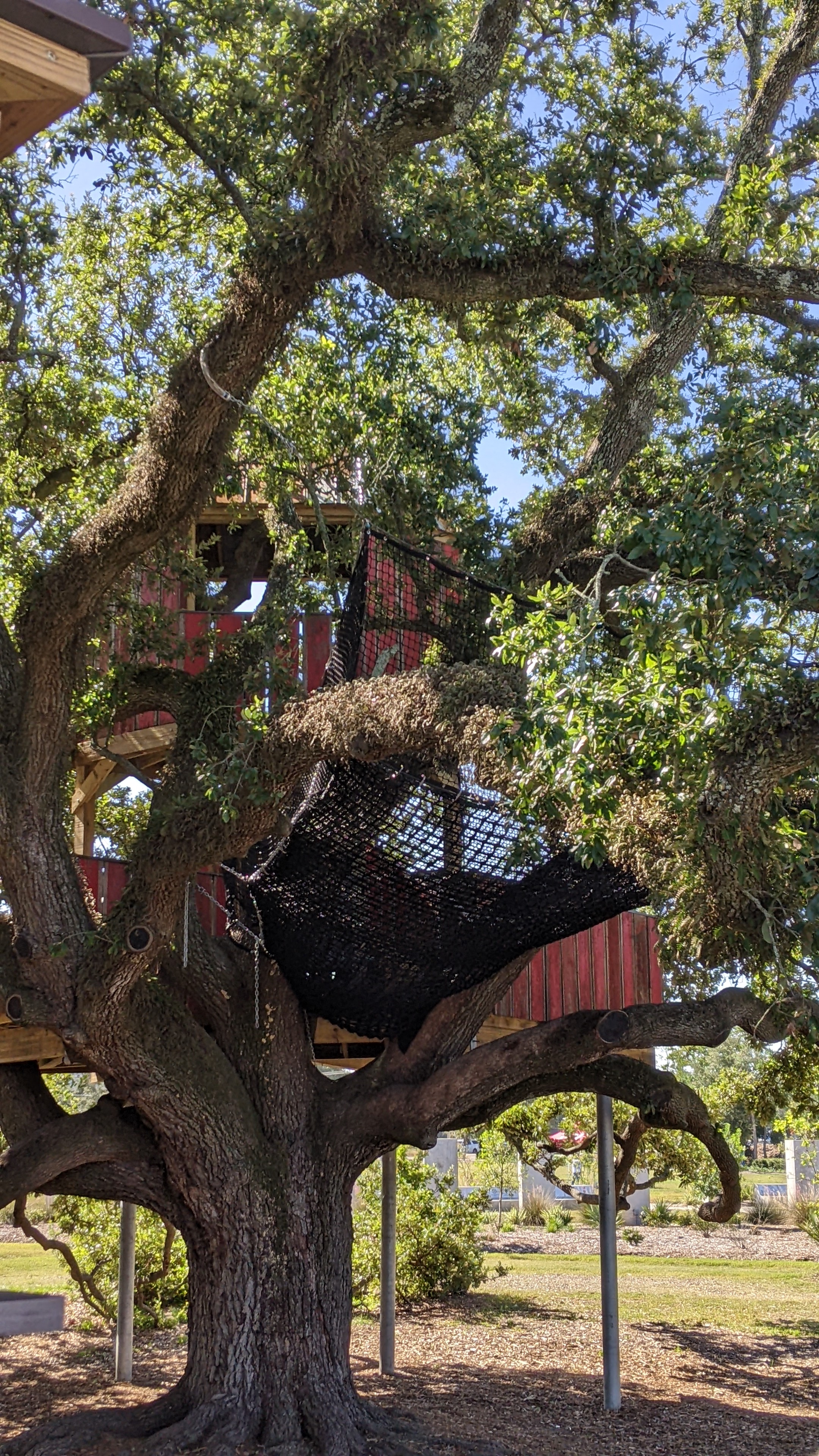
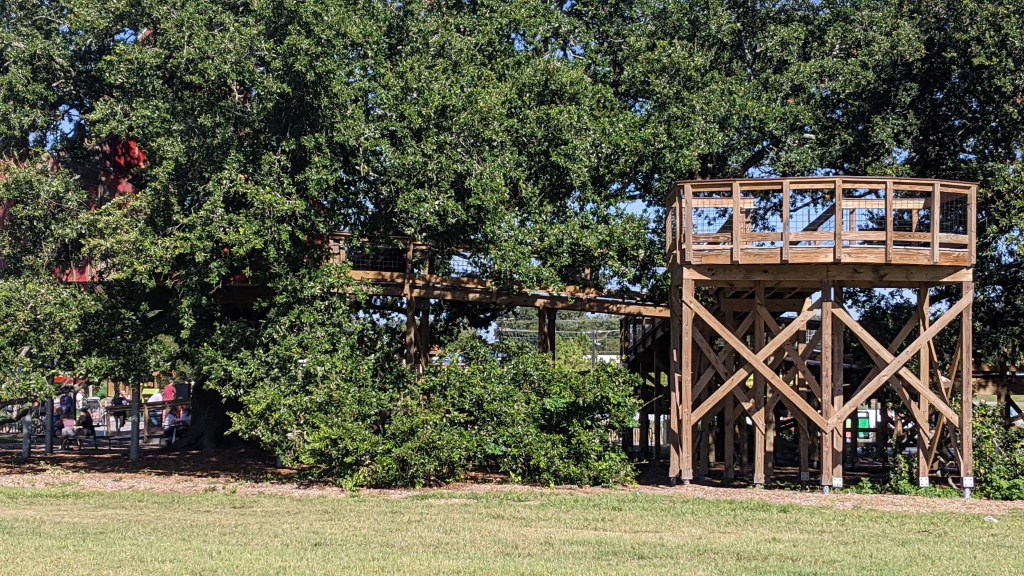
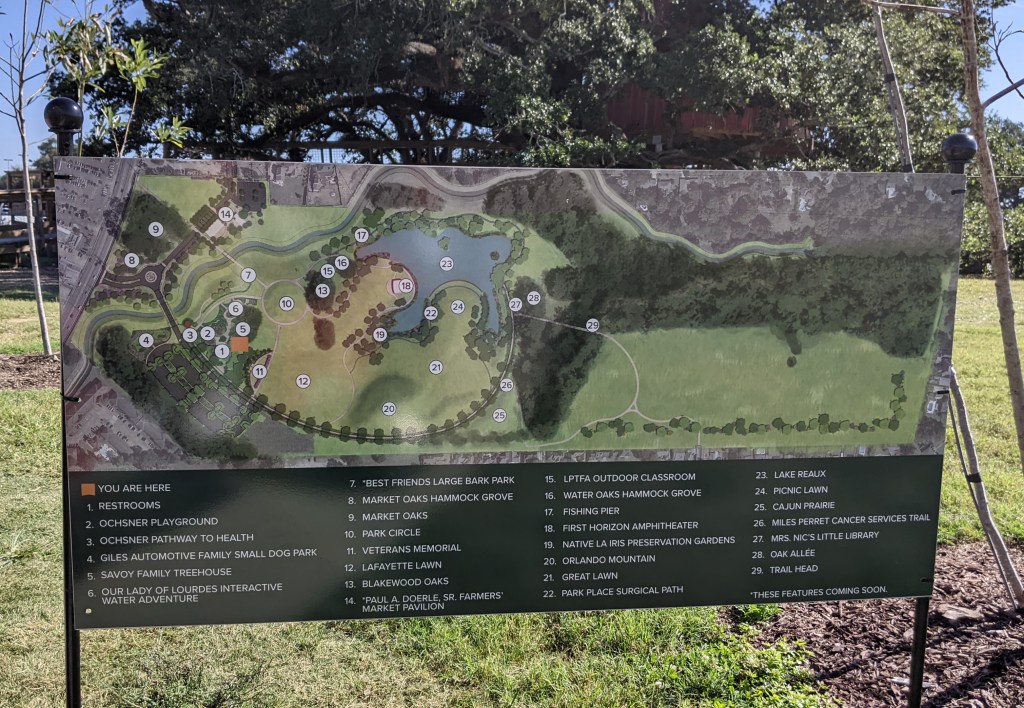
Hidden in the trees of Moncus Park in Lafayette, Louisiana, is a faded red treehouse constructed with lumber salvaged from a former horse barn on the property. It adjoins a children’s play area, but it’s almost hidden from view along the
paved walking path that meanders through the property. I’m sure that makes it all the more enticing for the children who choose to climb the ladder and walk the swinging elevated course to reach it.
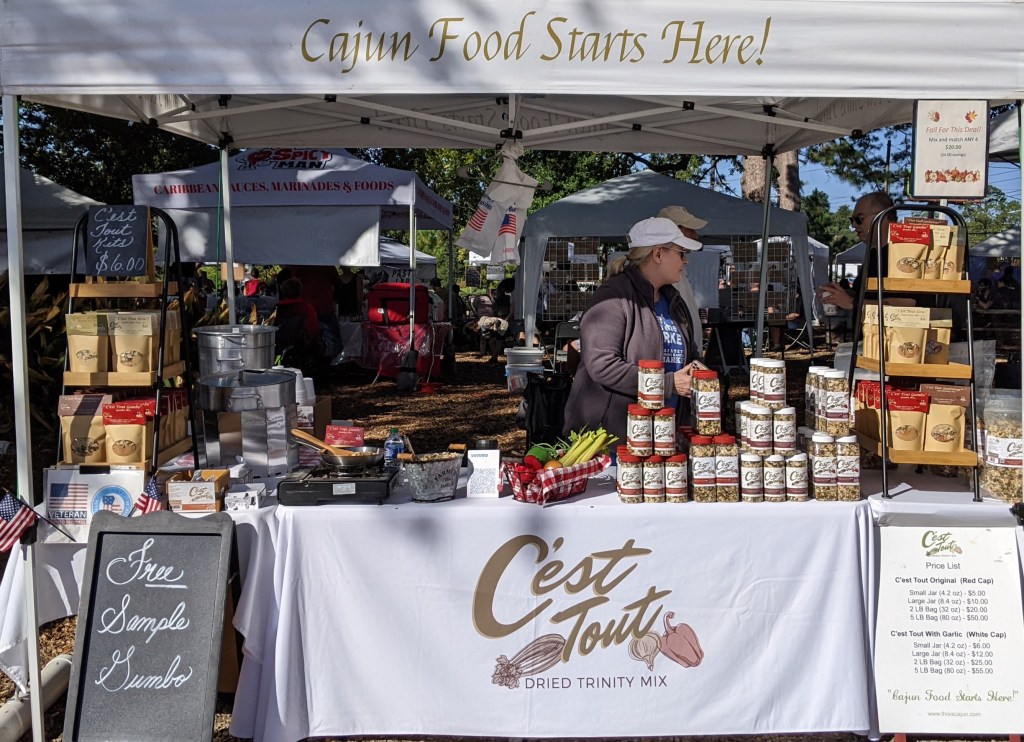
On the day we visited, the park was filled with people. Some, like our group of travel writers from diverse locations, had first visited the thriving adjacent outdoor Saturday Market, overflowing with food and crafts vendors every week throughout the year. This past summer, the market celebrated its 10th anniversary with the ringing of the Durel Bell.
The sun shown brightly on this mid-October day, and the park was alive with activities to attract young and old alike.
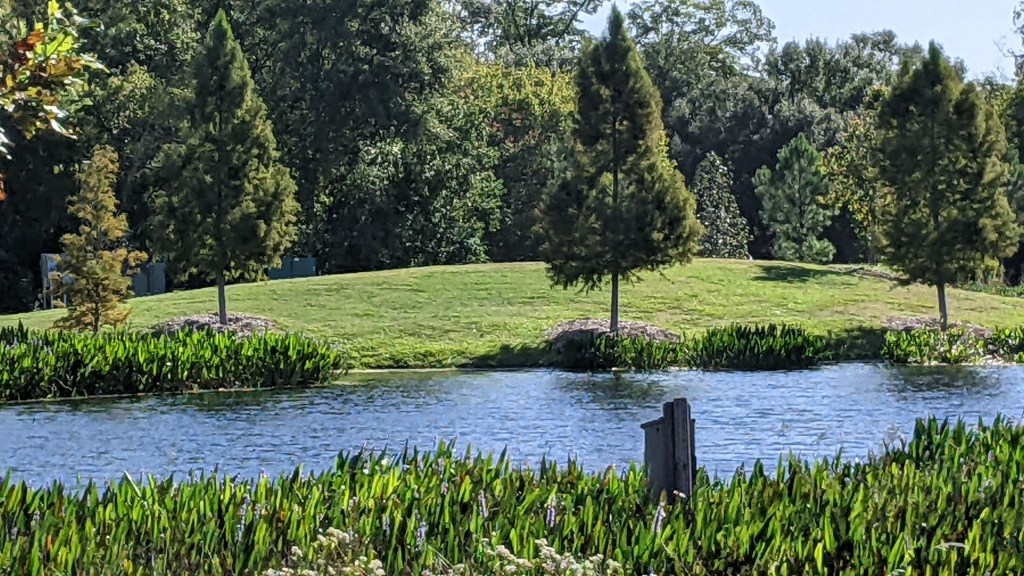
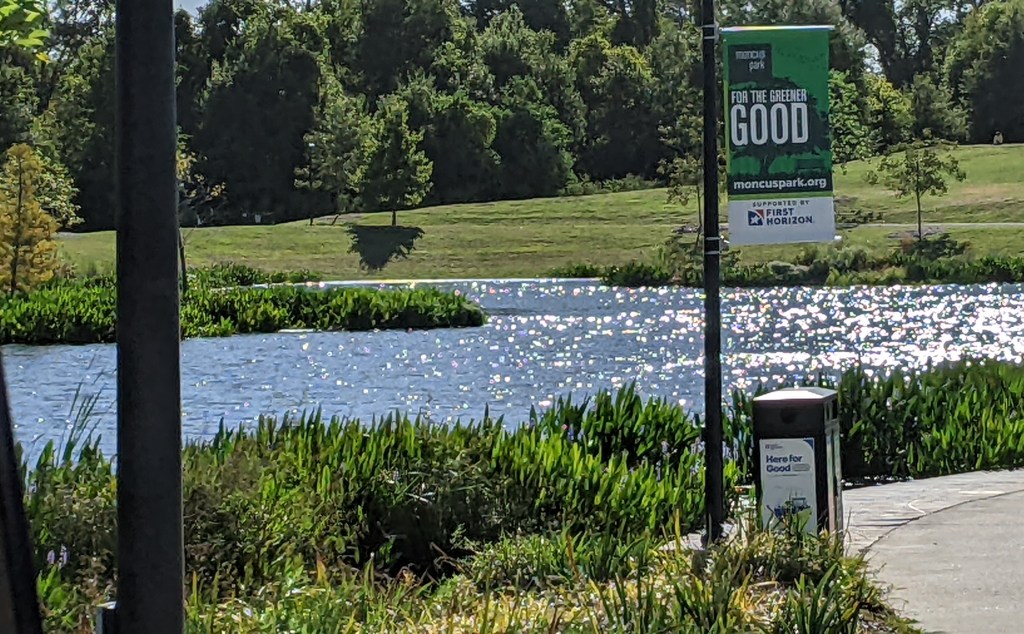
Some, accompanied by leashed dogs, were out for serious exercise in the beautiful surroundings while others simply enjoyed the various trees and plants on the rolling hills of a well-planned natural enclave that was once a horse farm. The park, operated now by a non-profit organization, was designed and built “by the community, for the community,” according to Kaylie LeBlanc, assistant vice president for communications of Lafayette Travel. One of the unique features is a 63-foot high hill, the highest point in Lafayette Parish! Development was begun in 2018, fueled by an initial $6 million grant. Now, a membership program funds ongoing park development and programming.
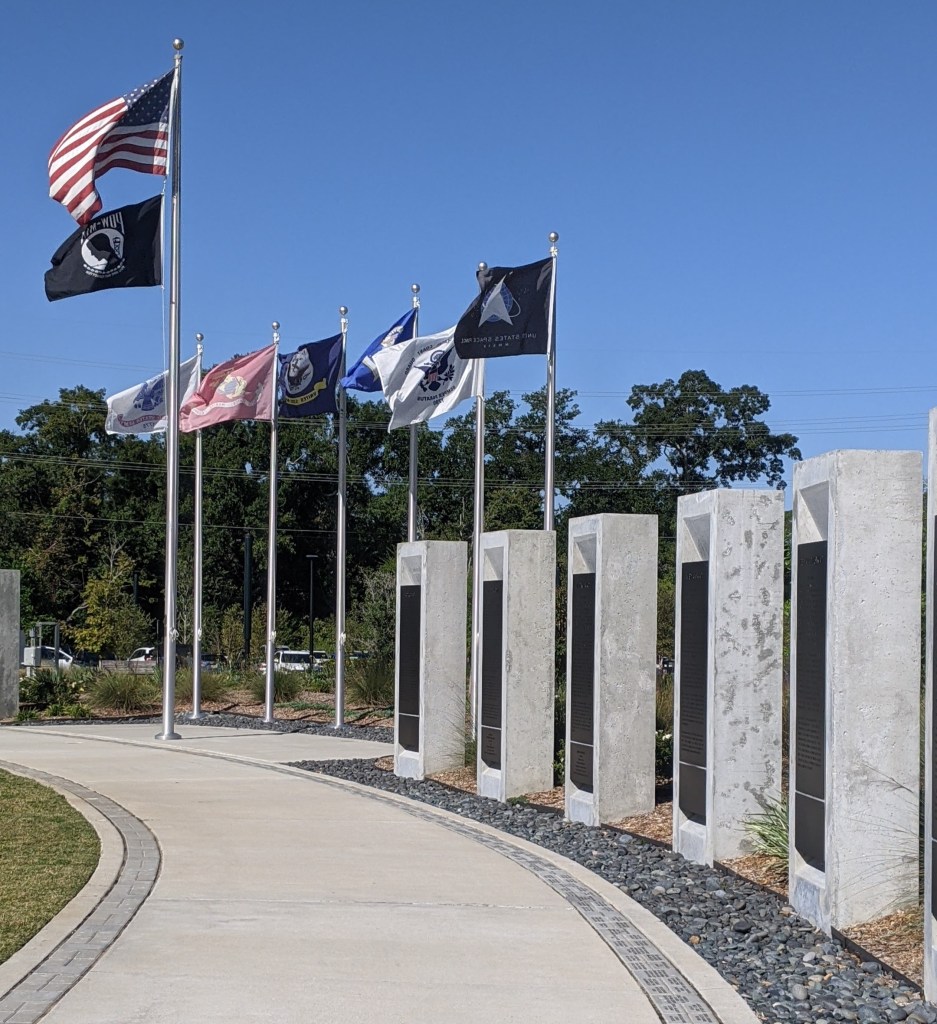
Also on the grounds is a striking Veterans Memorial that pays tribute to local residents who served their country in the various military forces throughout history. Memorial bricks line the path leading to the serene site with its polished granite plaques describing each war that U.S. troops have fought. It’s worth stopping to read each somber account, from a young country’s battle for independence to “Indian Wars — Circa 1600-1924” and the Global War on Terror — 2002-2021.
Moncus Park is one good reason to visit Lafayette, a city known as the “happiest city in America,” at the heart of Louisiana’s Cajun and Creole country. But there are many more.
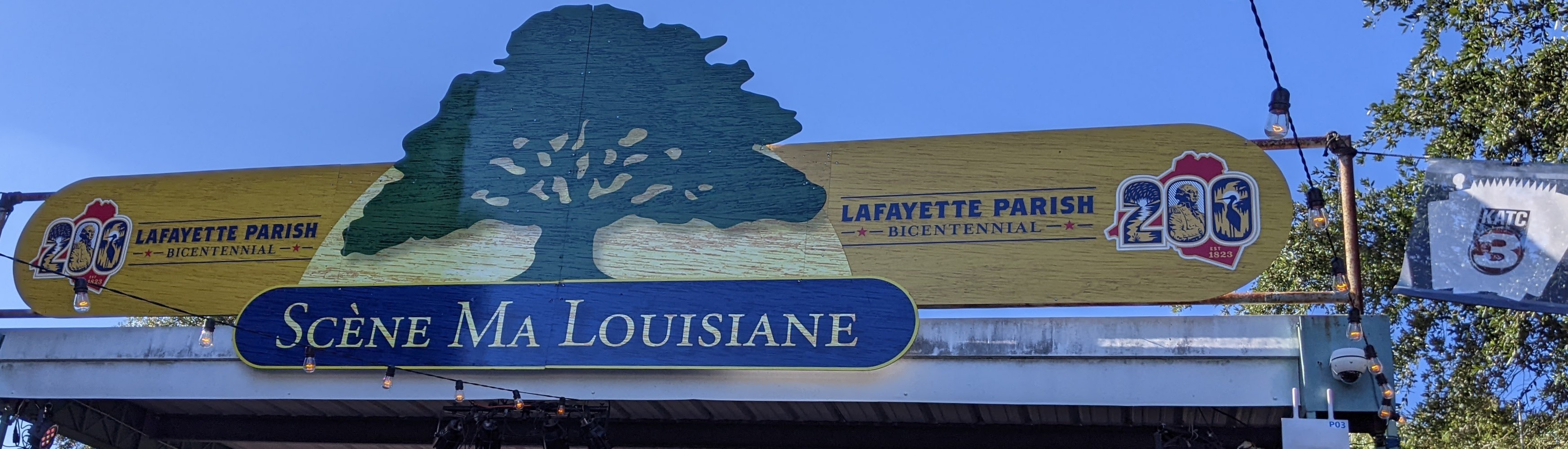
I was in Lafayette for three days of whirlwind activity during this year’s Festival Acadiens et Creoles, a celebration of food, art, music, history and distinctive culture. What a celebration it was! Lafayette boasts great food and lively music, to be sure, but learning the history of a people who left their homeland and resettled in faraway places was what I found intriguing, somewhat disturbing, and totally fascinating. I had not previously known that Cajun and Creole were and are so intertwined.
The Acadians who came to Louisiana from France by way of the Canadian Maritimes (primarily Nova Scotia, New Brunswick and Prince Edward Island) have retained a distinctive cultural identity that is remarkable and celebratory. Eventually, Acadian morphed into Cajun and Acadian/Creole/Cajun culture is the result. Although we did not visit it, the Acadian Cultural Center in Lafayette is one of six locations of Louisiana’s Jean Lafitte National Historical Park and Preserve. Admission is free, and the center is open Tuesday through Saturday year-round, except on national holidays.
An Ongoing Celebration
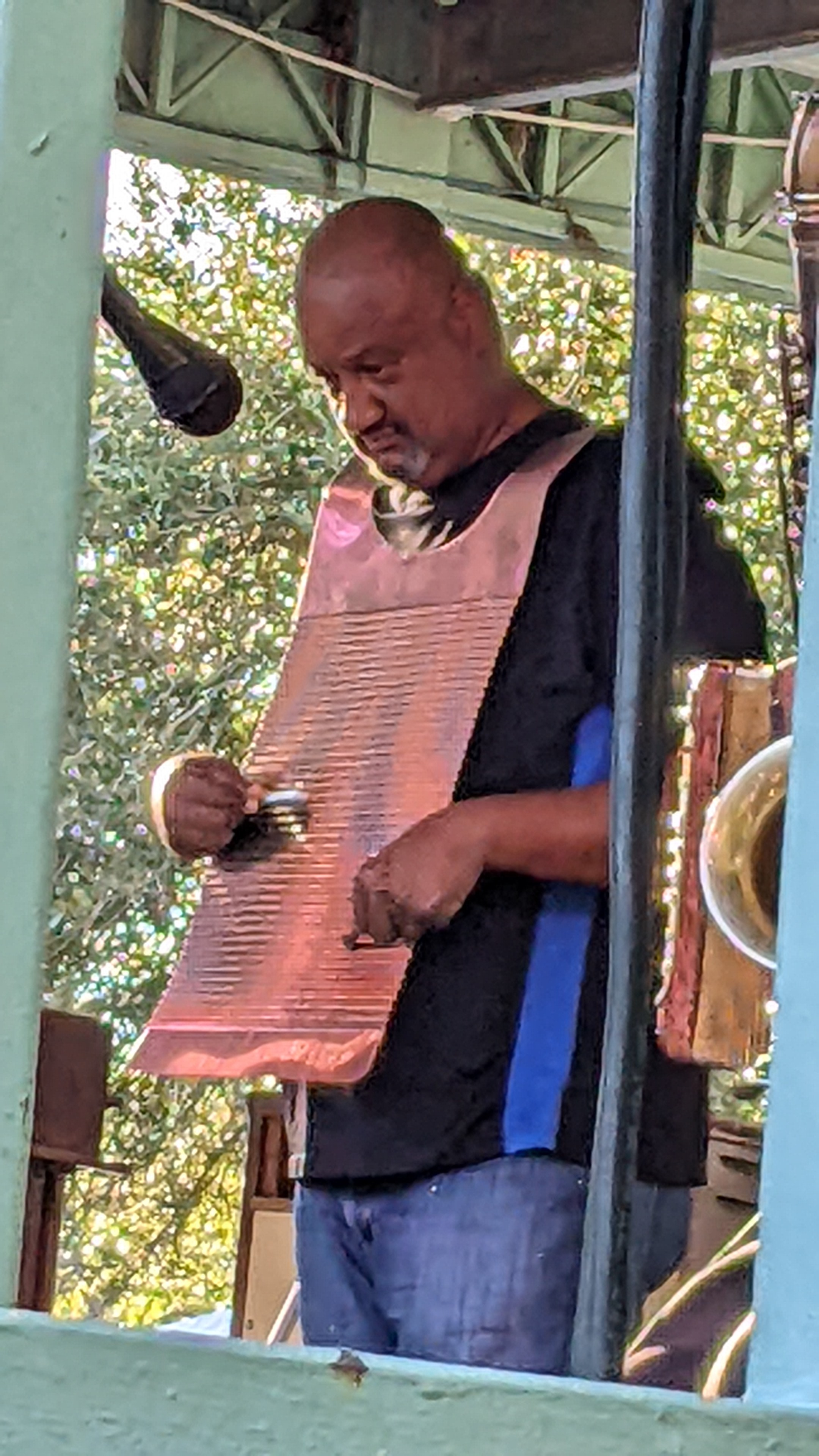
Lafayette is known for its festivals throughout the year, and this one certainly did not disappoint. What’s not to love about live bands that encourage complete strangers to “dance to the music” together? Add the enticing flavors of gumbo, jambalaya, etouffee and boudin sausage served fresh and hot from food trucks in the park, or the refreshing abundance of cold beer, spicy bloody Marys, flavored daiquiris, and other refreshments close at hand.
Girard Park in Lafayette takes on a carnival atmosphere that’s equally appealing for young and old alike, with food treats from beignets to soft ice cream, loaded hot dogs to boiled crawfish, fried gator bites and chicken wings to cheese-smothered grilled oysters! There is face-painting and bubble-blowing for the children, crafting demonstrations to watch and souvenirs to buy.
The performance stage is at the center of the activity, and many festival goers bring camp chairs or blankets. Picnic tables and benches are scattered about the park, and various tents offer seating for food and cooking demonstrations, musical lectures, and cultural programs.
From the ceremony of “cutting the boudin” to open the festival to the closing strains of music performed by an all-woman band as darkness fell on the festival’s last day, it was a great experience.
Traditionally held on the first full weekend in October, this celebration has been a Lafayette highlight since 1974. With a focus on the local sounds of Cajun and Zydeco music and local food specialties, the festival atmosphere extends not only throughout the park, but throughout the city. During festival weekend, shops are open late, visitors stroll the compact downtown area, marvel at the street art and local murals, enjoy crafts shows and outdoor exhibits, attend wine tastings and local business open houses, and snap souvenir photos at the Lafayette sign in a local park or selfies at the picturesque downtown arches.
Smiles and high spirits dominate the scene. It is truly a celebration that encourages active participation.
Beyond the Festival
The Festival Acadiens et Creoles is not, however, the largest celebration on Lafayette’s calendar. Held in April, the Festival International de Louisiane spills over into nearby cities and parishes and attracts visitors from throughout the world for the distinctly French-flavored celebration.
Lafayette also celebrates New Year’s Eve in a big way, and goes all out for Mardi Gras. Visit Lafayettetravel.com for up-to-date information on what’s happening when in this “happiest town” so you won’t miss out on any of the events that interest you. I don’t want to leave the impression, however, that visiting Lafayette, is simply one big party. As much fun as it can be, there is also a serious side to Lafayette’s personality
Cultural unity is pervasive and community spirit is inclusive. Informal, spontaneous musical jam sessions seem to be the norm and, more often than not, members of the public are invited to attend, join in, or sing along. Roots run deep here and pride of place and heritage is evident among young and old alike. Lafayette residents are intent on preserving their traditions. A conversation with a local resident can be equal parts history lesson and hope for the future, interspersed with family stories.
The Beginnings
Originally founded as Vermilionville in the 1820’s, the city was renamed Lafayette in 1884. Its population in 2023 is reported to be slightly more than 121,000, a slight decline from 2020 when it was just under 122,000. But the population of metropolitan Lafayette Parish exceeds 376,000.
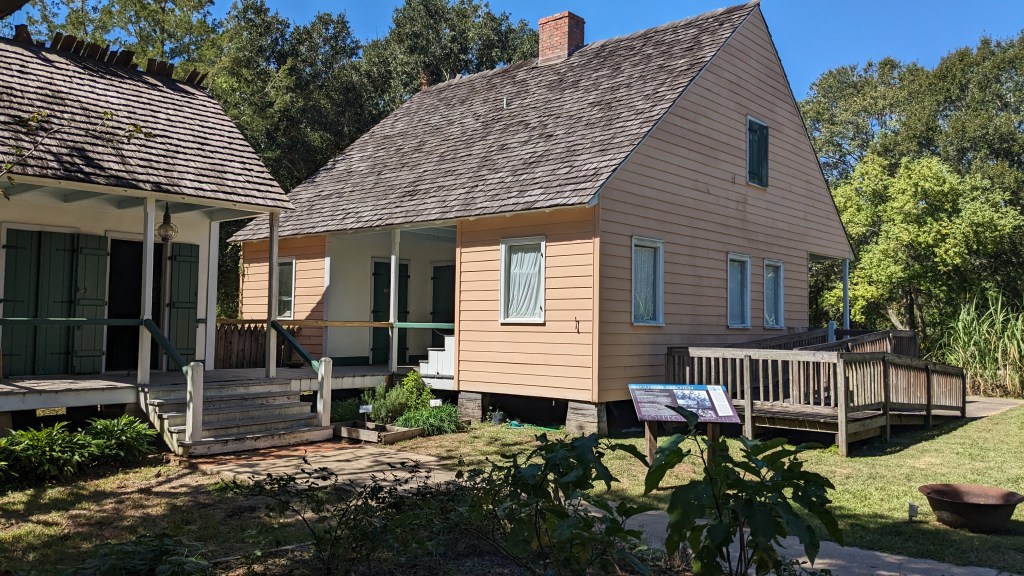
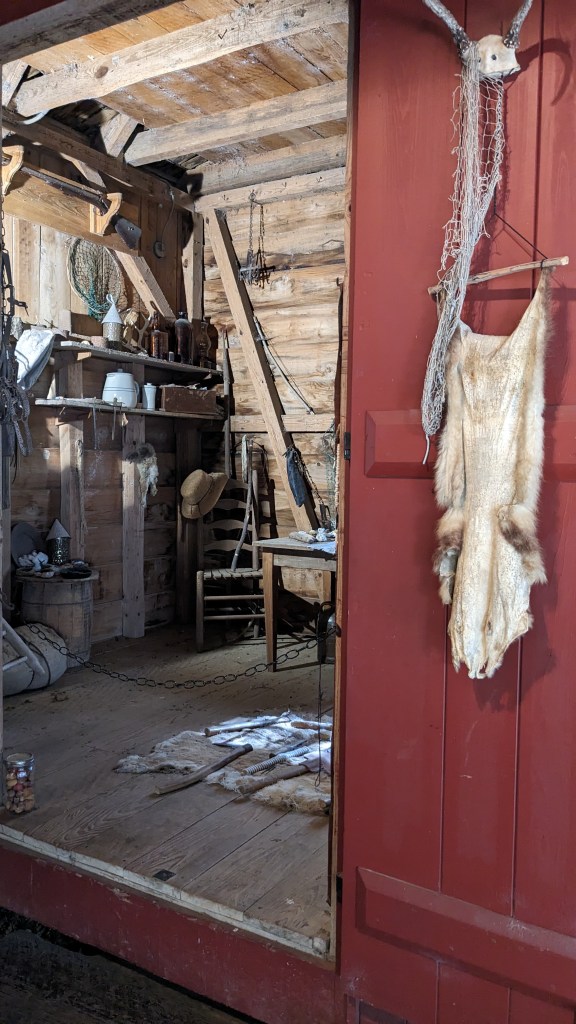
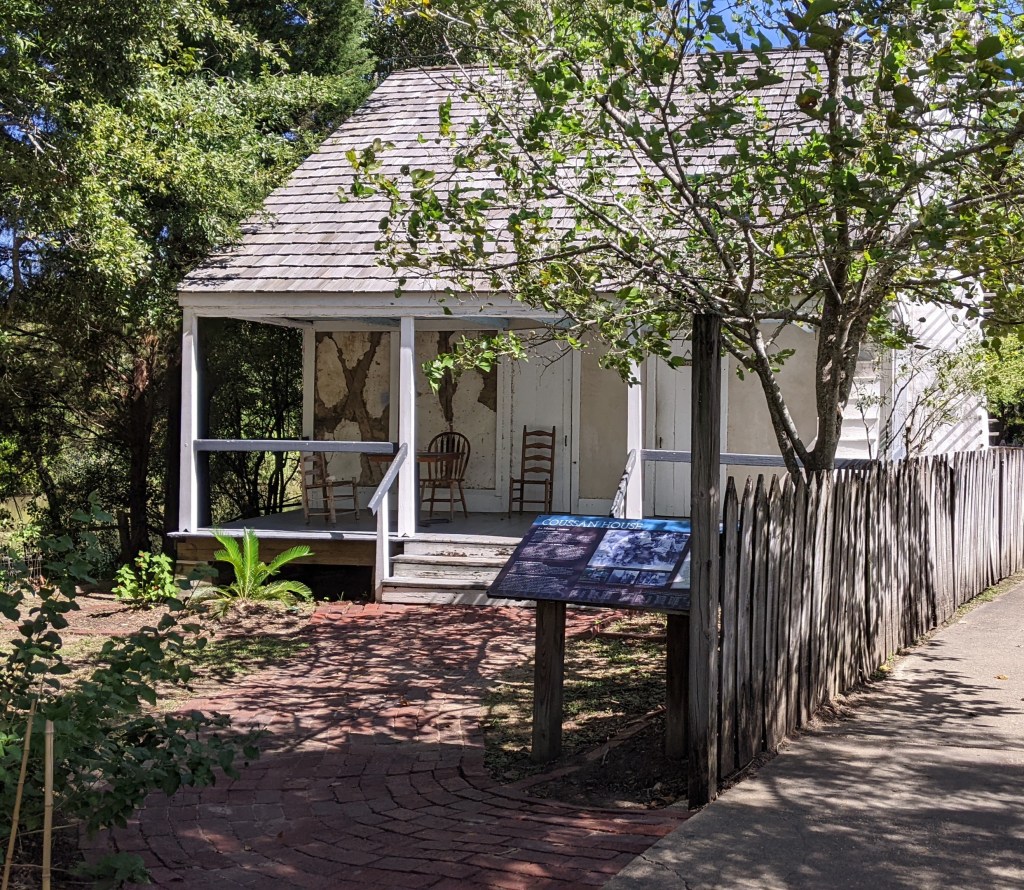
We visited the historical re-creation of Vermilionville, now a living history museum that takes visitors back to the early settlement. Signs along the paths chronicle how Acadian and Creole settlers interacted with native peoples and those of African descent through the late 1800s, and the buildings display a wealth of artifacts. It’s much better than a museum depiction. Walking along the paths offers a uniquely personalized insight into how lives were lived during those times.
Visit Vermilionville.com for information about events, programs and performances, including a 2nd Saturday French Table, a free gathering that allows visitors to “hear, speak and practice” the unique Acadian language. Other programs offer insight into the lifestyle and traditions of early Acadian settlers who sought to preserve their French-speaking culture on the American frontier.
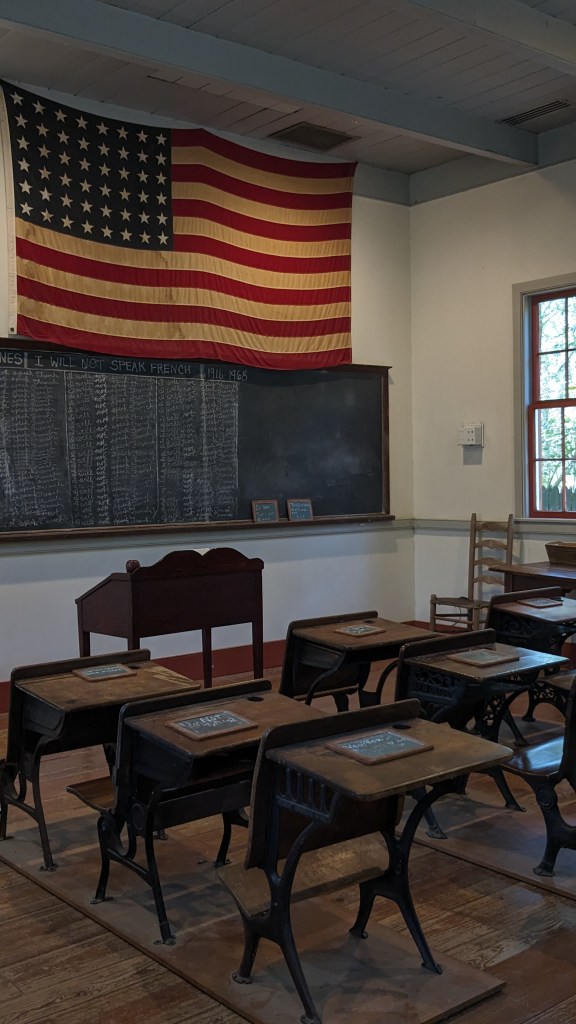
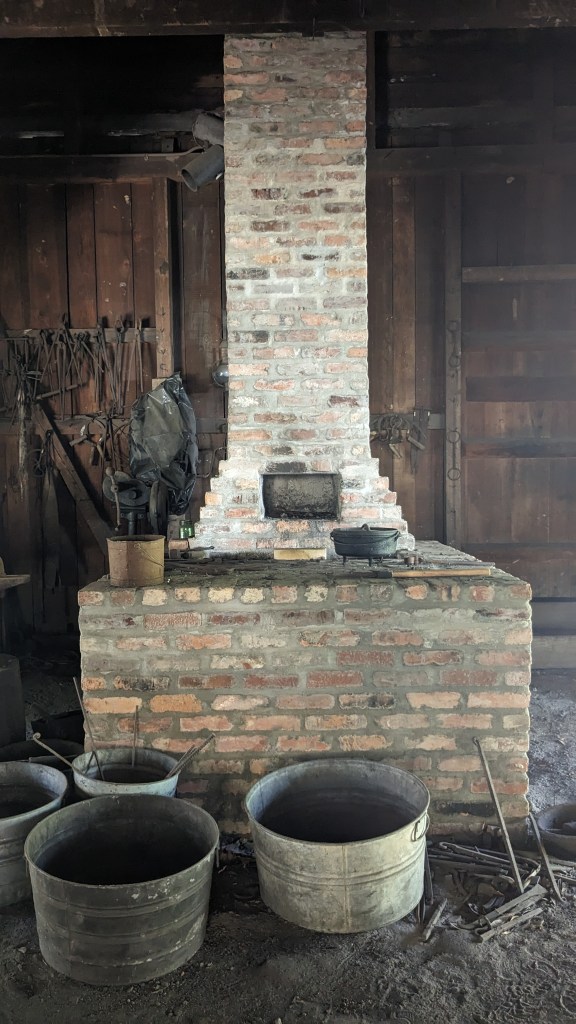
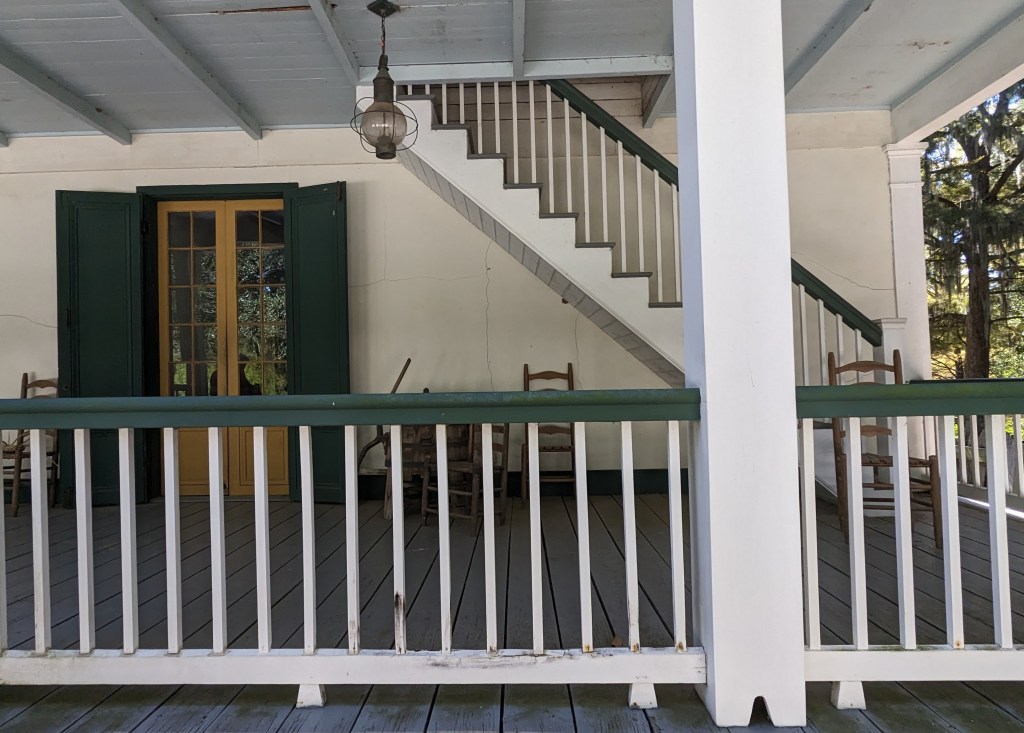
Among the buildings and various dwellings situated at the site are a schoolhouse, church, parsonage, carriage house and other utility buildings, as well as early “shotgun” houses and a wide variety of home styles that were popular through the decades. Traditional crops are still cultivated, and the historical village even has a resident donkey, a couple of sheep, and a working iron forge. This historical village offers a perfect opportunity to explore the history of Cajun culture and it’s impossible to leave without a profound respect for the early Acadian lifestyle, the Native American, Creole, and African influences, and Cajun traditions. We even learned some often-used words in Cajun French!
Our young guide, herself a proud Cajun, was clothed in traditional dress of the time, and she spoke with candor about growing up in this distinctive culture. I was awed as she sat down at a spinning wheel to demonstrate how yarn is spun from raw cotton, but then she apologized for not being very adept at spinning! We also were treated to an explanation of traditional, hand-sewn quilting skills by an older woman intent on preserving the skills that her ancestors possessed. We were duly impressed by the number, the quality and the variety of the quilts she has completed.
Building on Tradition
Our group was treated to a bountiful lunch at La Cuisine de Maman, where we feasted on traditional favorites prepared and served in a circa-1800 home at the site. Suffice it to say that no one left hungry!
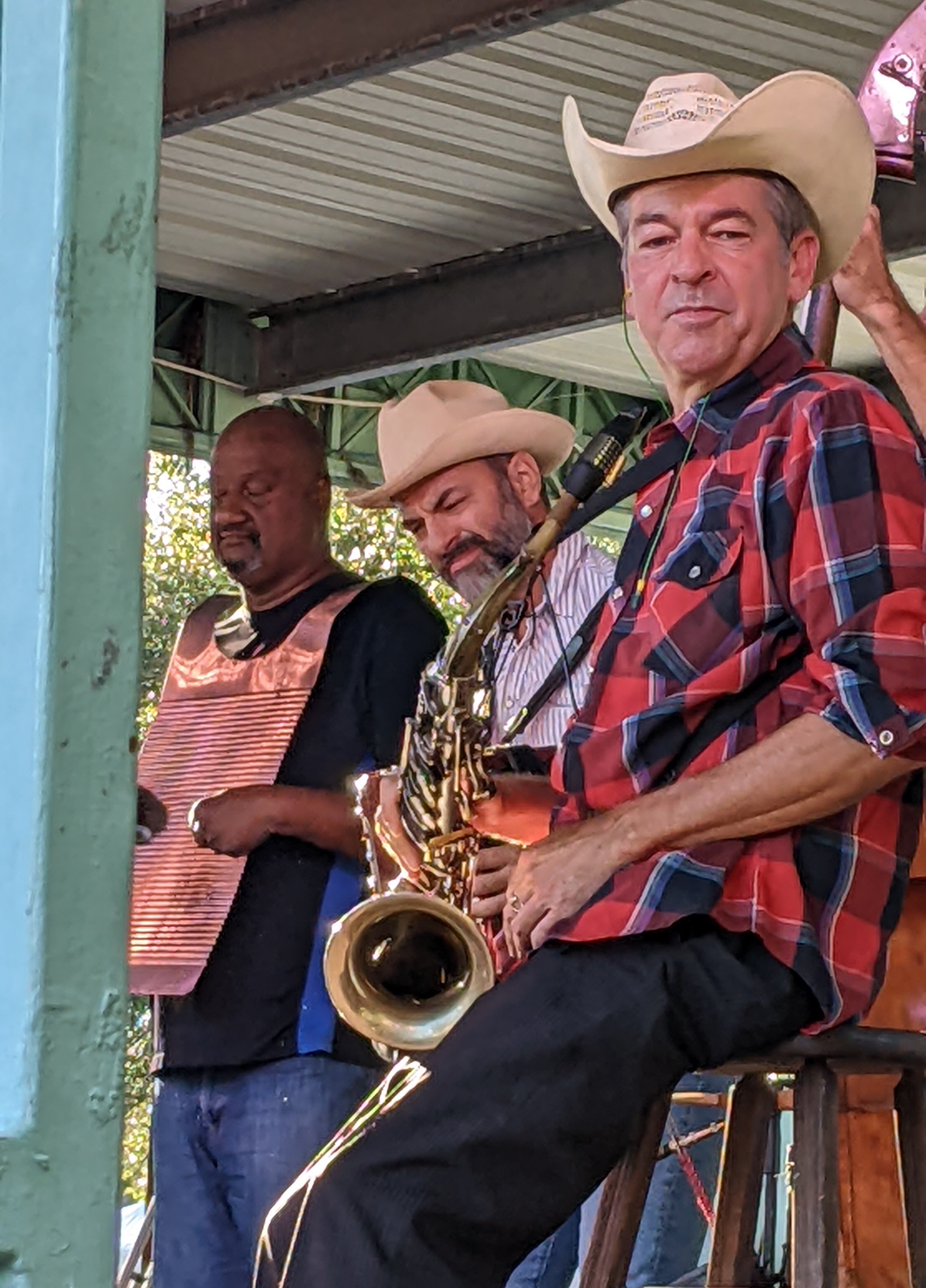
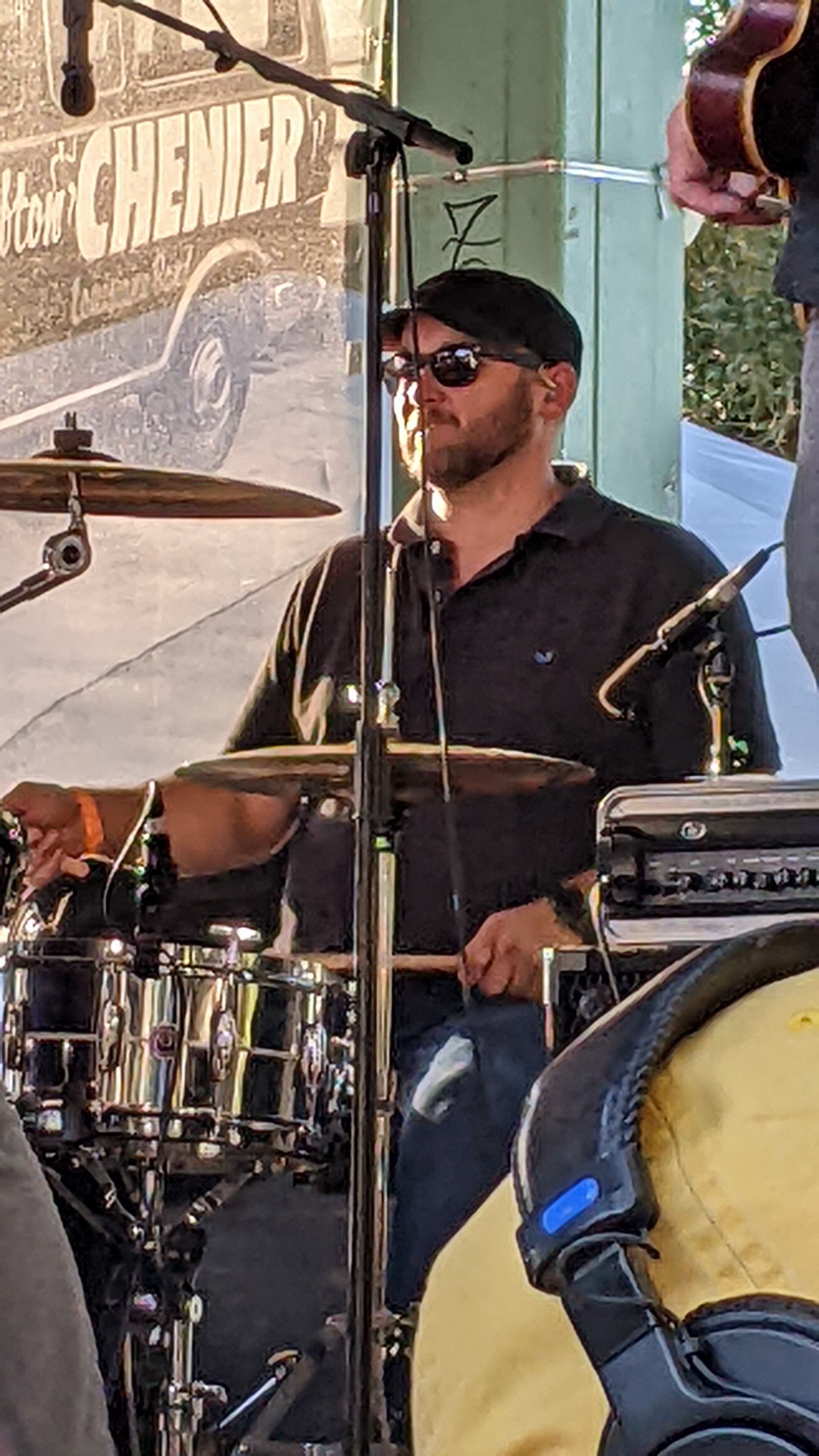
Before leaving Vermilionville, we stopped in at the Saturday music jam, held in a performance hall just across the courtyard from the restaurant. That became a fond memory of my short time in Lafayette, one that I will savor for a long time to come. That strangers come together to make music is impressive enough; that the music is well-played, sung with gusto, performed with no rehearsals and at no charge to the public, and enjoyed by all is truly special!
The music is one of the fondest memories of my time in Lafayette!
Yet to come is my account of an eye-opening and thrilling flat-bottomed boat trip through the Atchafalaya Swamp, along with a visit to nearby Avery Island with its jungle gardens and Tabasco factory, as well as more pictures and commentary about the people, the food and drink, the sights and the music scene in this distinctive Louisiana city. I’ll leave you with at least five good reasons to add Lafayette to your own travel plans for the coming year!
I must confess that the 1962 red Corvette convertible I once owned spawned dreams of taking the ultimate Route 66 road trip. The car didn’t come into my life until years after the TV show ended, but both were classics. And, as they say, old dreams die hard. Sadly, that car and I shared memorable times on other highways and byways, but the cruise along Route 66 never happened. The Corvette was a part of my automotive “stable” for about 15 years, and I fondly remember that first sports car.
I later learned, to my disappointment, that the car used in the television show wasn’t even red. Even so, it was easy to fall into the rhythm and excitement of traveling along the Mother Road, on a press trip in September with fellow travel journalists.
Route 66 was just about 2,450 miles long. It began in Chicago and meandered through eight states on its way to Los Angeles. Only 13 miles were in Kansas, but much of the original Kansas highway remains. What was America’s “first superhighway” opened in 1926 between Illinois and California, and it became a primary “escape route” for those who fled middle America during the Dust Bowl days. It was, at the same time, a symbol of opportunity and the sign of a country that changed rapidly following the war years.
The Way It Was
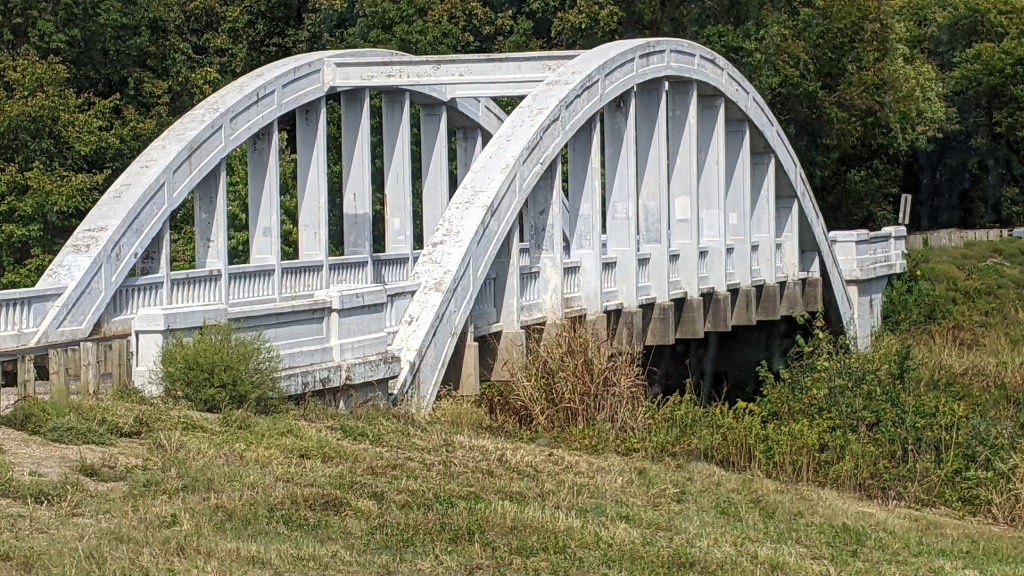
One can still drive across the last survivingMarsh Bridge over Brush Creek, one of three concrete and steel rainbow bridges that once traversed Kansas creeks along Route 66. The bridge now is on a loop road off the thoroughfare, and it’s a favorite destination for photos, picnics, and an occasional wedding. The Route was officially “decommissioned” only in 1985, and it is no longer the highway of choice for modern travelers, other than those who are seduced by its history and its television fame.
Kansas, at least this portion of it, hasn’t changed much visibly over the past several decades, but its people have. Modern highways move vehicles and people faster and more efficiently, but traveling the short stretch of Route 66 is definitely more fun! It’s clear that this section of the historic highway still does what it was designed to do — it “connects the main streets of rural and urban America.” The best part? There are ample opportunities to pull off the road and explore Kansas communities!
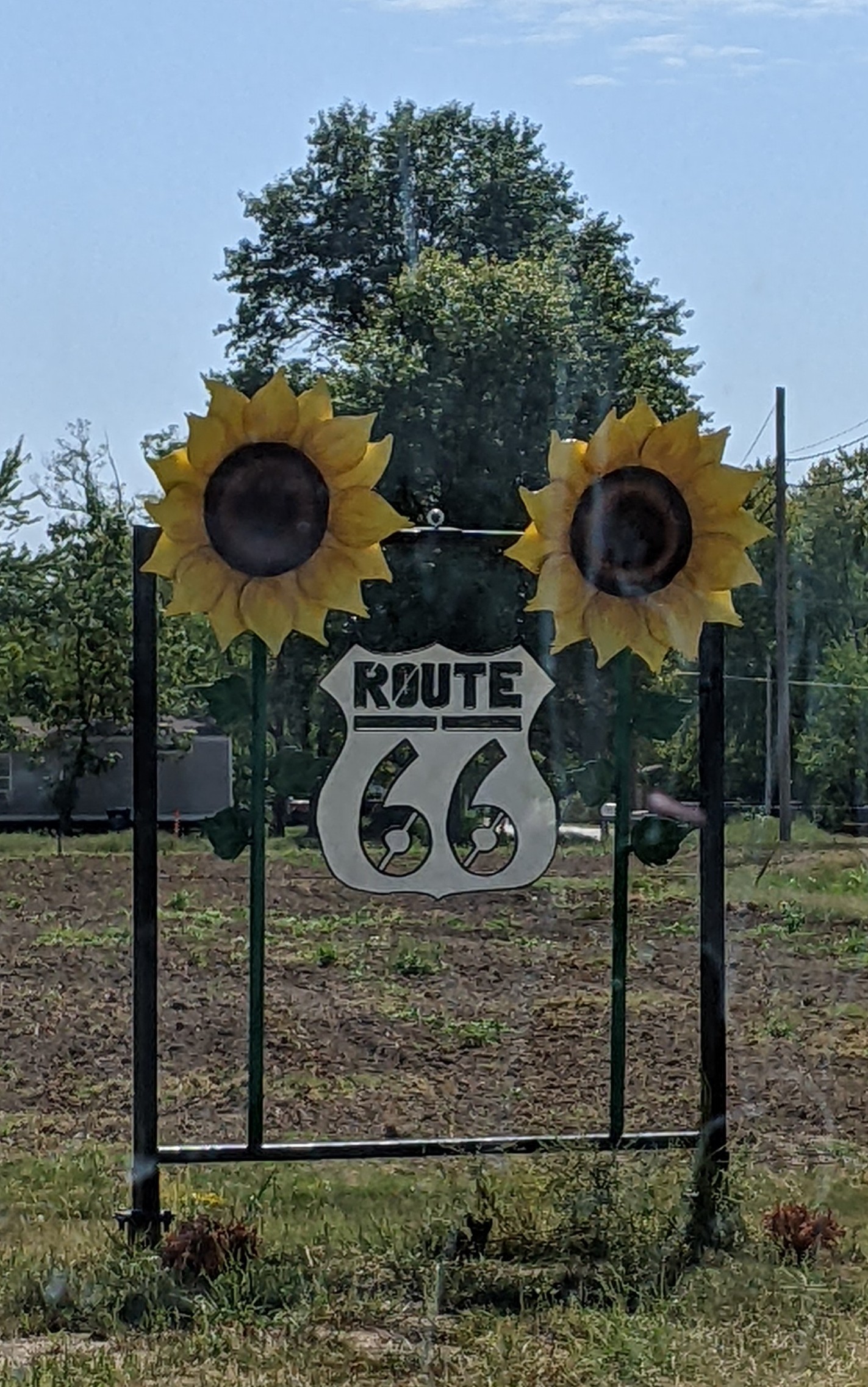
Nostalgic reminders of a very different past are evident along the way. History comes alive when the Route 66 signs appear.
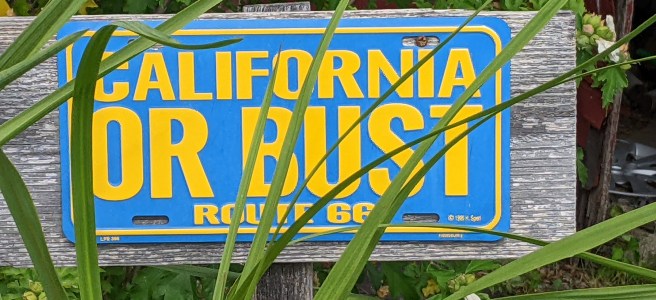
Nelson’s Old Riverton Store has been in continuous operation since 1925. Today, it looks much as it did then, and operates similarly, welcoming locals and tourists alike. It’s worth a visit – try a beet-juice pickled egg or purchase kitchy Route 66 magnets, ball caps, license plates and t-shirts. Why? Just because!
Locals still come to buy a loaf of bread or a can of beans, grab a soda and a sandwich, or just while away the time with friends. It’s that kind of place. It appears to be decades ago that any repairs were made to the building. Wildflowers grow up along the fence line and hanging baskets add color to the scene. Shopkeepers are welcoming and only too willing to share stories with visitors. It’s like stepping back in time.
It’s impossible to escape the influence of the Route in this part of Kansas.
Cars on the Route
Fans of Disney’s “Cars” are in for a treat at Cars on the Route in Galena. Visit the old Kan-O-Tex station and get up close to the rusty boom truck that was the inspiration for Tow Mater in the movie.
Walk down a dusty stretch of road and around a corner to enjoy a sack lunch at rustic picnic tables in the shade of a ramshackle lean-to. Snap some shots of the quirky old photo boards before moving on.
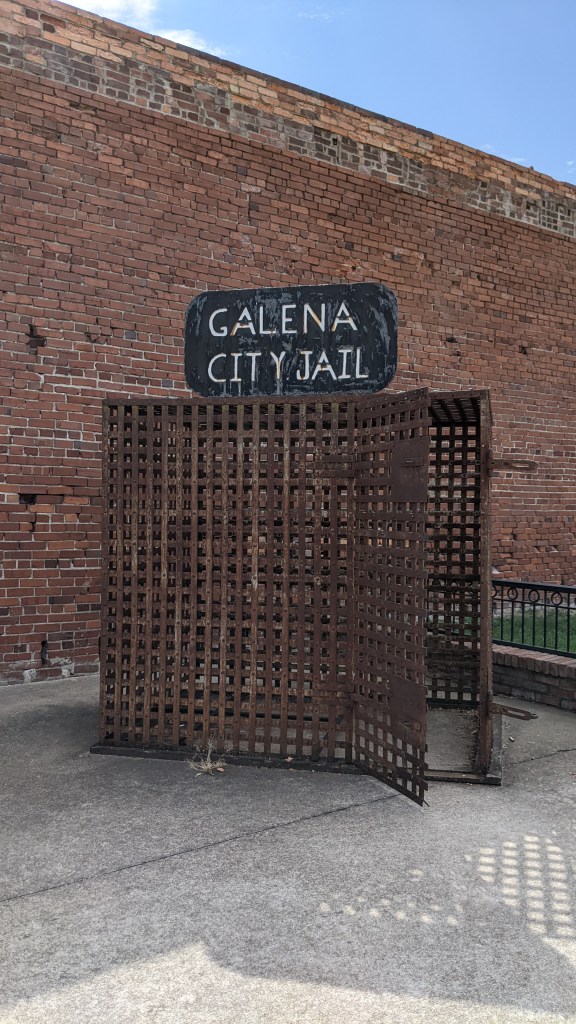
Other attractions in Galena include outdoor art and murals, a Texaco station turned curio shop on Main Street, complete with pumps set to recall the low gas prices of the time. There’s also a rusty old “jail” near the city’s square that provides an irresistible photo op!
We broke for lunch at Bricks & Brews in Baxter Springs, and what a treat that was, with a menu to satisfy any palate and attentive service accompanied by big smiles. We also stopped for an all-too-brief visit at the Baxter Springs Heritage Center and Museum. We had only limited time to spend, but it is a treasure trove of information about the town, the history of Cherokee County and southeast Kansas, the Civil War, and Route 66.
Nature and More
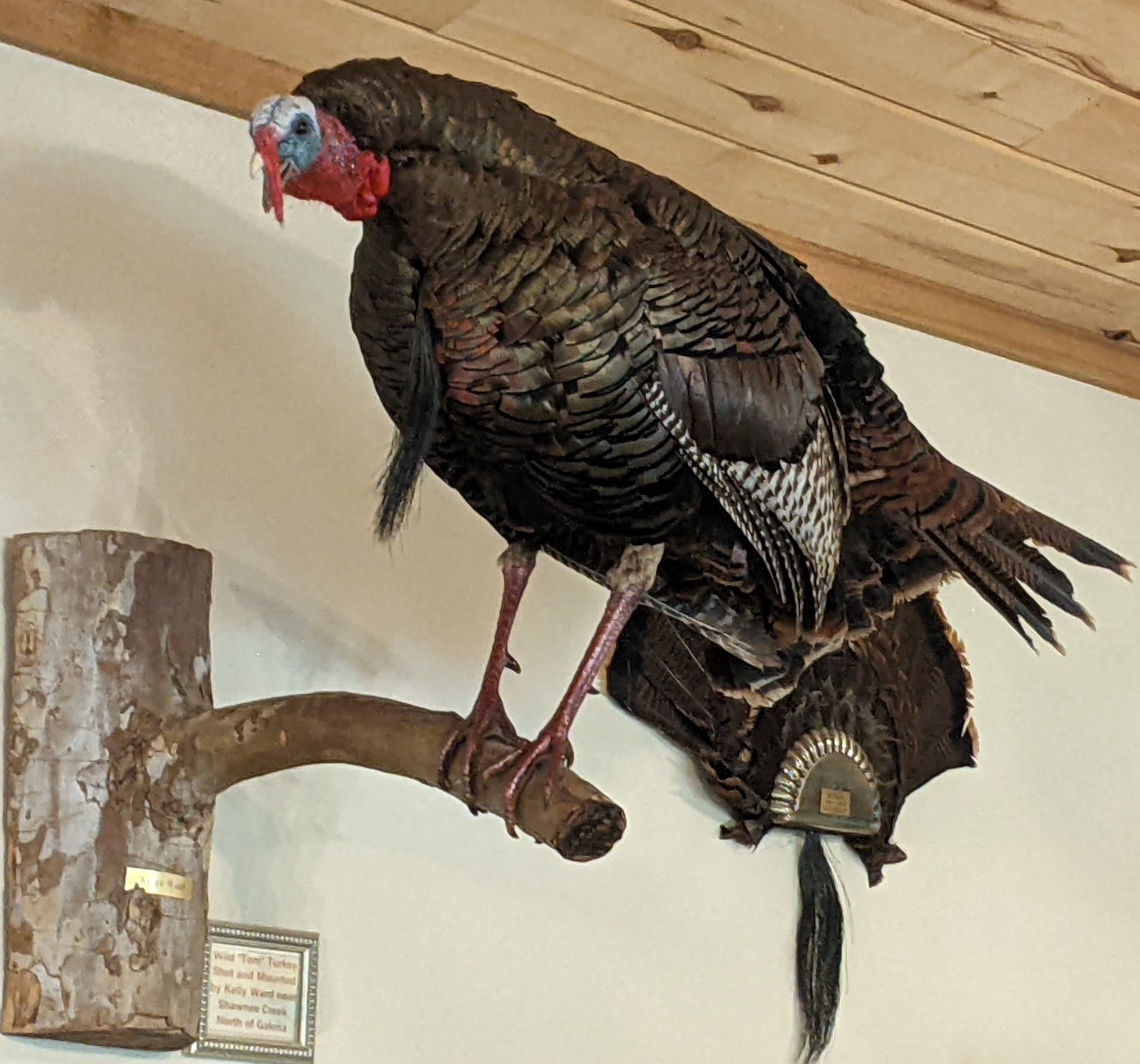
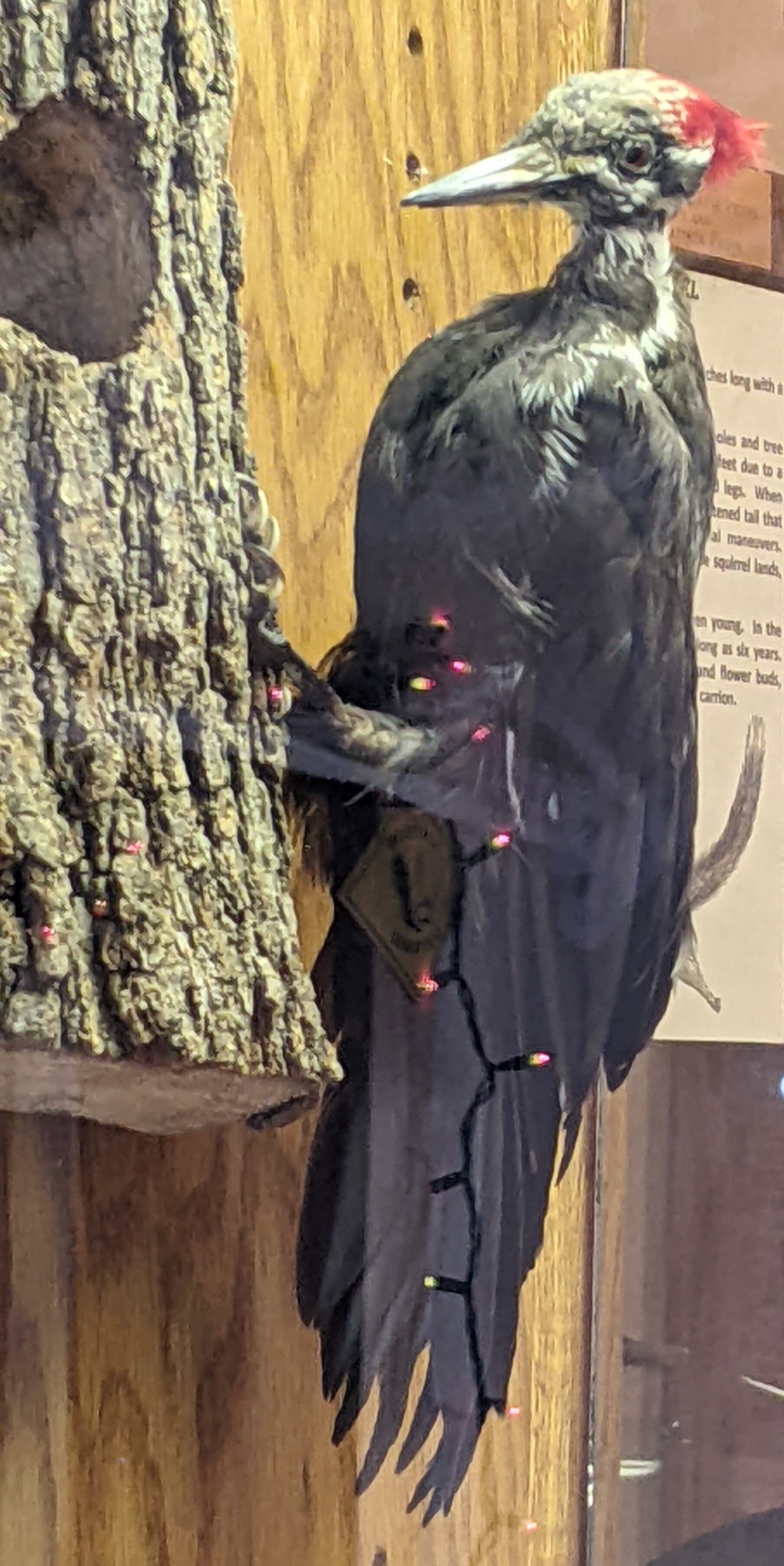
We pushed on to the Southeast Kansas Nature Center/Schermerhorn Park, near Galena. Admission is free, and the hilltop site acts like a magnet for anyone interested in visiting the 32-acre Shoal Creek Wildlife Area. There are wooded hills, streams, and caves to explore; dedicated anglers can even drop lines along a ¼-mile stretch of the creek. Indoor exhibits include live snakes, exploration drawers, plant, animal, and history exhibits, educational films, and the attention of a knowledgeable curator/guide. A bonus was a squirrel that visited the feeding station just outside the one-way glass!
Add in a visit to Big Brutus, standing tall and proud at an old coal mining site on the Kansas prairie, and we were ready to sample Kansas comfort food — fried chicken with all the fixins at not one, but two, local restaurants with long histories in Pittsburg, Kansas.
I’ll fill you in on the food — and there was lots of it — next time. Our group sampled both downhome dishes — some with a new twist — and culinary delights for sophisticated palates.
Planning a road trip to this part of Kansas from the neighboring states of Missouri, Oklahoma, and Arkansas, or from farther afield, is easy. It seems appropriate to leave the Interstates behind and enjoy the miles of farmland punctuated by picture-postcard views of old barns, fields filled with growing crops that stretch towards the sun, and animals lazily passing the time doing what farm animals do. The route stretches on with gentle curves; small towns are not far apart and each promises a unique and unusual experience.
Be sure to request your Kansas map and state travel guides in advance of a road trip to Kansas. Knowing where you’re going and what there is to see makes a driving trip so much better!
Full Disclosure: This trip was sponsored by Kansas Tourism, and the itinerary was prearranged. But the impressions are mine alone. I want to return, and it’s an easy road trip from my home base in Arkansas. I’ll be writing more about Kansas as well as about other travel to new destinations abroad in 2023. Subscribe to my blog here, or follow me on Facebook and Instagram.
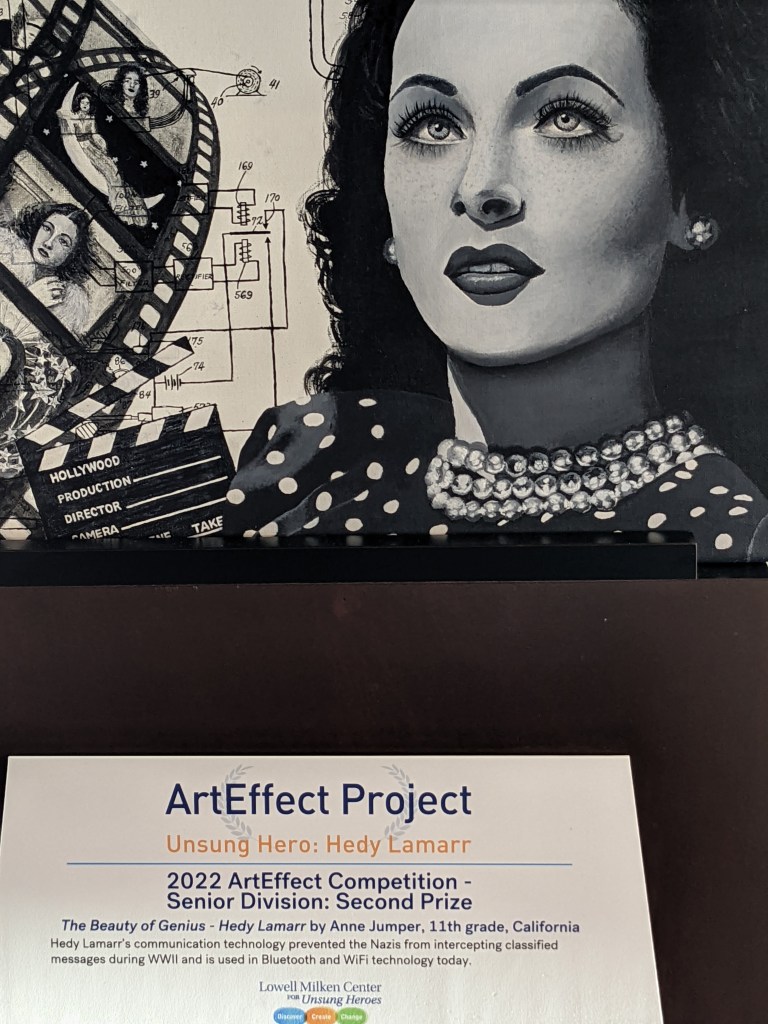
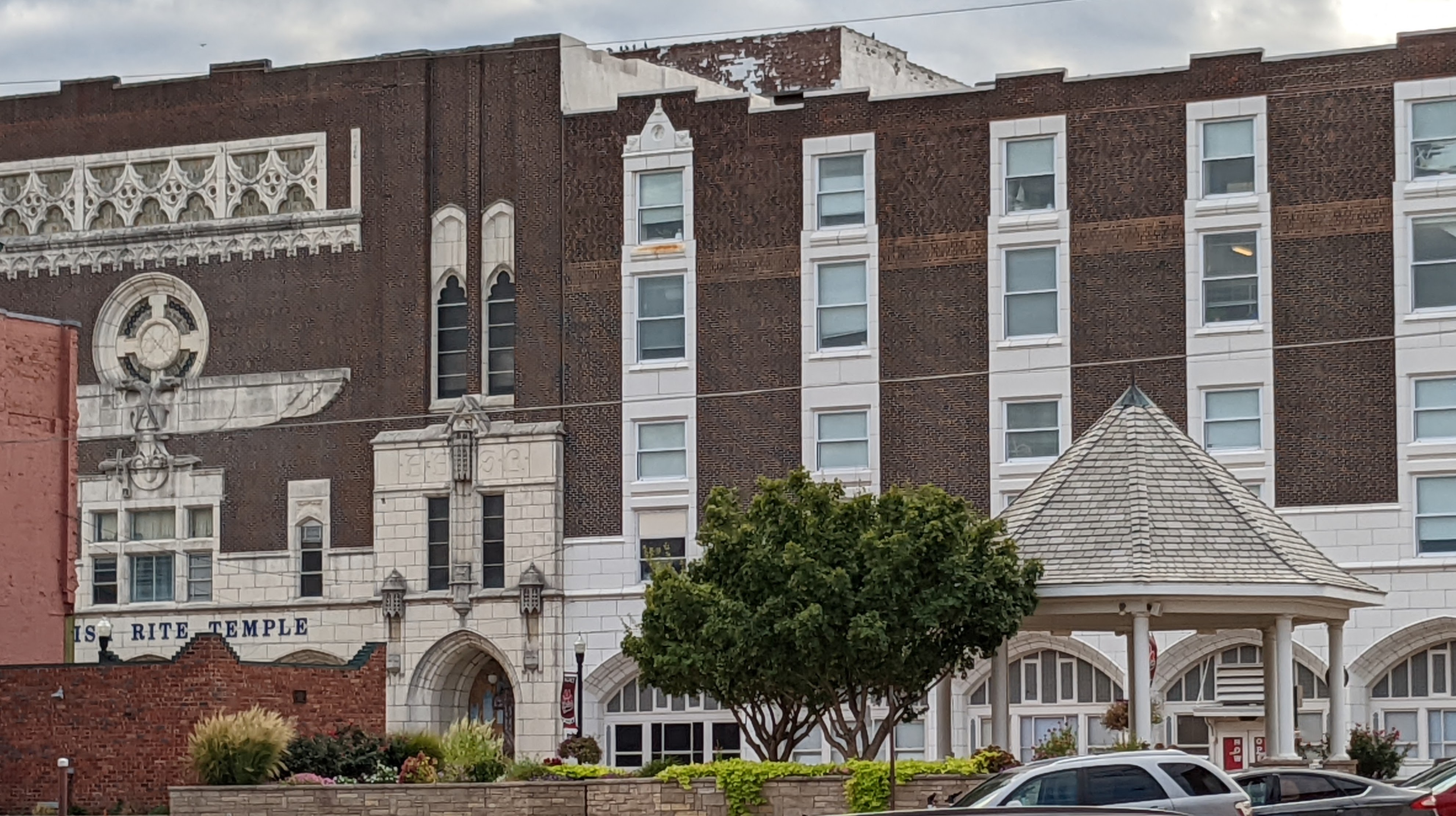
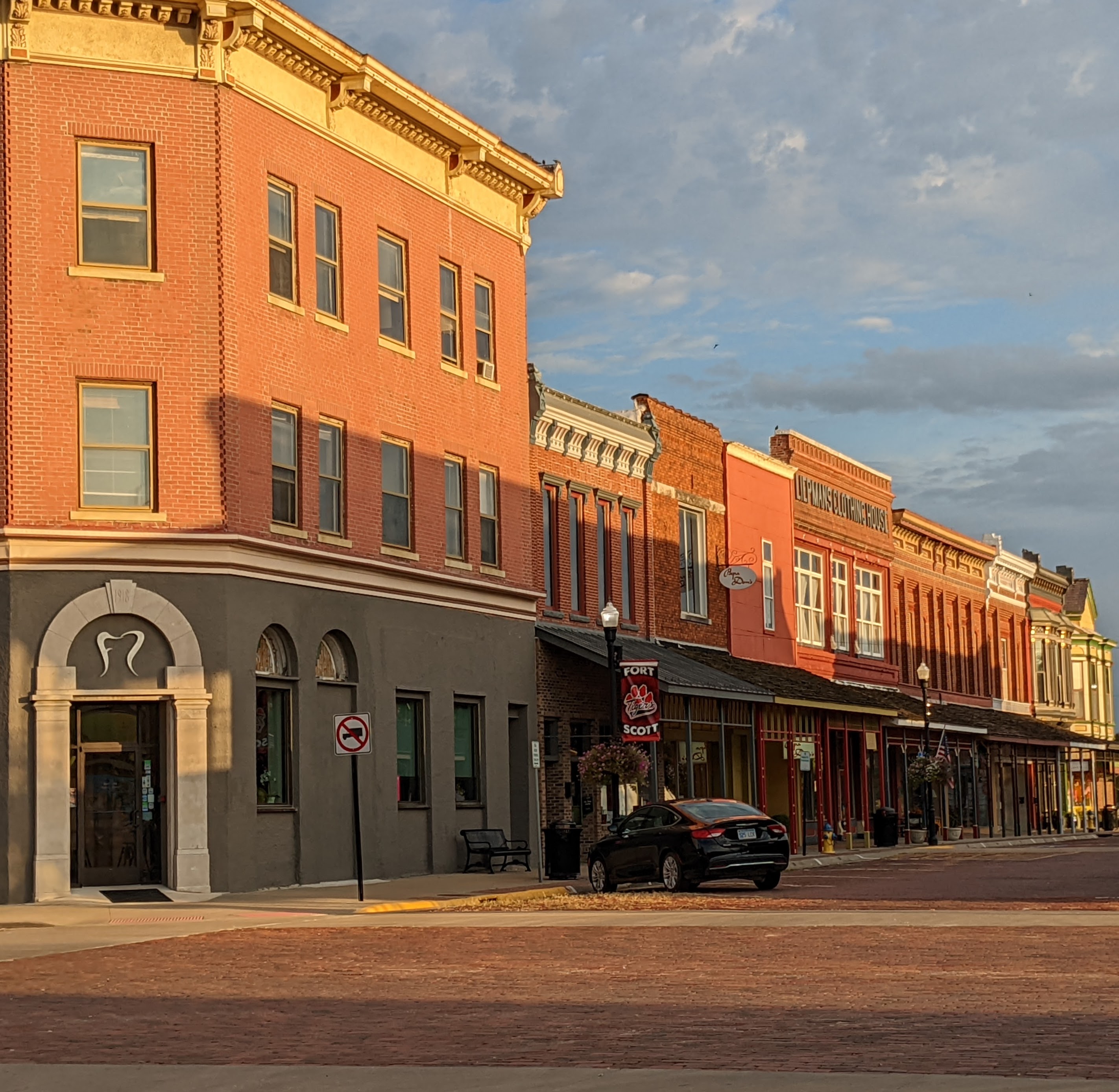
The Lowell Milken Center for Unsung Heroes occupies one of the newer buildings in Fort Scott, Kansas, situated across the street from its original location. Several century-old historic buildings in downtown Fort Scott, Kansas, were destroyed by fire in 2005 and have since been rebuilt. An adjacent outdoor park opened earlier this year and is a contemporary urban delight. The downtown still retains its former character, with traditional brick buildings and brick-paved streets, but the city’s history is being written with renewed vigor.
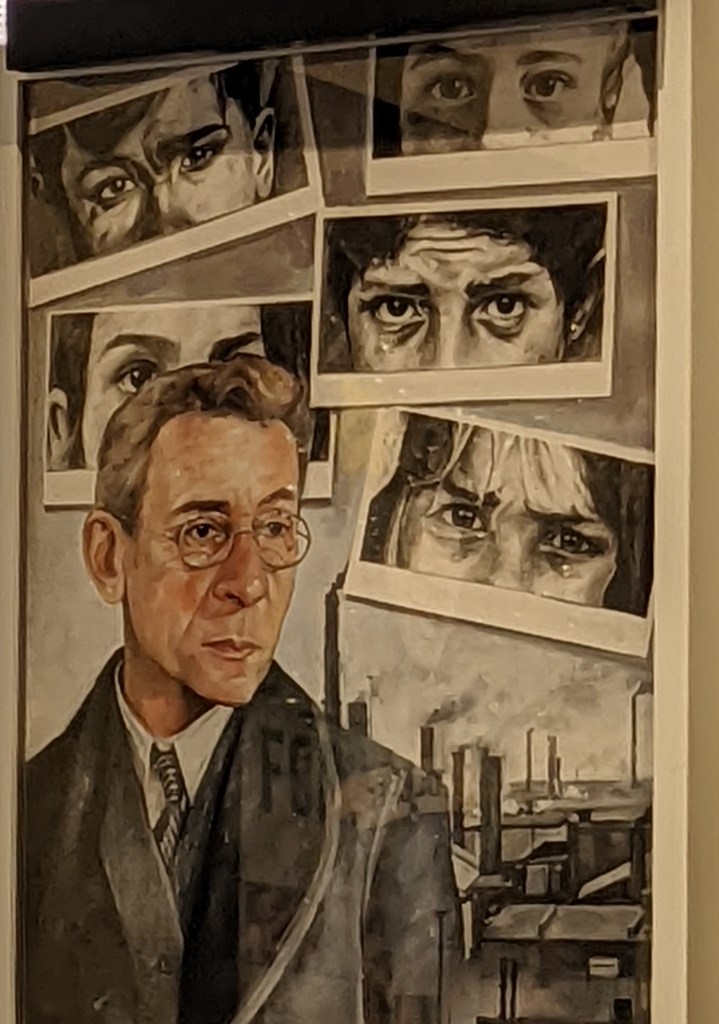
Stories told at the Center are larger than life, brought to life in a way that is truly remarkable. The history of the Milken Center is as awe-inspiring as the lives of the featured heroes. Visitors are introduced to real people who lived seemingly ordinary lives, playing largely unknown and unrecognized roles in history. Their stories have been uncovered, researched, and retold by students, through art and drama, photographs and videos, essays and interactive displays. Their truths are as thought-provoking as they are disturbing. The history of the Milken Center is as awe-inspiring as the lives of the featured heroes.
In 1999, Norm Conard was a social studies teacher at Uniontown High School in rural Kansas. He had given his class a History Day assignment. One of his student teams learned of Irena Sendler, a Polish Catholic social worker who was instrumental in rescuing children from the Warsaw Ghetto during World War II. She buried the names of rescued children in milk jars hidden under a tree. It was, and still is, quite a story. Read a more detailed account here. The students found that Sendler was alive and living still in Poland. In 2001, Conard accompanied a group of students to Poland to meet with her. Several other trips followed, until she passed away in 2007. The student-written play about her deeds, “Life in a Jar,” has been performed more than 350 times, and it continues to be be staged in the U.S and Europe.
During his tenure at Uniontown High School, Conard’s students created more than 85 projects, telling the stories of other common people who performed uncommon acts. Those stories are now the focus and backbone of the Center for Unsung Heroes. New heroes continue to be identified by groups of students — from fourth grade through high school — who have been inspired to dig deep into history and to move far beyond the obvious.
Today, Norm Conard serves as chief executive officer of the Center and is also the director of the Life in a Jar Foundation. It was, after all, his classroom motto for the History Day project in 1999 that gave birth to the idea. That motto? “He who changes one person, changes the world entire.” The Lowell Milken Center was founded with the goal of creating ripples of influence that will engage even more educators and students in an effort to change the world. Megan Felt, one of the students who first identified Irena Sendler, is the center’s program director.
Plan to spend longer than you may originally intend at the Milken Center. It is no ordinary museum. It’s a place to discover the true meaning of heroes in a time when that word is often overused. It’s mesmerizing and unforgettable.
But the Milken Center isn’t the only reason to visit Fort Scott.
Before Kansas was even a territory, Fort Scott was a military outpost. It was established on the frontier in 1842 but the Army abandoned the garrison in 1853. The city was chartered in 1860, one year before Kansas became a state. Today, it’s the only such town to survive. Its military cemetery, one of 12 originally designated by President Abraham Lincoln, is listed as U.S. National Cemetery #1.
Our group spent that first night in Kansas at the Courtland Hotel and Day Spa. Situated in a building that dates to 1906, it was once a bustling laundry with a boarding house on its upper level. Proprietor Frank Adamson, a Fort Scott native, is only too happy
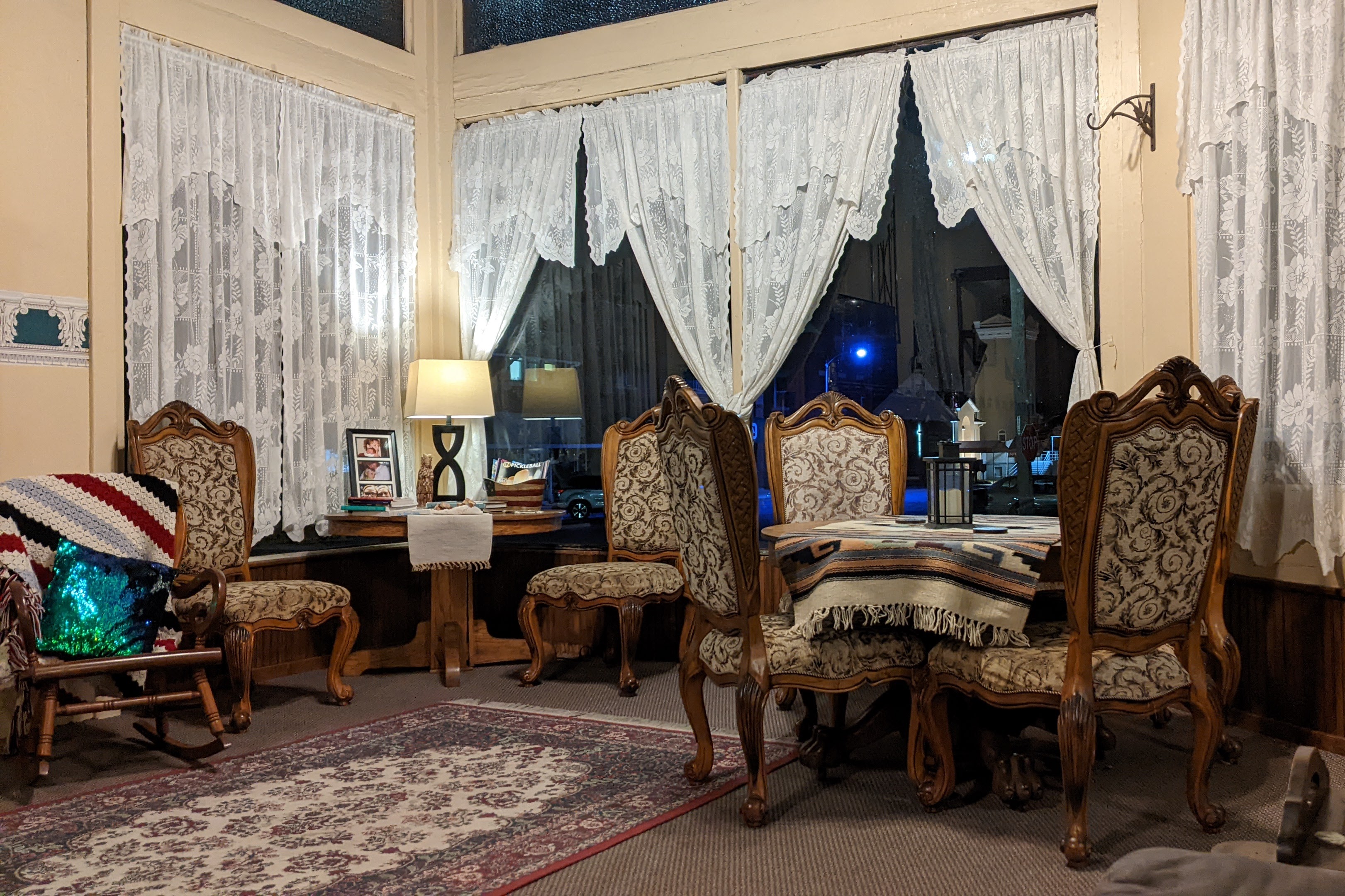
to offer insights into city history! He and his wife, a massage therapist, purchased the building as a location for her to open a day spa. They remodeled a portion of the main floor for the spa, with refurbished guest rooms on the second floor. Today, each room in the hotel is distinctive, filled with antiques and period decor to complement the architecture and honor the building’s history. A main floor lobby, office area and dining room retain the period charm of the past, and serve as a gathering spot where Adamson regales guests with stories of Fort Scott’s past.
A center of pre-Civil War turmoil between slavery proponents in nearby Missouri and local anti-slavery forces, this part of of the state was known as “Bleeding Kansas” until the end of the Civil War, even though Kansas entered the union as a free state in late January 1861, before the war began. As the U.S. Army’s district Headquarters, Fort Scott was a quartermaster supply depot, training center, and recruitment station.
At one time, it was a noted frontier city, one of the largest in eastern Kansas, and it rivaled Kansas City as a railroad center. All that now remains of that time is the original, restored Old Fort building, now relocated to the town square. But the stories that date to those times are fascinating, and visiting Fort Scott is like stepping back in time to a simpler era. Brick-paved streets, sturdy brick buildings, and stately period lamp posts reflect its history, but its people have their sights set on the future, and they’re doing their best to integrate the two.
We left Fort Scott and headed for Route 66 — The Mother Road. Only 13 miles of the unique highway traversed a corner of the state, but it’s impossible to escape the influence of the Route in this part of Kansas. Come along next Wednesday as we recreate a legendary road trip. We had great fun along the way and discovered more unique attractions in Southeast Kansas!
It’s called the Natural State, or sometimes the Diamond State. After moving to Arkansas in the midst of the pandemic, my husband and I have now been residents of this state for a full year. We have settled into a new routine, and now we’re more than ready to venture out to see what prompted those labels for Arkansas. Within minutes of our home are both a national park and a national forest. Numerous state parks, mountains, lakes, rivers and historical sites are not much further afield. Getting to them is easy by car, and we have already enjoyed quick road trips on back roads to learn the lay of the land, as they say.
We like what we see.
We also just acquired a “new to us” vehicle, purchased with the sole intent of having fun as we explore some of the interesting highways and byways of our adopted home state. It’s a convertible, so we can feel the wind in our hair on pleasant drives when weather permits. As anyone who knows me knows, I typically try to avoid interstate highways, much preferring back roads and curvy lanes where it’s easy to catch a glimpse of wildlife, wildflowers in the fields, odd signs and old buildings.
We like pulling off the road to have a closer look if we see something interesting, and we have been known to follow hand-lettered signs to classic car shows, country stores, out-of-the-way fudge shops, charming churchyards and old battlefields. Bear that in mind as I take you to some unique destinations. We have found also that there are plenty of friendly folks in smaller towns, folks who, for the most part, are only too willing to stop whatever it is they’re doing and tell us about what we’re about to discover.
Sometimes we pack a picnic, or we’ll stop for a quick bite and a cool drink anyplace that seems a little quirky. We might look for a quaint B&B or a rustic cabin, but many of our jaunts don’t require an overnight away from home. Most of the time we don’t make reservations. We are footloose and fancy free at this point in our lives. Until we are free to travel globally again without restrictions, warnings (or masks) we will probably stay closer to home. We have decided that’s okay for now, so we’re busy planning more regular getaways. I hope you’ll come along.
Here’s a peek just to whet your appetite for what’s to come. I take lots of pictures, so they’re the focus right now — the stories will come later; I’m saving my words for later and longer trips. For now, I’ll just share some Hot Springs sights, beginning with random shots around Hot Springs and the home turf that we have come to love.
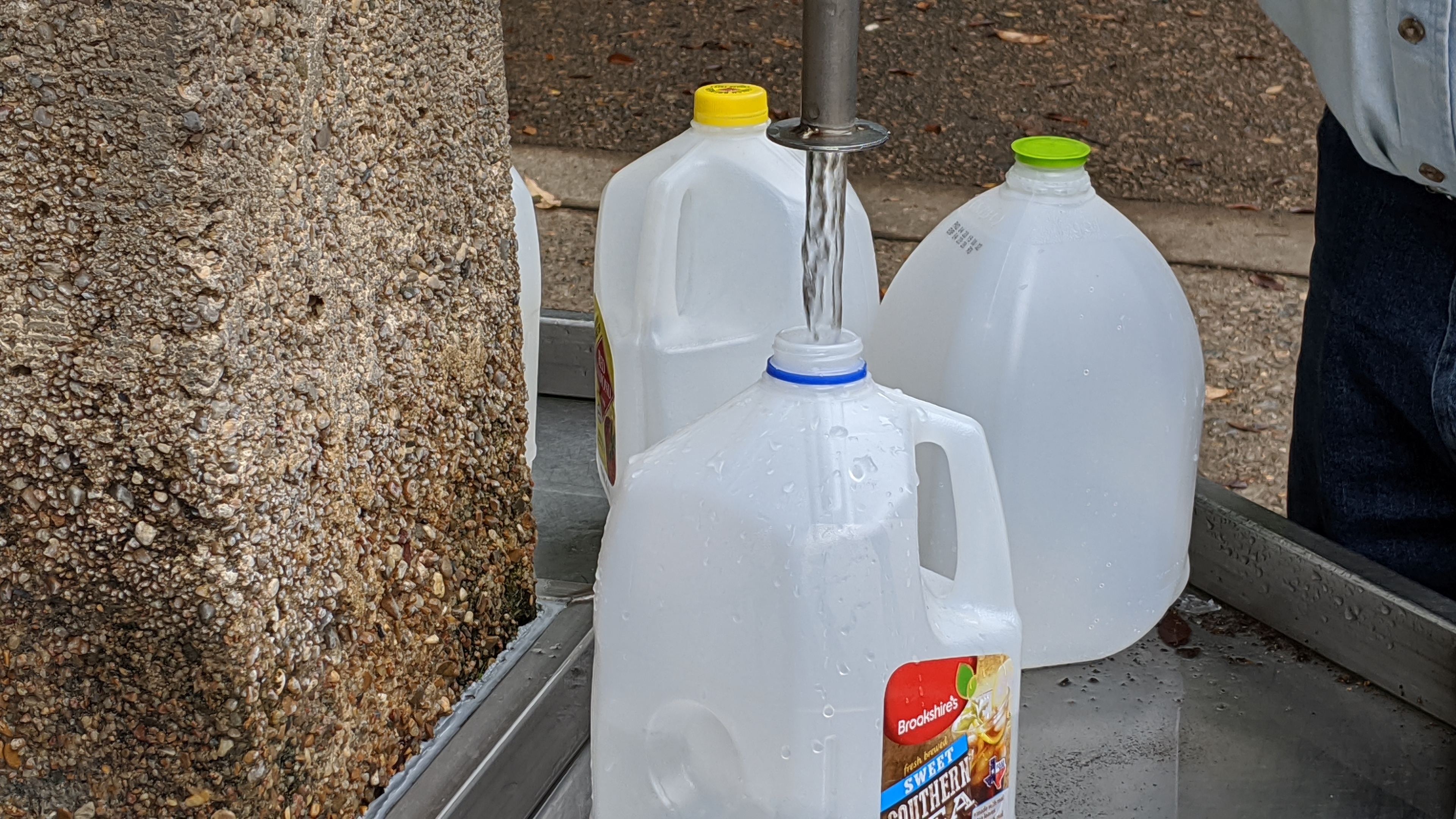
In case you’re wondering, the hot springs still flow . . . and, like many other locals, we make a weekly trip to the city’s free spigots to fill our water bottles. It’s nature’s gift to us, and it’s really good water!
We want to explore Hot Springs more fully, and we will do that this winter, when it becomes somewhat quiet again after summer tourists leave. The National Park that encompasses the city just celebrated its centennial. Land that contains the natural thermal springs was set aside as Hot Springs Reservation in 1832, but the area was mapped initially under an order to explore the southern Louisiana purchase, issued by President Thomas Jefferson in 1804.
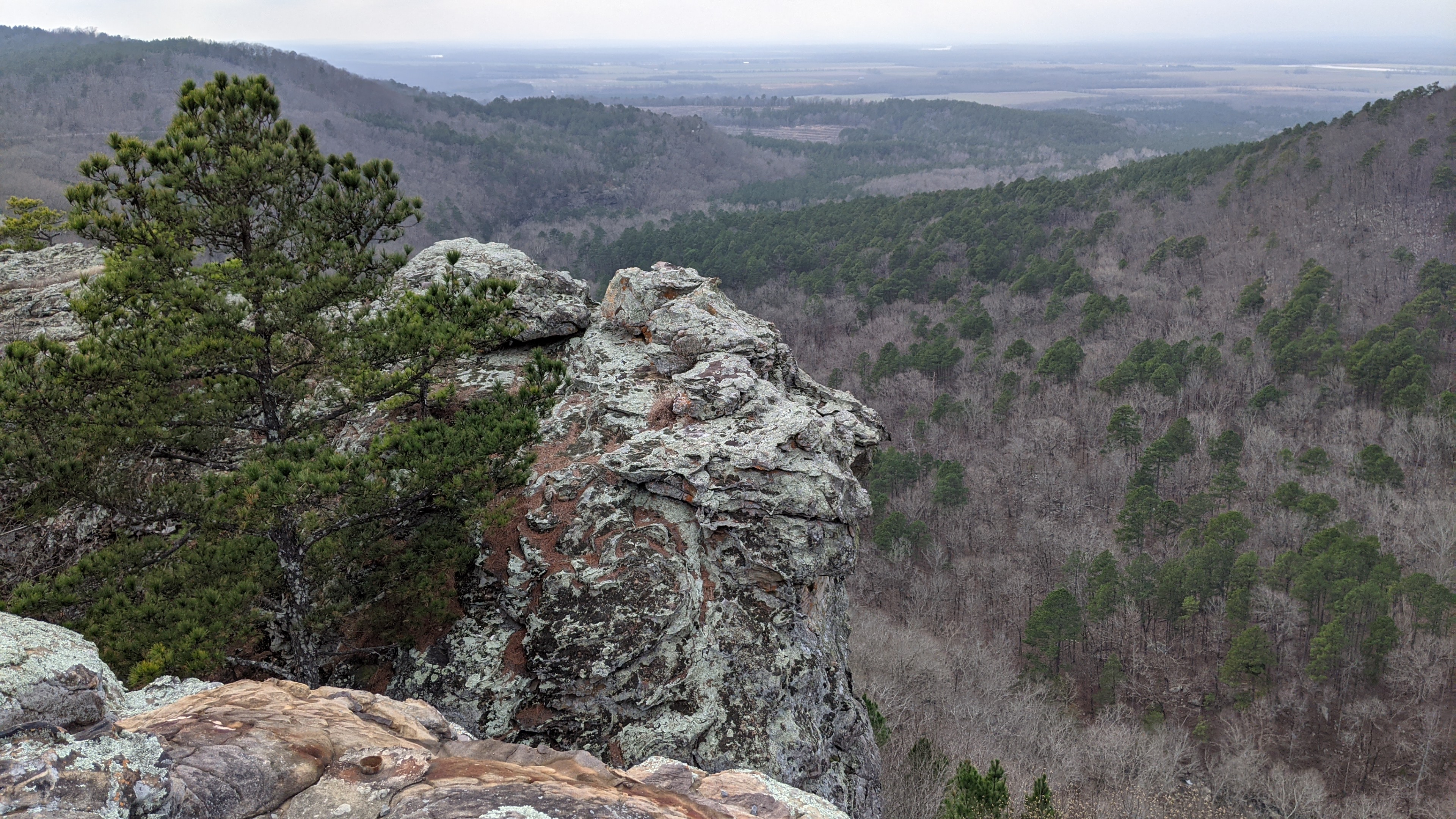
The sprawling Ouachita National Forest extends westward from the Hot Springs area throughout much of Arkansas and into eastern Oklahoma, and it too is only minutes away, with all its natural beauty. We want to get out to the forest more as well. And Arkansas state parks, judging by Petit Jean where we spent a wonderful couple of hours not long ago, is not only delightful, but it’s an easy day trip!





































































 Good Food and Faraway Places