

I had never developed an appreciation for raw oysters; nor for oyster stew or oyster stuffing at Thanksgiving, for that matter.
I have been known to order Oysters Rockefeller because that seems a “classy” choice at an upscale restaurant, on the same culinary level as escargot or whole artichokes. I love showy foods, and I admit that I enjoy demonstrating that I know how to deal with such dishes. I have, on occasion, skewered a salty, smoked oyster for a cracker.
But as for raw oysters. No, thank you. I do not love oysters.
My husband, on the other hand, enjoys oysters any way they’re served, but preferably right in the shell, cold, salty and fresh from the sea.
It was a preference he worked hard to cultivate, ordering oysters on the half shell several times in his early 20s. He initially discovered that the slippery oysters didn’t slide so easily down his throat, no matter how much he tried to disguise them with cocktail sauce and and Tabasco. Those first few times, he admits, were less than pleasant experiences.
But he persevered. At a tiny cafe in Brittany, with a view of the oyster fields just out the window, he ordered an oyster. One fresh-from-the-Atlantic oyster. The lone half shell on ice, accompanied by lemon and course sea salt, was brought to the table with a flourish by an ever-so-proper French waiter. It prompted curious smiles from those seated at nearby tables.
The waiter stood by expectantly, awaiting a reaction.
I was there, cheering him on.
Other diners also waited, and nodded approval as he downed that first cool slippery oyster. It was a personal triumph. And it started a trend. He has since ordered oysters in Maine, in numerous Gulf Coast eateries, and in fine restaurants in cities across the globe. He does, you see, love oysters.
After many years, we returned to that same restaurant in Cancale, France. It had changed a bit over the years, but the oyster fields are still the same, and this time my husband ordered a half dozen and enjoyed every one. In fact, he considered ordering another half dozen.
Today, he rarely passes on the opportunity to order oysters on the half shell when we’re near an ocean that allows them to be delivered fresh and cold from their habitat. He still asks for extra horseradish and hot sauce.
I resisted for the longest time, until we visited the Adriatic three years ago. Sitting on the open deck of a vessel anchored only feet from the oyster beds, I was prepared to enjoy the local fare along with the white wine promised as part of a half-day excursion from Dubrovnik, Croatia.


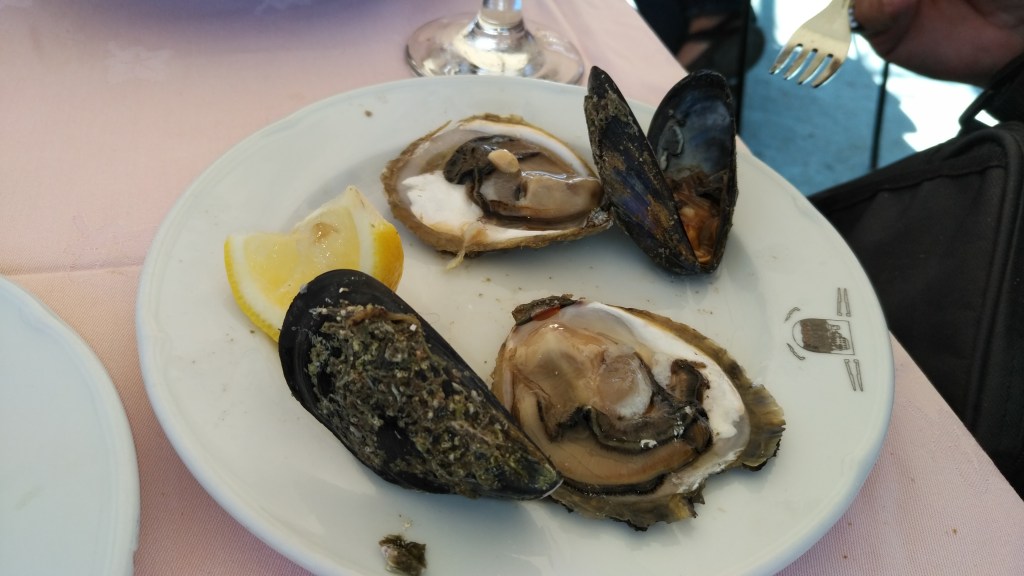
I had planned to say no to the oysters. But I was curiously enthralled as I watched the servers expertly open the shells and plate up the briny treats. Before I took much time to think about it, I was repeating “I can do this” to myself. I accepted my plate with a bit of trepidation, but I knew my mate would help me out if I couldn’t finish my share.
I sprinkled the smallest oyster with lemon juice, added just a drop of Tabasco, and closed my eyes. My first sensation was memorable. I sensed the cold, and tasted the sea. Then I swallowed. It was a whole new reality.
I actually liked the sensation. I was pleasantly surprised by the silky texture, the intense fresh flavor, and the saltiness. I felt close to the sea and its bounty in profound ways.
It was a lesson. It was delicious. It was unforgettable. Not only was it an eye-opening confirmation of the bounties of the sea, but it was the beginning of a love affair with Croatia. The time we spent there was all too short. Last November we returned to see more of the country.
I did not sample any more oysters, but I did partake, willingly, of other Croatian treats! The food is special, as are the people. To say we loved our two short visits to Croatia is an understatement. I still have no great love for oysters, but Croatia captured our hearts. This Thanksgiving I cannot help but think again of those trips.
I am thankful that we took those trips when we did. When the world is once again healed, we will return. I look forward to it.
And I am sure there will be more stories to tell.

 Wars VIII scenes. Croatia as a nation has existed on maps with its current boundaries for scarcely more than a decade, after years of ongoing struggle for sovereignty and independence. The city, though, is solid, ancient and unforgettable, picture postcard worthy.
 “It’s the end of the season,” we were told. All large cruise ships depart by the end of October, and the cadence of life changes. Locals live quietly, or leave on vacation, even though the local weather remains pleasant throughout the winter.
 Good Food and Faraway Places