Digesting art and history — good memories

Two menus occupy special places in my heart and in my home. They couldn’t be more different.
20160110_114516

When in Rome

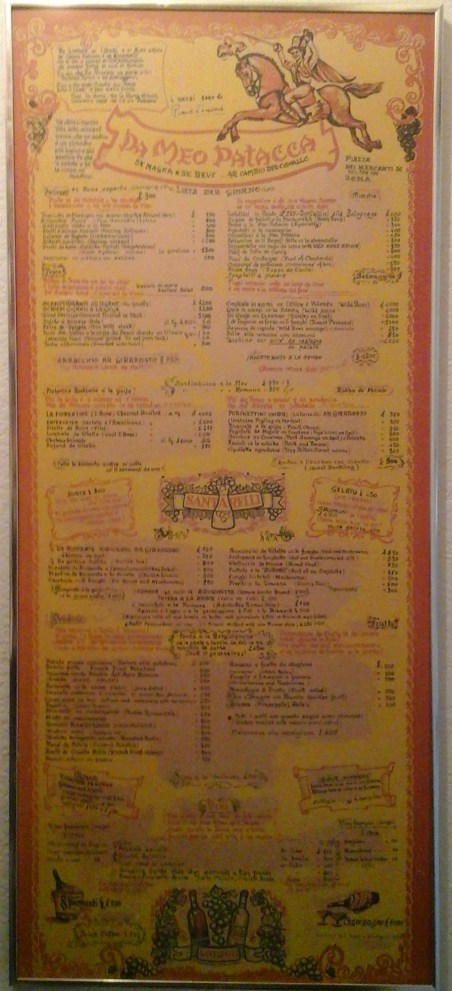
The first is a colorful, poster-size graphic from Da Meo Patacca, a memento from a first “Roman holiday” when I was 21. I still smile every time I look at it, remembering how impressed I was with the white-shirted waiter who unfurled the almost three-foot-long roll of paper with a deft flick of his wrist.  I don’t remember the food of that long-ago dinner table, but I can’t forget the experience, and the framed menu has graced my kitchens and pantries for longer than I care to admit.

The classic restaurant is still serving its traditional fare in Rome and, by all accounts, still delighting tourists from all over the globe. It is now possible to purchase the extravagant vintage menus on ebay or etsy, and I suspect that many, like mine, are still kept as keepsakes.20160110_120156

I treasure the memory; I also delight at the items priced in Lira. A mixed salad for 250, garlic bread at 100, saltimbocca a la romana at 950, gelato for 300 and a bottle of wine at 2500 – dinner easily required counting out bills running to multiple thousands! Truly, that was culture shock. However, the exchange rate at the time was around 600 Italian Lira to a single U.S. dollar. My dinner, I am sure, was quite a bargain! I returned to Da Meo Patacca a few years ago and came away with a later version of the menu, this time with prices in Euros. I also took away a renewed appreciation for this lively eatery that has served generations of diners during its five decades of operation. I know there is better food in this ancient city, and trendier trattorias. But this is a tradition of sorts and, on a pleasant evening, the patio is friendly, the wine is abundant, and the music can be fine!

Vive la France

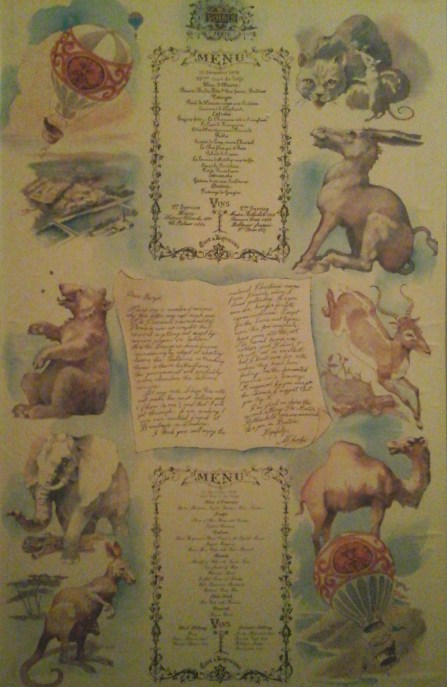
The second menu is not as vibrant in color, but it boasts fascinating pastel drawings of animals around its edge – elephant, bear, camel, kangaroo, cat and rat – along with frivolous hot air balloons floating over the countryside. It is dated “25 Decembre 1870 – 99eme Jour du Siege” from Voisin in Paris. It is in French. And, no, I did not eat there. Rather, I was entranced by the images and by the subject.

I have loved this menu for years, knowing it was not a real menu. I thought it was simply a quirky take on French culture and paid little attention to the actual items: Haunch of Wolf with Venison Sauce, Cat flanked by Rats. Jugged Kangaroo and Elephant Consomme20160109_171810Among the Hors d’Oeuvres: Butter, Radishes, Stuffed Donkey’s Head, Sardines. It includes other food choices as well: Wild Mushrooms Bordelaise and Rice Cake with Preserves. Again, I thought, a nod to French ingenuity, or an attempt to be entertaining. I thought nothing of the English translation at the bottom of the poster. I investigated no further, and simply enjoyed the artwork of my charming wall hanging. Until just recently.

The Back Story

Around Christmas, I happened across a blog post with an intriguing title. With an audible gasp, I realized that it was the story of my menu. I now know about the Franco-Prussian War, about the long and celebrated history of Voisin Restaurant, about how adaptable French cuisine can be, and about the suffering and endurance of a proud people during hard times. I know about how a renowned chef was truly creative and managed a Christmas dinner that must have been quite a treat for wealthy diners, and that at least one other restaurant routinely served equally bizarre dishes. By discovering the history of “my menu,” I have gained a new understanding of life, and of war and survival. During this siege, not even the well-to-do were spared hunger and deprivation.

The City of Light has known some very dark times. The French surrendered to the Prussians in 1871, when the citizens of the city were truly half-starved. I still love the depictions of the animals in their faded watercolor reality. But I will never again look at this menu in quite the same way. And I now view history very differently.

Learn more about the war, the zoo and the dinner.

Also included, between the French and English versions of the historic menu, is a letter to “Dear George,” signed “See you in Boston. Hopefully, Charles.” Perhaps it’s a figment of someone’s imagination. Or not.

Among other things, the letter states: “The Prussian encirclement of Paris is now so complete that no word is getting out except by carrier pigeon or balloon. As the besiegers have become increasingly adept at shooting down the balloons or tracking them to their destinations, the government will probably soon abandon the balloon service.”

It continues with the odd statement: “I think you will enjoy the enclosed Christmas menu from Voisin’s where I dined yesterday. As you can see, hunger forgets squeamishness.”
The Old West

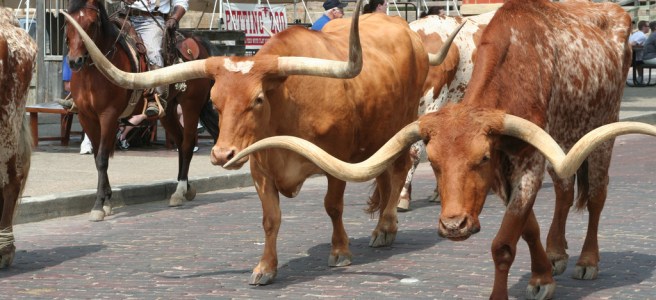
20151108_111650It may actually be more a lazy stroll than a “drive,” but the longhorns and the drovers never fail to gather a crowd as they appear for their twice daily parade down Exchange Street. The historic Fort Worth Stockyards District is not exactly the Old West. But when the buildings and the beasts are reflected in the sparkle of children’s eyes,  it does seem almost like the Old West. If only for just a moment.

As they parade down the cobblestone street, herded by “cowboys” on horseback, these impressive animals give us just a glimpse of that past, the time of “beef on the hoof.” Familiar cattle trails stretched like highways across the plains, into the high country and on to railheads and markets throughout the West and Midwest.20151108_113639 - Copy (2)Men and animals, in those days, were both larger than life. At the heart of the legends are the longhorns and the stampedes.

Today, Fort Worth’s herd probably couldn’t even be prodded to take off running, but it’s still quite impressive to see the big beasts with their six-foot horn-spans up close and personal. It’s even possible to climb on the back of a tethered longhorn in order to pose for a snapshot.  It was a beautiful day — crisp, clear and sunny. In the stockyards district, the towering buildings of modern, downtown Fort Worth fade away.

It’s the spectacle that draws people, and although it bears little resemblance to the running of the bulls in Pamplona, to cattle drives of old, or to a working ranch, it does transport spectators back to the day when Fort Worth truly was “where the West begins.” 20151108_111447

It’s the spirit of the place, as well as its heritage.

I, for one, am very happy to stand on the sidewalk, admire the architecture, speak with the patient horsemen and smile at the children who are excited equally by the horses and the “cows.” In a period of about four years from 1866 to 1870 more than four million head of cattle passed through Fort Worth, and were “driven” along the Chisholm Trail to Abilene, Kan. Then, other trails developed, as did other markets. The range was open, and beef was a diet staple.

Those days, however, actually did not last long. The growth of settlements, the arrival of the railroads and westward expansion all took their toll. The long cattle drives were hard on the cowboys and hard on the cattle, and they were over by about 1890.20151108_113946

As a product of the American West, I am aware of other cowtowns: Miles City, Mont., Medora, N.D., Las Vegas, N.M. Some have played prominently in my past. I know the names — Abilene, Dodge and Wichita, Cheyenne, Greeley and Prescott; Amarillo and Wichita Falls back in Texas. I know the stories. I grew up with the lore. They all retain some of the spirit of the frontier. So, too, does Fort Worth. And that is comforting.

Even though Fort Worth is not a frontier town today, it is protective of its cowtown past and personality. These urban longhorns live on here, and they get their daily exercise by parading along a route that played such an important part in the development of the country, the taming of the West and the feeding of the nation. 20151108_114431 (3)

Driving around Texas, it’s still possible to spot longhorns grazing on private land. After many years, the breed is today making a comeback, not only for sentimental reasons, but also because lean beef is much in demand. Only in Fort Worth, though, is it possible to see them in this way, on twice-daily cattle drives, close enough to reach out and touch!

Not only is it worth a trip to see the Fort Worth herd; it’s a trip back in time, one that is highly recommended and fun for old and young alike.

Note: The history of the Fort Worth Stockyards is fascinating, and special events, including rodeos and livestock auctions, are still held here. Read More. In 1976, the area was designated a National Historical District.

Photograph of longhorn pair via Flickr by Amy the Nurse; all others by author.

4686916667_c6bbdcf9a6_b

There be dragons

BHBD

For years, I pored over historic maps, examined old globes and spent hours looking at the edges of tattered nautical charts hoping to glimpse those letters: BHBD.  20151201_103125 (1)

My searches never yielded any kind of “Eureka” moment, but I held fast to the romantic notion that someday I would encounter that cryptic message. Some other friends also believed the oft-repeated notion that ancient mapmakers noted the ends of the known world with the notation, “Beyond here be dragons.”

As it turns out, it simply isn’t so. And it’s a disappointment, for a lot of reasons. First, it was not just my fantasy, but a commonly held belief. I feel cheated somehow, and duped. No matter how silly it seems, I still choose to believe that out there, somewhere, there be dragons.

The notion has fueled my wanderlust for decades; I am certain that old salts and continental explorers fully expected dragons when they embarked on those journeys into the beyond. Instead they encountered wonders, and that was sufficient to keep them moving.

But do you think they secretly longed for the dragons? I still choose to believe so.

Those who today visit the depths of the oceans and those who venture into space must, I think, still be searching for them.

Back to those dragons

Truth be told, apparently, there are no maps that bear any sort of legend concerning dragons — here, there or beyond.

There is one reference — in Latin, mind you — on a small globe dating to the early years of the sixteenth century (1503-1507). It is now in the possession of the New York Public Library; it is the first to depict the Americas in reasonable perspective, and it notes “HC svnt dracones” along the eastern line of Asia.

But, even though there are other beasts on its copper surface, there are, unfortunately, no dragons. (There is also some doubt about the translation from Latin — does it really mean “here be dragons?”) Another question that will not be answered, apparently, any time soon.

The only other map that anyone can point to is a real leap for those who search for dragons on the pages of vellum. The phrase “Here There Be Dragons” was reportedly used for an unknown polar region labeled Terra Incognita on the asteroid Vesta in a paper submitted by Michael Gaffey of Rensselaer Polytechnic Institute for the planetary science journal Icarus.

Just what is it about dragons?

There are dragons, large and small, worldwide, it seems. Not only Saint George, but countless others — Norsemen and Chinese, among others — searched for and battled dragons. There are Japanese, North American Indian and Ethiopian dragons; they lived in Scandinavian, Welsh and German myth and in the mind of J.R.R. Tolkien.

There are dragon sculptures and dragon jewelry and dragon tattoos.

There is a final reference to the phrase  (and the title of the book) by David Koerner and Simon LeVay in “The Scientific Quest for Extraterrestrial Life.”

During my travels, especially on the sea, I have over and over again scanned the horizon for dragons, just as I still sneak quick peeks at the edges of old maps. I am certain I always will.

I cannot put aside the conviction that, somewhere, beyond the known limits of the page or of this world, somewhere . . .

There be dragons

Koerner and LeVay say in their introduction: “The same sense of mystery, the same lure to adventure, now colors the unexplored lands of the cosmos. Welcome to the dragon hunt.” 

Indeed.

There are many ways, and many reasons, to celebrate Thanksgiving

Chasing Sunsets 056

It’s a community of sorts. Loosely knit, perhaps, but the armada of sailors and cruisers that descends on St. Mary’s towards the end of November each year is every bit as much a family as most of those with blood ties.

It’s Thanksgiving that brings this maritime family together in a little town on the river between Georgia and Florida. It’s a time to share stories, good times and good drinks. They arrive each year. They come “home” for the holiday.

St. Mary’s residents have been hosting this gathering for Intracoastal Waterway voyagers since 2001. This year, it begins the Saturday before Thanksgiving, and ends with a pancake breakfast the following Friday. There are other events over the weekend and some of the vessels stay on for a few days. Cumberland Island is nearby; there is much to see and do.

Gypsy Cold - Winter 2010-11 086

Newcomers are welcomed by the old-timers with warmth and good cheer, greeted as new friends and immediately inducted into the “family.”

There is a camaraderie that is natural and unforced. The week’s activities center around the Riverside Hotel and its Seagle’s Restaurant and Saloon.  Boaters and townspeople mingle at happy hour, enjoy a chili cook-off  and consume dozens of oysters at a Wednesday afternoon free roast. They drink coffee and other libations, exchange anecdotes and tell tall tales.

Townspeople come to the harbor to meet the “boat people.” They offer “restocking” rides to nearby grocery stores and gift shops and they renew old acquaintances. They come to ask questions about the boats, to hear stories of adventure, to marvel at the hardiness (or the folly) of those who choose the sea over the comforts of land-based homes. Children view the boats with wide-eyed wonder.

Those who arrive early find dock space. Those who come later pick up moorings or drop anchor. There seems always to be enough room. Those who travel the Intracoastal Waterway routinely plan their voyages with a St. Mary’s Thanksgiving in mind. Others happen on the celebration by chance. Still others hear of it, and can’t resist the urge to see if it’s true.

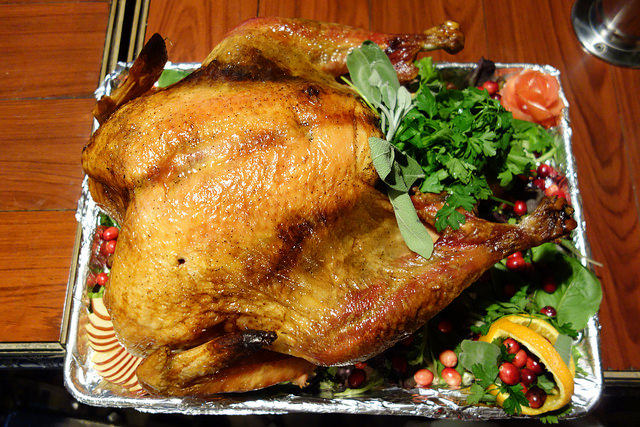
Photo by Tony Alter/Flickr15714052278_913ff71a3c_zIt does not disappoint. Thanksgiving festivities begin along the docks, and drift into town each day. On Thursday, local resident volunteers arrive in the morning with home-cooked turkeys and hams. Side dishes, salads and desserts appear as if by magic, contributed by the boating community. Dinner is served buffet style, beginning just after noon, and it continues until the food disappears. There always seems to be more than enough — of food and friendship.

We pulled in at dusk:  It had been a long and chilly journey.  But fellow cruisers along the waterway had told us it was worth the effort. November is somewhat late for pleasure boats to be traveling on the Intracoastal Waterway, but 2008 was relatively mild, and we encountered few problems other than the loneliness of being alone for Thanksgiving.

How quickly that changed. Although we have not returned, we think of that special Thanksgiving often. It was, indeed, memorable — an event out of all proportion to the size of the town. We filled our stomachs. The experience filled our hearts.

Even old salts find solace in planting their feet firmly on the ground on occasion. This holiday in this town, with these special people, is a unique and lasting gift.Chasing Sunsets 054

All boaters travel on, but they leave satisfied, awed and thankful.

For more information on St. Mary’s, visit the city’s official website.