A Mournful Whistle Recalls the Storied Past of a Massive Steam Locomotive

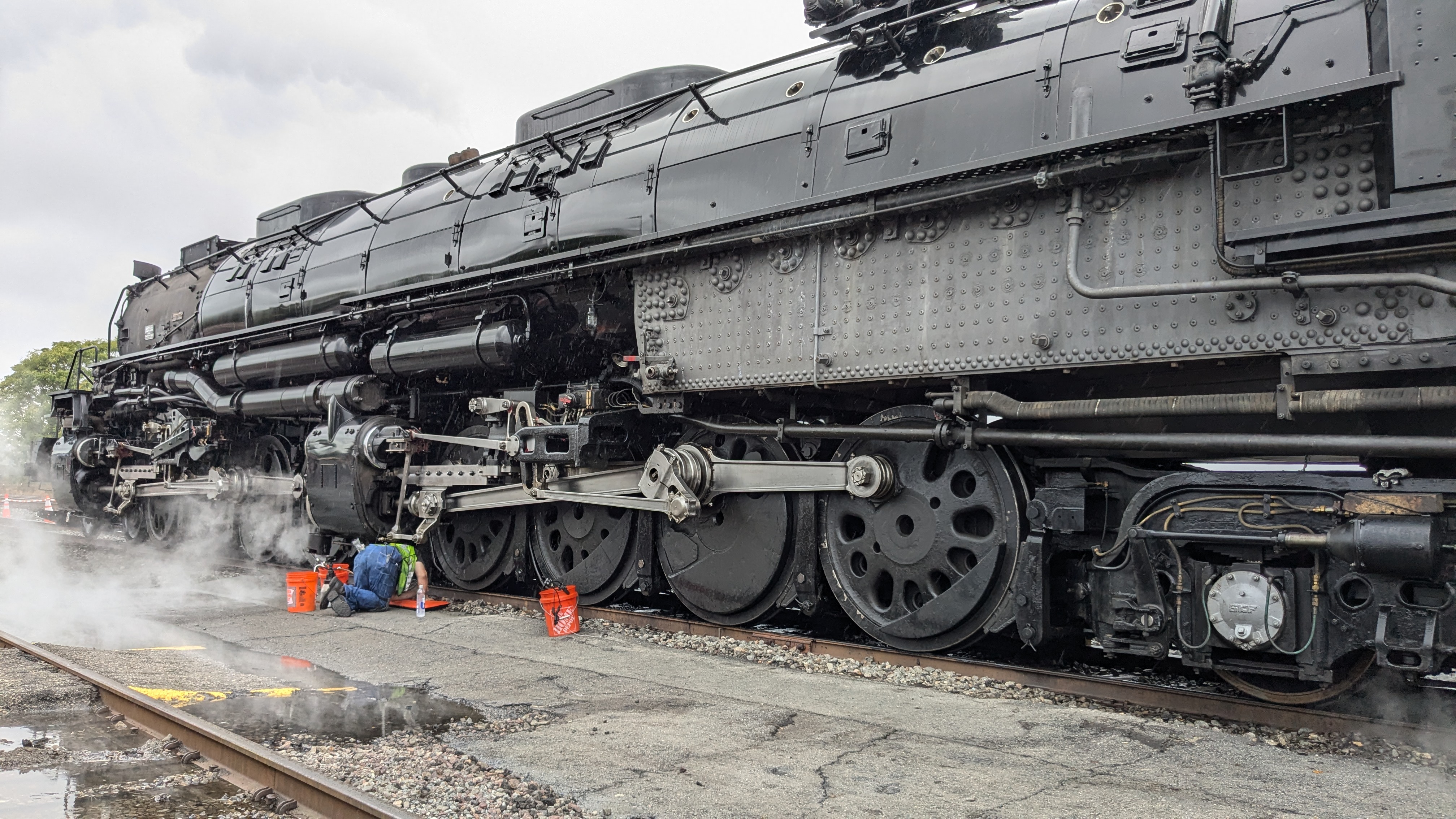
I made my way as close as possible to the railroad tracks earlier this month, as eager as children half my height, for a close-up view of Union Pacific’s “Big Boy” 4014 steam locomotive. It was at rest in the rail yard in North Little Rock, a scheduled stop along its 2024 Heartland of America Tour. The route takes it through nine states, with “whistle stops” in more than three dozen different communities. You might also see it passing through the countryside, but visitors are admonished to stay “at least 25 feet back” as the massive locomotive travels along the rails. View the route and tentative schedule.

This relic from the glory days of transcontinental railroad commerce and loaded freight trains is the last operating steam locomotive of 25 built between 1941 and 1944 for the Union Pacific Railroad.

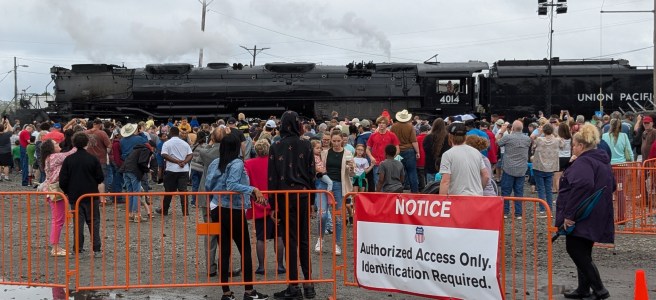
The public was invited to view the glistening black behemoth from 5 to 7 p.m. on September 15, during an overnight visit to one of the railroad company’s major modern servicing facilities. The facility is busy 24 hours a day, sorting freight cars that arrive and depart from across the country. It was a cloudy, grey afternoon, but hundreds of people, young and old alike, turned out to see the historic steam locomotive. The round-trip “rolling tour” began August 28 in Cheyenne, Wyoming, and will end back in Cheyenne in late October.

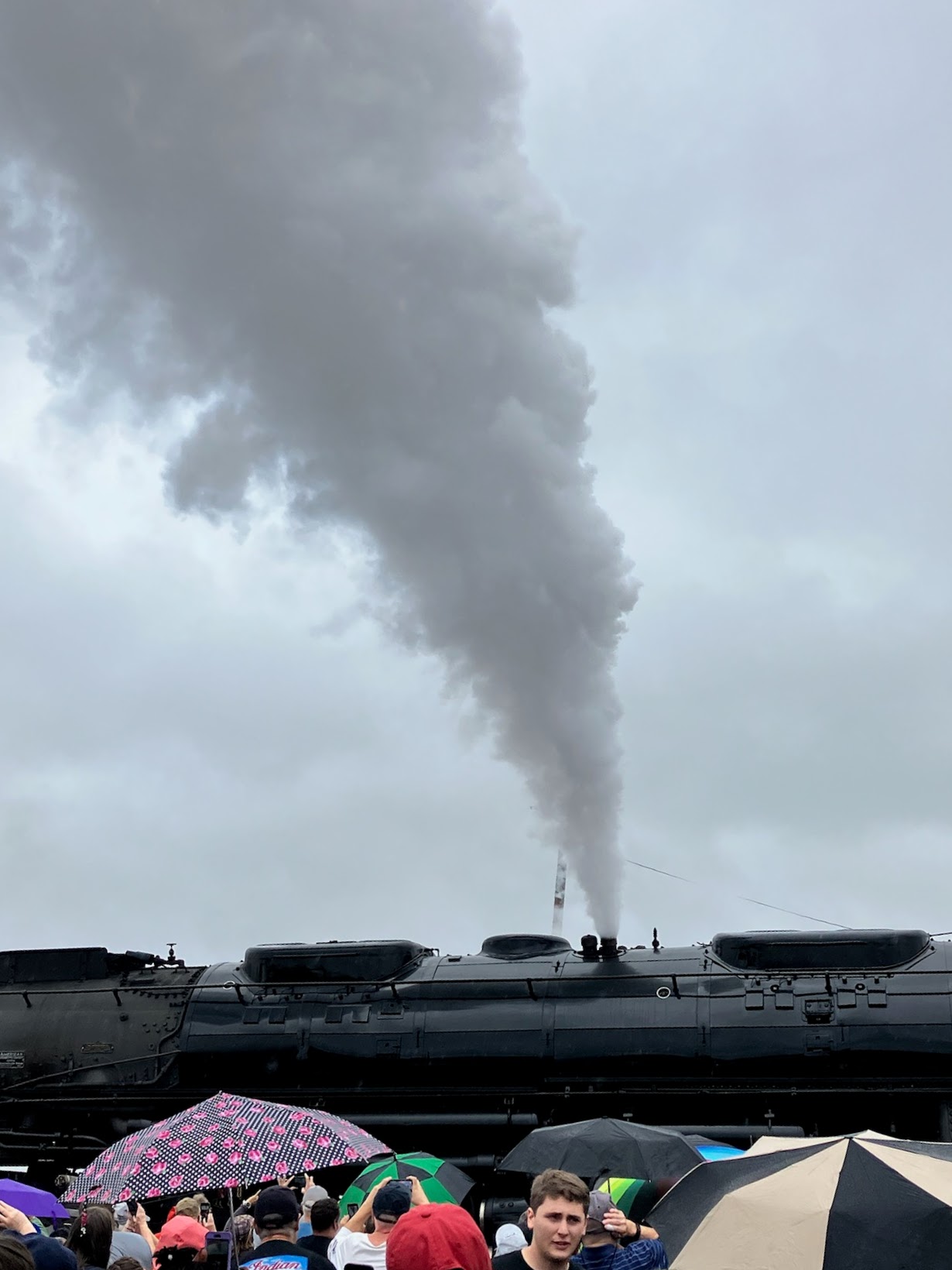
Some visitors parked blocks away, but a walk over uneven gravel and through a sea of mud puddles did not dampen their enthusiasm. Even the unrelenting drizzle was just a minor annoyance. Ed Dickens, senior manager of Union Pacific Heritage Operations, is the locomotive’s chief engineer for the tour. From all appearances, he was having as much fun as the viewers, waving to children and snapping his own photos of the crowd. Occasionally, he sounded the mournful whistle, and laughed as young children covered their ears.

People of all ages stood transfixed, the younger ones beside me pushing against the barricades. Many of them had probably never before been close enough to even wave at a train. There were aging men and women with canes and walkers, and others in wheelchairs. A layer of colorful umbrellas formed a spotty canopy above the heads of the crowd. Children sporting hoodies and ear-to-ear smiles clasped grown-up hands, and toddlers perched expectantly on their fathers’ shoulders.

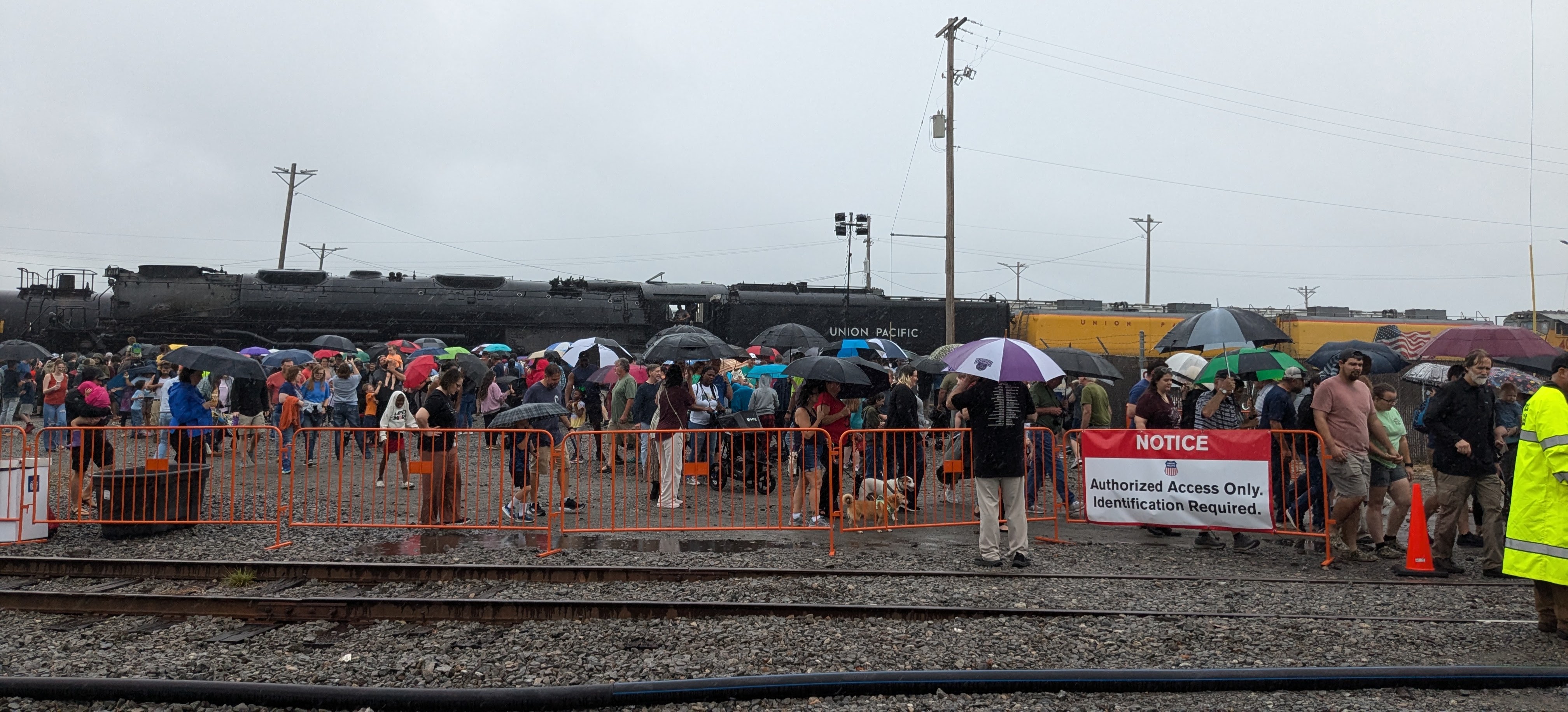
A service crew was busy at work, even as raindrops continued to fall. The engine belched billows of steam into the sky and more steam drifted between the wheels along its underbelly.

A Return to Days Long Gone

Some of us who grew up watching freight trains rumble through small towns still love the “choo-choo” sounds of the wheels as much as the “melodies” of the whistles. Note: This recording is a blast of the whistle on another steam locomotive in Union Pacific’s Heritage Fleet, Number 844, the only one never to be officially “retired” from active service. Smaller than the Big Boy, it is used to pull expedition trains from its home base at the Union Pacific Museum in Council Bluffs, Iowa.

I have numerous train-related memories. My husband, who grew up in Maine, remembers placing pennies on railroad tracks near a rented summer beach house, waiting for a train to pass, and then retrieving the flattened, elongated pieces of copper.
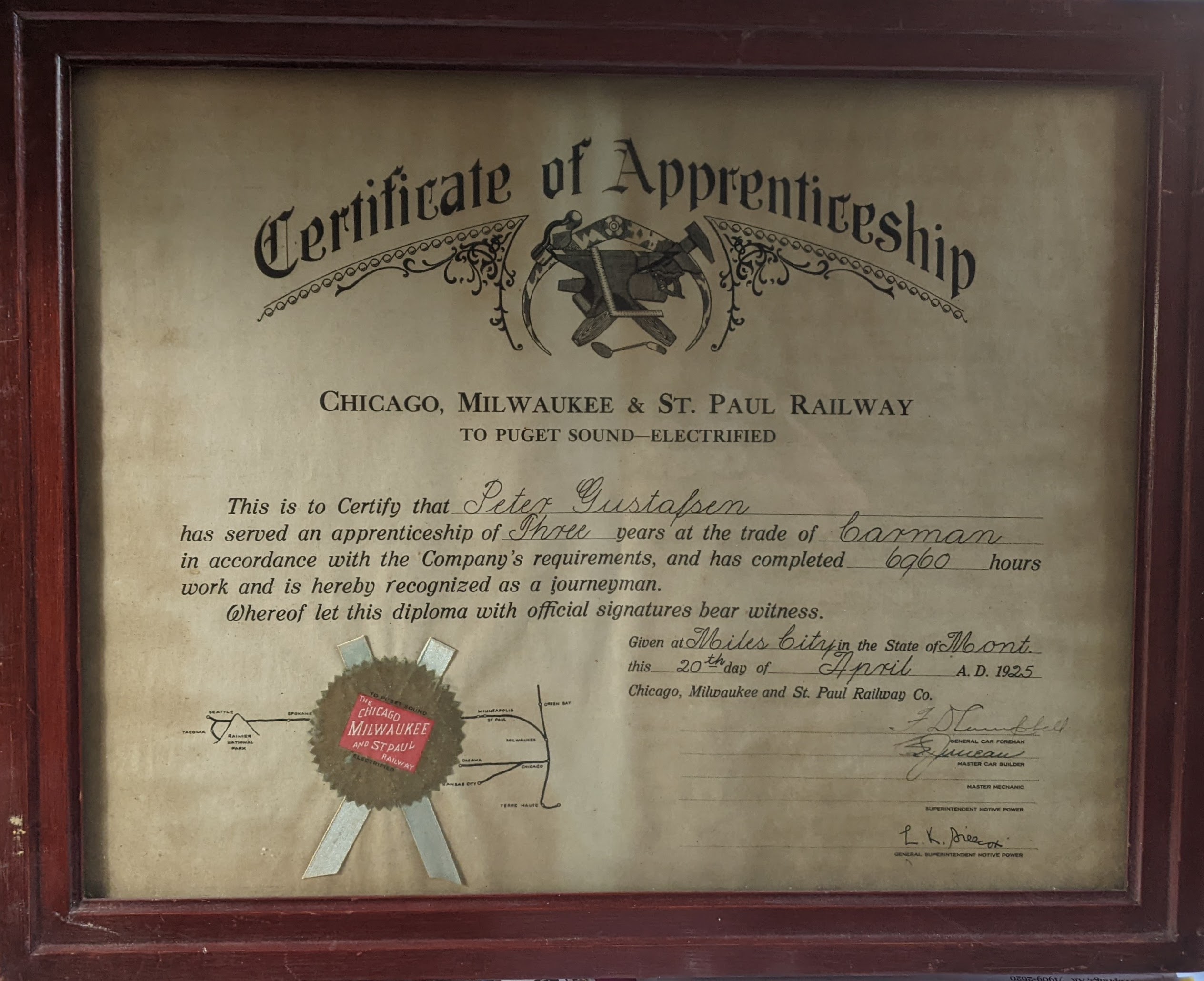
One of my grandfathers completed a three-year apprenticeship as carman for the Chicago, Milwaukee & St. Paul Railway Co., to “Puget Sound—Electrified” in April 1925. Today that certificate hangs on my office wall, along with a photo of yet another early steam locomotive. I confess that I still wave at trains, although I typically don’t expect a return wave from the engineer. Sadly, the brakemen on those cabooses of long ago have also now disappeared. Most trains no longer even have a caboose; they have been replaced by electronic small-box sensors.

I remember passenger trains as well as long-haul freight trains, and I sometimes yearn for those days of “slow travel,” observation cars, and meals served by white-gloved waiters in dining cars with linen tablecloths and distinctive china, silver, and sturdy glassware. Seeing this locomotive, the last and largest of its type still in use anywhere in the world, represents a step back into much-loved childhood memories for me.

The trains that now speed along tracks adjacent to the nation’s highways no longer have the same appeal, but freight trains still serve the needs of modern commerce and transport our country’s freight. The market is expected to reach $400 billion in 2024, with growth to more than $510 billion by 2029. There is also a growing resurgence in railroad tourism in some parts of the United States, and travel by high-speed rail in other countries is increasingly popular.

Saved from the Scrapheap

The Big Boy is the largest articulated steam locomotive ever constructed, and it was designed specifically to pull heavy loads over the steep grades of the Wasatch Mountains in Utah. Constructed by American Locomotive Company, with development input from Union Pacific, the Big Boy was designed to handle heavy freight loads, conquer the mountain grades of the routes through western mountain states, do it all at a reliable speed with no need for an auxiliary engine, and deliver the goods to western destinations on schedule.

Twenty were delivered to Union Pacific and placed in service in 1941, largely in support of the second world war effort. Another five were delivered in 1944, but the last of the Big Boys was pulled from service by 1962. Number 4014 completed its last revenue run in July 1959, and was officially retired in December 1961 after 17 years of active service, exactly 20 years after its first run.
Union Pacific launched a five-year-long restoration of Big Boy 4014 when the company reacquired it from a museum in California in 2013. The locomotive was moved from southern California to Cheyenne, where it sat idle for nearly two years as plans were completed for its restoration. Not only did the facility require expansion and updating to accommodate the Big Boy, but the locomotive had to be totally disassembled. In some cases, new parts were fabricated, and it was converted from coal to run on more efficient, less expensive diesel fuel.

Otherwise, however, the locomotive has been restored to its original design and configuration.

In the spring of 2019, a test-firing was successful, and Number 4014 moved “under its own power” for the first time in nearly 60 years. The revitalized Big Boy locomotive made a first test run the next evening from Cheyenne to Nunn, Colorado.
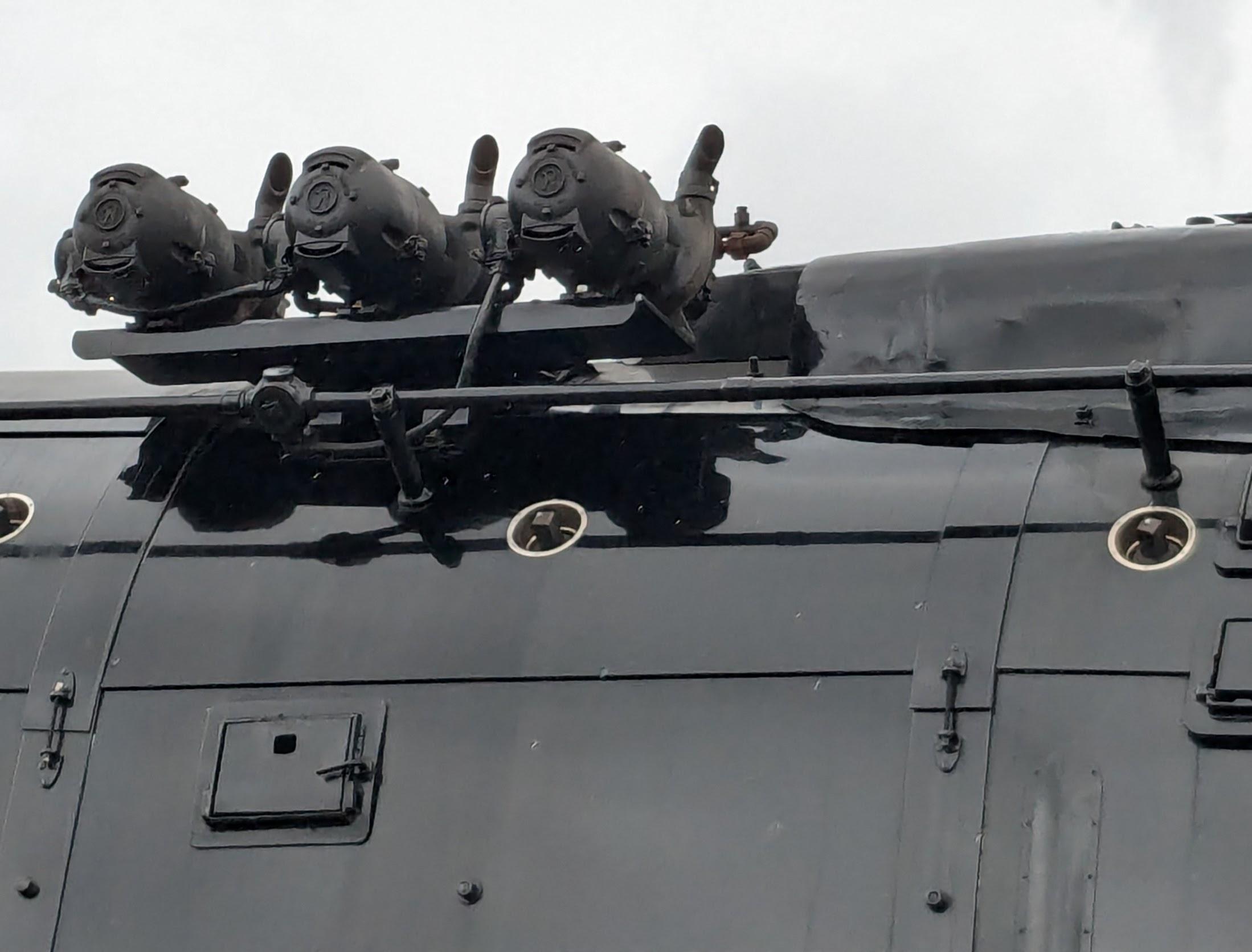
The rest, as they say, is history. And now, the public can share that history on annual runs that typically attract thousands all along the designated routes.

When the restoration was complete in 2019, Big Boy 4014 embarked on an inaugural tour to commemorate the 150th anniversary of the Transcontinental Railroad’s completion. The locomotive was then placed in excursion service as a member of the Union Pacific Heritage Fleet. Today, it is said to be Union Pacific’s primary public relations tool. Earlier this year, the locomotive completed a “Westward Bound” tour to California, passing through five states and culminating with an excursion for paying guests. Such special events help underwrite the railroad’s museum operation.

Who Cares about an Old Steam Engine?

Although Big Boy locomotives were said to be capable of speeds up to 80 miles per hour, there is no confirmation that they ever actually traveled that fast. They typically ran well under 60 mph, often chugging along at a much lower speed, but they did so reliably and consistently for nearly two decades.

Many of them traveled a million miles or more. Number 4014 logged 1,031,205 miles during its years in service.  Astoundingly, the Big Boy locomotive is nearly 133 feet in length and weighs 1.2 million pounds. The primary advantage was its power. It is still robust and, for all its size and power, it is able to maneuver mountain curves because it is articulated, or “hinged” at strategic points.

This is no ordinary engine. And a lot of people care. I have fond memories of traveling by train both in this country and abroad, but the passenger trains I remember, with their sleek diesel engines, are a totally different breed from the steam locomotives that served as the iconic workhorses of the railroads.

Big Boy 4014 is the only one of 25 built that is still in operation. And it is the largest operational steam locomotive in the world today.

Ed Dickens of the train’s crew notes that the locomotive, with a weight of approximately 600 tons, “runs like a Swiss watch,” even though it can easily pull a train five miles long on flat ground. He says that it was designed to be simple to operate, adding that “you drive by the seat of your pants – you smell the brakes,” and the crew becomes familiar with the sounds.

If you’re interested in learning more about Big Boy 4014, and the history of the steam engine era, tune in to this episode of Jay Leno’s Garage on You Tube. You’ll love it!

Finally, if you’re interested in seeing Big Boy 4014, its home base is in Cheyenne, Wyoming, when it’s not on tour. Other Big Boy locomotives can be viewed in Denver CO, St. Louis MO, Scranton PA, Green Bay WI, Frisco TX, and Omaha NE, just across the river from the Union Pacific Railroad Museum in Council Bluffs, Iowa. If you’re a fan of old trains, though, and you go to Council Bluffs, plan to spend the better part of a day there. And you’ll leave wanting to return.

Santa Fe: What to Know Before You Go

Imbued with a long and multi-faceted history, Santa Fe is a fascinating city characterized by a cultural richness that few other places possess. It offers something of interest to every visitor, in every season. But it’s impossible to see it all in just a few days, and no matter how much time you spend in the city or how many times you return, there is always something new to discover. First-time visitors are typically eager to learn about Santa Fe, but can leave exhausted if they attempt to see, do and “feel” it all.

Don’t let that happen to you.

Instead, prepare for a trip to this 400-year-old city by doing some homework before you leave home. Know that, at an elevation of 7,000 feet, you are likely to tire more quickly than you might at home. Understand that Santa Fe has a delightful downtown square, and the city radiates in all directions from that plaza. In many ways, it’s a city to explore on foot, but distances can be deceiving. Embrace the art, the food, the museums, and the galleries, the restaurants and bars, and the natural beauty that surrounds you, but understand that Santa Fe is not a “bargain” destination. Learn about Santa Fe’s history, and appreciate the cultural differences. It’s that mix of old and new, of “everyday” and “one-of-a-kind” that casts a spell and makes Santa Fe unique.

Plan your trip and your activities wisely. Santa Fe is the capital of New Mexico, a state known for its diverse attractions, from mountains and winter sports to the sprawling desert landscape of White Sands, from ancient cliff dwellings and Native American Pueblos to Old West mining towns and the futuristic Very Large Array National Radio Astronomy Observatory. If possible, take the time to get out of Santa Fe and visit other parts of the state.

Chances are you’ll find something to love no matter what direction you go. Santa Fe is just “up the road” from Albuquerque, New Mexico’s largest city with a major airport. If you fly into Albuquerque, it’s best to rent a car there and drive north. One of your first stops should be at the Tourist Information Center in Santa Fe, near the state capitol. The knowledgeable staff can help you flesh out your plans for the time you’ll spend in “The City Different.”

Where to Stay

Downtown hotels, particularly those within walking distance of the Plaza, are typically expensive and frequently fully booked. If one of these highly desirable options is your choice, make your reservations well in advance. There are also numerous boutique hotels, B&Bs, nearby resort accommodations, chain motels, timeshares, private guest casitas and rental condos in and near Santa Fe.

Use your favorite booking site or ask for recommendations from friends who have recently visited the city. On my recent trip, I stayed two nights at a delightful motel in a location that was convenient for what I planned to do in the city. I was there primarily to visit old friends. I was not looking for luxury, but was pleasantly surprised by the price and the amenities. The included breakfast is worth a shout-out — featuring freshly-prepared plump burritos and a variety of muffins, cereal, juice and yogurt — as is the level of service. The decor at Coyote South is distinctive, fresh and modern, and the staff is friendly and knowledgeable.

You will also find noted resorts and wellness retreats, although some are located quite a distance from downtown Santa Fe. Visitors can book packages that include spa treatments, pools and hot tubs, luxury accommodations, and distinctive meals. Two of the most unique are Ten Thousand Waves and Ojo Santa Fe.

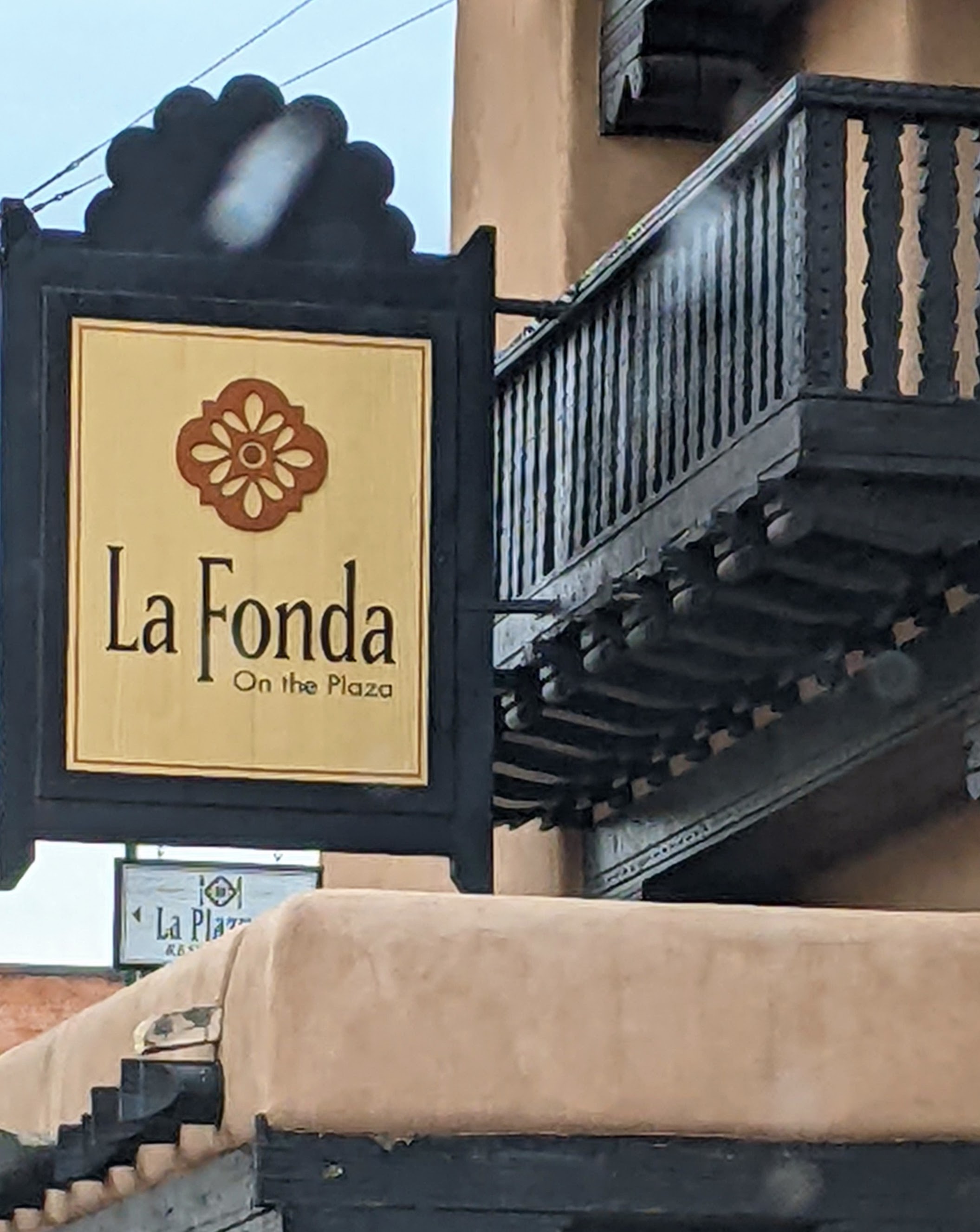
Wherever you choose to stay, I can recommend a visit to La Fonda on the Plaza, for a drink or a meal, or just to look around. One of the city’s oldest landmarks, it occupies the site of the city’s first inn, built in the early 1600s when the city became the northern outpost of Spanish colonization. In the 1800s, La Fonda provided hospitality for anyone traveling west on the Santa Fe Trail. The current structure dates to 1922, and many of its signature features — beams, tin chandeliers and skylights — are original.

The inn was acquired by the ATSF railroad in 1925 and leased to hotelier Fred Harvey, whose “Harvey Girls” provided travelers great food and service until the hotel was sold in 1968. Today, it continues to serve travelers, with 180 guest rooms, three dining options, luxury amenities and an onsite spa. It is also a popular event venue and business center, renowned because of its period architecture, its history, and its hospitality. Stop in for a drink or a meal, or take a complimentary history and art tour, and you’ll see why.

Ask for assistance from a hotel concierge or your B&B host to help you plan skiing, hiking or fishing excursions, and trips to surrounding pueblos and casinos. Locals are usually only too willing to share information and help visitors,

Where to Eat

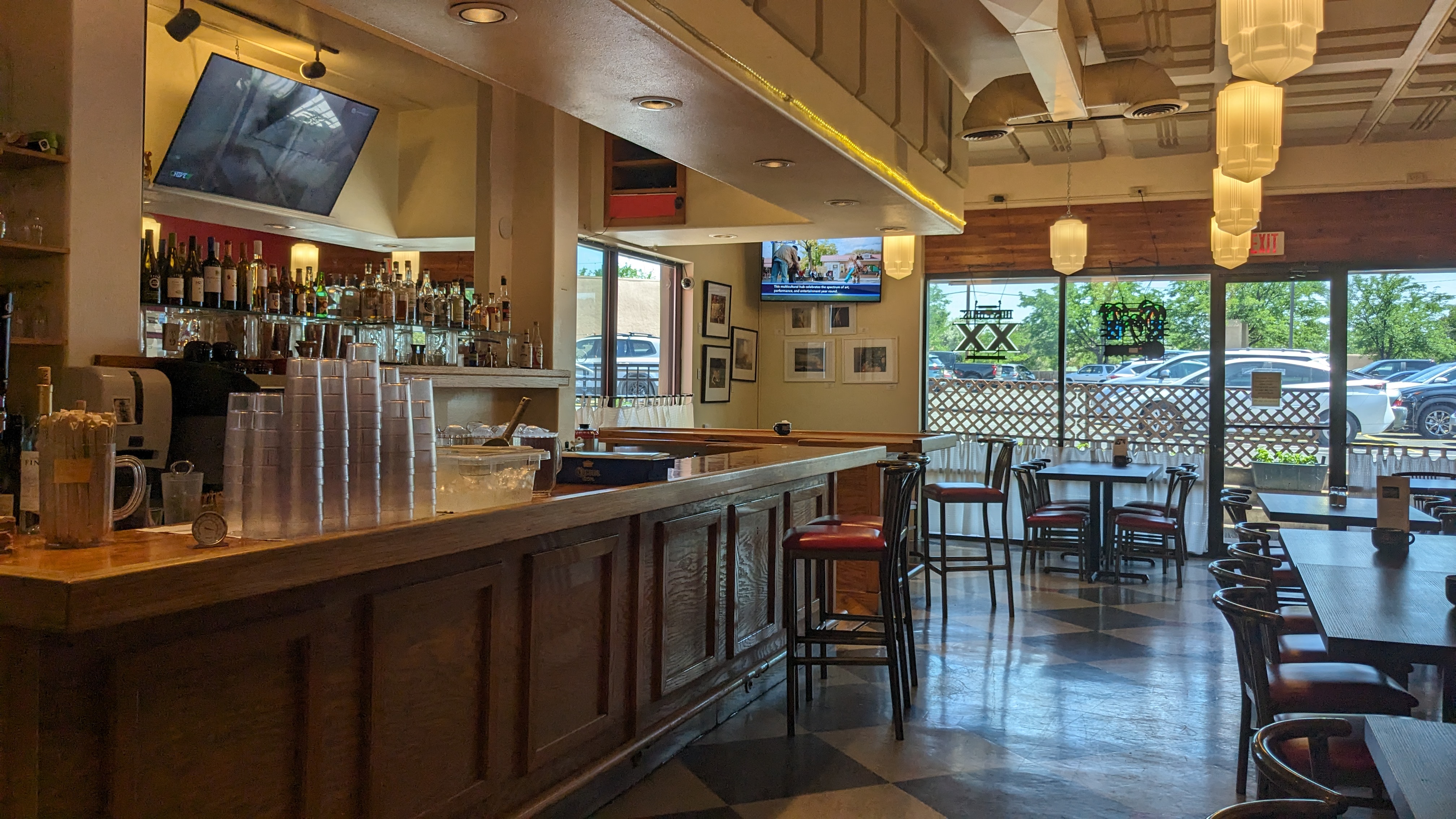
Santa Fe is also a noted foodie destination, with almost limitless options for both casual fare and fine dining. Many of the city’s finest restaurants are small, and reservations are recommended. You may encounter lines at popular lunch spots, especially in summer, during the many festivals, or at the height of the ski season. Plan ahead and be patient.

Breakfast is a favorite meal and a long-standing tradition in Santa Fe. Pasqual’s, situated a block off the Plaza, is always crowded, especially for breakfast, but it’s open every day except Tuesday, and it’s worth a wait. When ordering breakfast burritos or any type of egg dish, you may be asked “red, green or Christmas?” The question is to determine your preference of chile toppings. Know that it’s no sin to ask which is hotter; if you’d like to sample the different tastes, ask for Christmas. You’ll get some of each.

Casual eateries serve a wide variety of tastes, offering food that is fresh, flavorful and fun. Stop to sample local specialties at out-of-the-way cafes with patio seating, or order New Mexican or Native American street food from a vendor during a Santa Fe festival. You won’t be disappointed, and people-watching is a popular pastime. Order take-out from The Burrito Company or the Plaza Cafe to eat on a bench at the Plaza, or spread a blanket on the grass near the river.

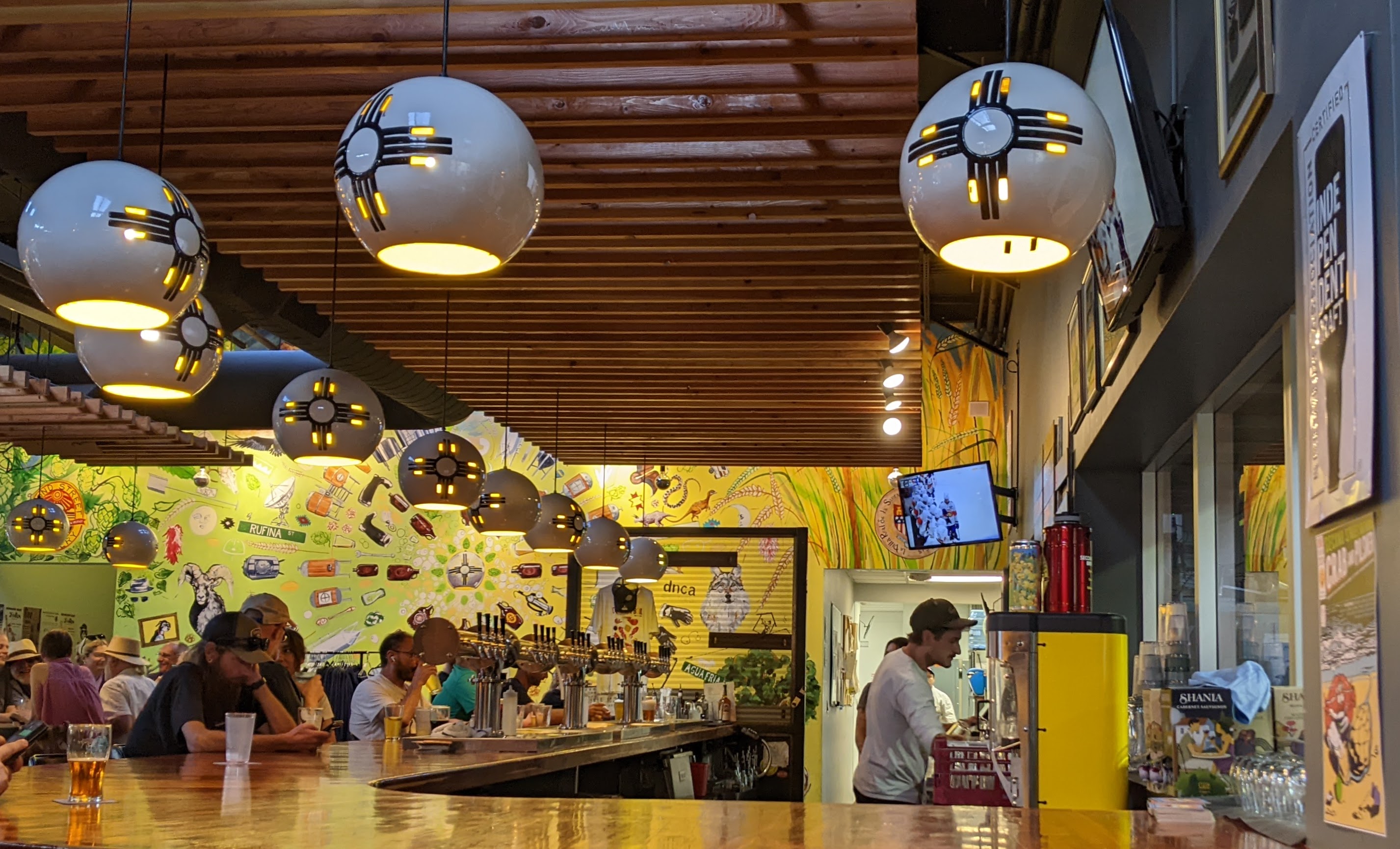
If you explore Santa Fe neighborhoods, don’t neglect shopping center eateries and local craft breweries. You’ll find reasonably priced food, prompt service, and friendly people. Joe’s, on the south side of town is one such place, and Santa Fe Brewing Co. has several locations in both Santa Fe and Albuquerque.

Need more suggestions about where to go? Here’s my short and very random list of personal favorites, but be open to exploring. Try someplace new and find your own favorites.

El Farol on Canyon Road is a classic Santa Fe hot spot located in an adobe building that dates to 1835. Open Wednesday through Sunday from 4 to 9 p.m., the parking situation can be difficult, and the decor is rustic rather than refined, but the live music and flamenco performances make it an experience rather than simply a meal. Daily Happy Hour drink and tapas specialties attract crowds. Dinner choices that include paella, mussels, beef, and salmon as well as New Mexico enchiladas and desserts are legendary. Vegetarian and vegan options are available.

Coyote Cafe at 132 W. Water St. has won awards since it first opened in 1987, and the acclaim continues to this day. Named 1st Place winner in the Best of Santa Fe competition for 2024, Celebrity Chef Mark Miller pioneered the use of strictly regional and native ingredients to develop menus that have stood the test of time. Coyote Cafe attracts an army of repeat visitors. The Rooftop Cantina is a lively casual gathering spot for locals and visitors alike. Order Mama Schutz’ Frito Pie as a nod to tradition. Santacafe, a sister venue, is located at 231 Washington Ave., and is noted equally for its elegant outdoor courtyard dining patio and its delicious food.

El Nido in Tesuque, another of my go-to choices, is especially soothing on a chilly fall afternoon or a cold, snowy winter evening. The heated garden portal is a wonderful gathering spot from spring into fall, but the interior is El Nido’s all-season haven, with the ambience of aged wood, original tin chandeliers and colorful wall murals. Meals are prepared at an open-fire grill center, so diners can watch the action. Order sake and sample starters from El Nido’s companion sushi bar “SU.” Then, your dinner choices — pizza, pasta, steak, seafood, or chicken — will arrive at your table perfectly prepared, well-seasoned and hot off the grill.

After a day of gallery hopping or sightseeing, a restorative Margarita from the 100 or so on the menu at Maria’s may be “just what the doctor ordered!” It’s a long-standing tradition, where Santa Fe friends meet and visitors to the city go to make new friends and exchange stories. It’s lively and loud, usually crowded, exceedingly friendly and welcoming, and totally likeable. I’m not kidding. Don’t hesitate to ask locals for recommendations for a late dinner or an early breakfast.

New bars and restaurants spring up regularly, while others have been open for decades, if not centuries.

What to Do

Excursions from Santa Fe provide a long list of opportunities. Depending on your interests, you can fish clear lakes or swift-running mountain streams. Visit Native American pueblos to learn about the ancient cultures that have existed here for centuries. Visitors are welcome, but respect the traditions of each pueblo, especially if you visit on a feast day or for a special ceremony.

Visit the Bradbury Science Museum in Los Alamos. It explains the history of the Manhattan Project and other research and discoveries during the atomic age, as well as continuing scientific studies. Admission is free, and the museum is open every day except Monday, but check current hours. On the way to Los Alamos, about an hour from Santa Fe, stop at Bandelier National Monument to explore ancient cliff dwellings in the Jemez mountains. Nearby Frijoles Canyon offers spectacular scenery and views.

The award-winning Los Alamos Nature Center is filled with interactive exhibits and displays, including live animals, a topo map of the surrounding plateau, a children’s discovery area, information about the Valles Caldera, and a wonderful planetarium. Evidence of volcanic action is still detected at this dormant, but not extinct caldera, formed by an eruption more than a million years ago. It’s a not-to-be-missed attraction, especially if you’re traveling with kids.

Las Vegas lies an hour or east of Santa Fe. In addition to its historic Old Town, the Las Vegas National Wildlife Refuge boast 8,000 acres of grasslands, wetlands, and forests, where birders and hikers can explore to their heart’s content. Guided tours are available at historic Fort Union that played a pivotal role in both Indian conflicts and the Civil War, and the Rough Rider Museum sheds light on the time that Theodore Roosevelt spent in New Mexico, offering insights into his legacy. Finally, a visit to Montezuma Castle, a pueblo structure built more than 800 years ago, gives visitors a unique glimpse into the history of the area. Las Vegas also has an active modern arts community, and you’ll find galleries, eateries, and plenty to round out a visit to an interesting historic town.

Madrid, pronounced with an emphasis of the “Mad,” is on the back road to Albuquerque, and if you’re driving, it’s worth your time to explore this funky old coal mining town turned artist’s colony. Madrid is pretty much the midpoint of The Turquoise Trail, the designated scenic byway between Tijeras, east of Albuquerque, and Santa Fe. It passes through the small towns of Cedar Crest, Sandia Park, Golden, Madrid, Cerrillos, and Lone Butte/San Marcos on its way to “the top of the trail,” and Santa Fe. The Mine Shaft Tavern in Madrid is worth a visit, whether you make it a lunch excursion from Santa Fe, or a stop along the Turquoise Trail.

Finding Enchantment in The City Different

New Mexico is termed the Land of Enchantment. I was first introduced to this enchantment in the mid-7o’s when I visited as a tourist from Dallas. Then, I moved to Santa Fe in 1991, and spent nearly 20 years there. During my tenure, the city changed in many ways, and I moved on. But my love for Santa Fe never waned. In some ways, I still miss the city, the culture, and the lifestyle. I have not returned often enough over the decade or so since I left. But each time I do, I fall in love with the city all over again. It tugs at my heartstrings.

If you haven’t previously visited this magical place, perhaps you too will be captivated as I was. Try not to draw comparisons with other places. Just enjoy it because it is The City Different.

In Santa Fe, you can eat the food of many different cultures, gaze at stars in the sky so bright you’d swear you could reach up and touch them. Breathe in the fresh mountain air — it will be pinon-scented in the winter from the wood that burns in local fireplaces. Smell the lilacs in the spring and savor the scent of roasting chiles in the fall. Bask in the warm sun all summer and don your boots to hear the crunch of fresh snow on crisp winter days. The sun will shine most days, no matter what the season. Hopefully, no matter how long you stay, you’ll leave wanting to return.
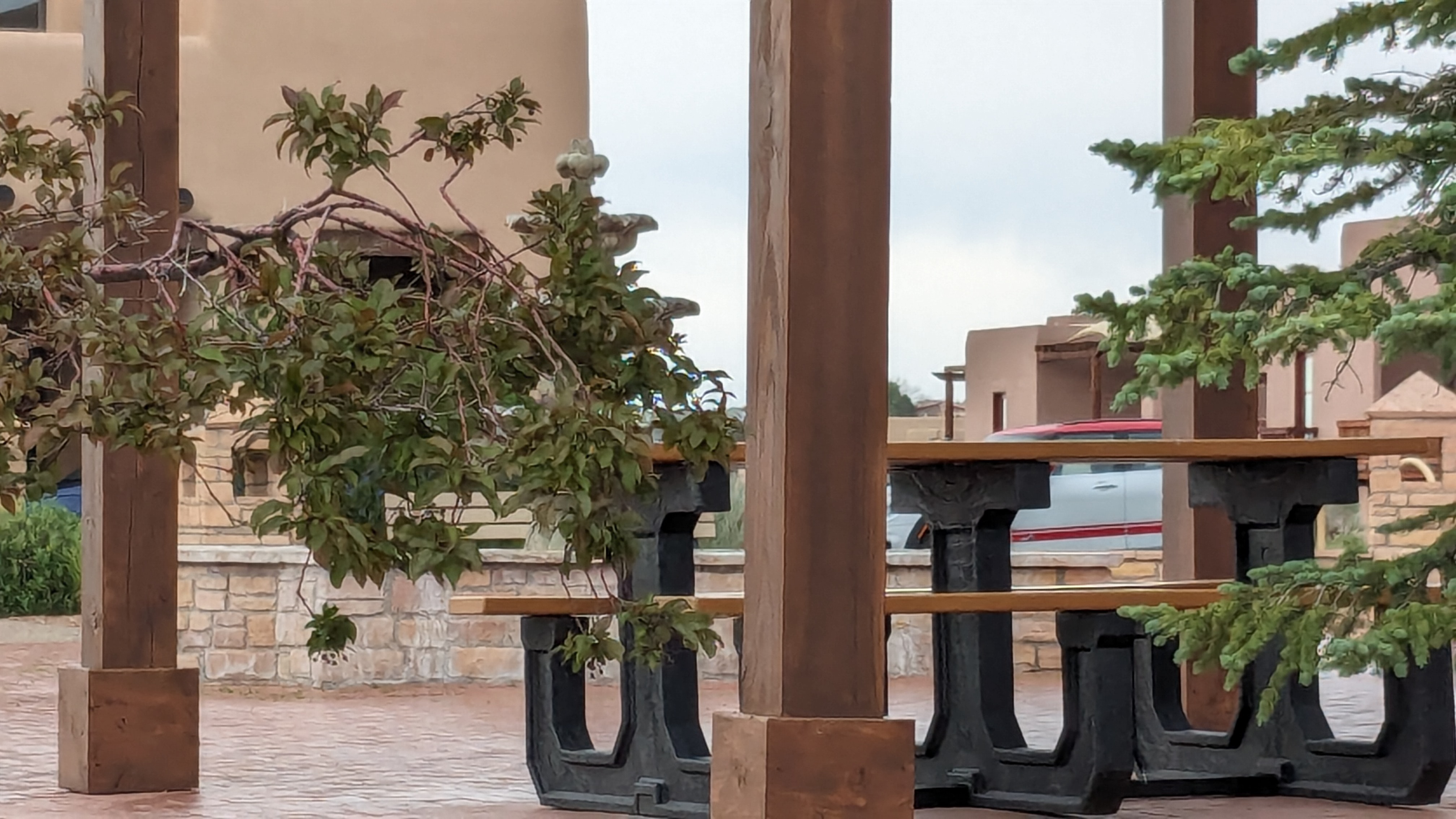
Pick and choose from the seemingly unending buffet of treats that Santa Fe offers. Stop to enjoy its quiet beauty. A traveler’s best resource is the Official Visitors Guide. It provides a great introduction to the City Different. View it online or request a copy delivered right to your home.

Note: The recommendations I have made are all based on personal knowledge gained during the years I was a resident of Santa Fe or my travels in New Mexico over the years. I have not been compensated, financially or otherwise, based on opinions I have shared.